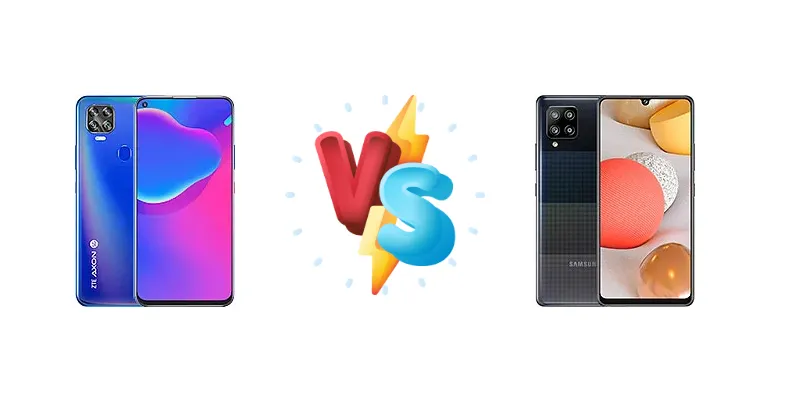
The ZTE Axon 11 SE 5G and Samsung Galaxy A42 5G represent compelling options in the increasingly crowded mid-range 5G smartphone market. Both devices aim to deliver 5G connectivity at a palatable price point, but they achieve this with different approaches to chipset selection and feature prioritization. This comparison dives deep into the specifications to determine which phone offers the best value for your money.
🏆 Quick Verdict
For users prioritizing raw processing power and responsiveness, the ZTE Axon 11 SE 5G emerges as the winner. Its Mediatek Dimensity 800 chipset, built on a 7nm process, provides a noticeable performance edge over the Samsung Galaxy A42 5G’s Snapdragon 750G. However, both phones offer comparable battery endurance, making the choice dependent on individual performance needs.
| Network |
|---|
| 2G bands | GSM 850 / 900 / 1800 / 1900 | GSM 850 / 900 / 1800 / 1900 |
| 3G bands | HSDPA 850 / 900 / 1900 / 2100 | HSDPA 850 / 900 / 1700(AWS) / 1900 / 2100 |
| 4G bands | 1, 3, 4, 5, 7, 8, 12, 17, 20, 34, 38, 39, 40, 41 | 1, 2, 3, 4, 5, 7, 8, 12, 17, 20, 28, 38, 40, 41 - Europe |
| 5G bands | 1, 3, 28, 41, 78, 79 SA/NSA | 1, 3, 5, 7, 8, 28, 40, 41, 78 SA/NSA/Sub6 - Europe |
| Speed | HSPA, LTE, 5G | HSPA, LTE, 5G |
| Technology | GSM / CDMA / HSPA / LTE / 5G | GSM / HSPA / LTE / 5G |
| | CDMA 800 | - |
| Launch |
|---|
| Announced | 2020, June 01. Released 2020, June 22 | 2020, September 02 |
| Status | Discontinued | Available. Released 2020, November 11 |
| Body |
|---|
| Dimensions | 162.7 x 76.3 x 8.8 mm (6.41 x 3.00 x 0.35 in) | 164.4 x 75.9 x 8.6 mm (6.47 x 2.99 x 0.34 in) |
| SIM | Nano-SIM + Nano-SIM | · Nano-SIM· Nano-SIM + Nano-SIM |
| Weight | 184 g (6.49 oz) | 193 g (6.81 oz) |
| Display |
|---|
| Resolution | 1080 x 2340 pixels, 19.5:9 ratio (~395 ppi density) | 720 x 1600 pixels, 20:9 ratio (~266 ppi density) |
| Size | 6.53 inches, 104.7 cm2 (~84.3% screen-to-body ratio) | 6.6 inches, 105.2 cm2 (~84.3% screen-to-body ratio) |
| Type | IPS LCD | Super AMOLED |
| Platform |
|---|
| CPU | Octa-core (4x2.0 GHz Cortex-A76 & 4x2.0 GHz Cortex-A55) | Octa-core (2x2.2 GHz Kryo 570 & 6x1.8 GHz Kryo 570) |
| Chipset | Mediatek Dimensity 800 (7 nm) | Qualcomm SM7225 Snapdragon 750 5G (8 nm) |
| GPU | Mali-G57MP4 | Adreno 619 |
| OS | Android 10, MiFavor 10.1 | Android 10, upgradable to Android 13, One UI 5 |
| Memory |
|---|
| Card slot | microSDXC | microSDXC (uses shared SIM slot) |
| Internal | 128GB 6GB RAM | 128GB 4GB RAM, 128GB 6GB RAM, 128GB 8GB RAM |
| | UFS 2.1 | - |
| Main Camera |
|---|
| Features | LED flash, panorama, HDR | LED flash, panorama, HDR |
| Quad | 48 MP, f/1.8, (wide), 1/2.0", 0.8µm, PDAF
8 MP, f/2.2, 120˚ (ultrawide)
2 MP (macro)
Auxiliary lens | 48 MP, f/1.8, 24mm (wide), 1/2.0", 0.8µm, PDAF
8 MP, f/2.2, 13mm, 123˚ (ultrawide), 1/3.94", 0.8µm
5 MP (macro)
Auxiliary lens |
| Video | 4K@30fps, 1080p@30fps | 4K@30fps, 1080p@30fps, 720p@480fps |
| Selfie camera |
|---|
| Features | HDR | HDR |
| Single | 16 MP, f/2.0, (wide) | 20 MP, f/2.2, 25mm (wide), 1/2.78", 1.0µm |
| Video | 1080p@30fps | 1080p@30fps |
| Sound |
|---|
| 3.5mm jack | Yes | Yes |
| 35mm jack | Yes | Yes |
| Loudspeaker | Yes | Yes |
| Comms |
|---|
| Bluetooth | 5.0, A2DP, LE | 5.0, A2DP, LE |
| NFC | No | Yes |
| Positioning | GPS | GPS, GLONASS, GALILEO, BDS |
| Radio | No | FM radio |
| USB | USB Type-C 2.0, OTG | USB Type-C 2.0 |
| WLAN | Wi-Fi 802.11 a/b/g/n/ac, dual-band, Wi-Fi Direct | Wi-Fi 802.11 a/b/g/n/ac, dual-band, Wi-Fi Direct |
| Features |
|---|
| Sensors | Fingerprint (rear-mounted), accelerometer, proximity | Fingerprint (under display, optical), accelerometer, gyro, proximity, compass |
| Battery |
|---|
| Charging | 18W wired, 50% in 30 min | 15W wired |
| Type | Li-Ion 4000 mAh | Li-Po 5000 mAh |
| Misc |
|---|
| Colors | Aurora Glamour, Aurora Glacier | Prism Dot Black, Prism Dot White, Prism Dot Gray |
| Models | - | SM-A426B, SM-A426B/DS, SM-A4260, SM-A426U, SM-A426U1, SM-A426N |
| Price | About 250 EUR | € 279.99 / £ 139.10 |
| SAR EU | - | 1.15 W/kg (head) 1.33 W/kg (body) |
| Tests |
|---|
| Battery life | - | Endurance rating 144h |
| Camera | - |
Photo / Video |
| Display | - |
Contrast ratio: Infinite (nominal) |
| Loudspeaker | - |
-30.1 LUFS (Below average) |
| Performance | - |
AnTuTu: 324686 (v8)
GeekBench: 1910 (v5.1)
GFXBench: 33fps (ES 3.1 onscreen) |
ZTE Axon 11 SE 5G
- Faster charging (18W vs 15W)
- Potentially better CPU performance with Dimensity 800
- More efficient 7nm chipset
- Display brightness data unavailable
- Limited brand recognition compared to Samsung
Samsung Galaxy A42 5G
- Brighter display (570 nits)
- Well-established Samsung ecosystem
- Comparable battery endurance
- Slower charging (15W)
- Less powerful chipset (Snapdragon 750G)
- 8nm process less efficient than 7nm
Display Comparison
The Samsung Galaxy A42 5G boasts a measured peak brightness of 570 nits, suggesting a more visible screen outdoors compared to the ZTE Axon 11 SE 5G, for which brightness data is unavailable. While Samsung advertises an 'infinite' contrast ratio, this is a common marketing term and doesn't necessarily translate to superior real-world image quality. The absence of detailed display specifications for the Axon 11 SE, such as panel type (IPS vs AMOLED) and refresh rate, makes a direct comparison challenging, but the A42’s brightness advantage is clear.
Camera Comparison
Both phones are listed as having 'Photo / Video' capabilities, lacking specific details. Without sensor size, aperture, or OIS information, a meaningful camera comparison is impossible. It’s reasonable to assume both phones target similar image quality levels for their price bracket, relying heavily on software processing. The presence of a 2MP macro camera on the A42 5G is likely a marketing feature with limited practical benefit due to its low resolution and fixed focus.
Performance
The core difference lies in the chipsets: the ZTE Axon 11 SE 5G utilizes the Mediatek Dimensity 800 (7nm), while the Samsung Galaxy A42 5G features the Qualcomm Snapdragon 750 5G (8nm). The Dimensity 800’s 7nm fabrication process generally allows for higher transistor density and improved power efficiency compared to the 8nm Snapdragon 750G. The CPU architecture also differs; the Axon 11 SE employs Cortex-A76 cores for performance, while the A42 5G uses Kryo 570 cores. This translates to the Axon 11 SE likely exhibiting superior multi-core performance, beneficial for multitasking and demanding applications. The Snapdragon 750G, however, benefits from Qualcomm’s optimized 5G modem integration.
Battery Life
Both the ZTE Axon 11 SE 5G and the Samsung Galaxy A42 5G achieve an endurance rating of 144 hours, indicating comparable battery life under similar usage conditions. However, charging speeds differ: the Axon 11 SE supports 18W wired charging, claiming 50% charge in 30 minutes, while the A42 5G is limited to 15W. This suggests the Axon 11 SE will recharge faster, mitigating any potential battery life differences.
Buying Guide
Buy the ZTE Axon 11 SE 5G if you frequently engage in demanding tasks like mobile gaming or video editing and need a phone that can keep up. Buy the Samsung Galaxy A42 5G if you prioritize a consistently bright display and a well-established brand ecosystem, and your usage is primarily focused on everyday tasks like browsing, social media, and casual photography.
Frequently Asked Questions
❓ Does the Mediatek Dimensity 800 in the Axon 11 SE 5G struggle with sustained gaming performance due to thermal throttling?
While the Dimensity 800 is a capable chipset, thermal throttling is always a possibility in prolonged gaming sessions. However, the 7nm process node generally offers better thermal efficiency than the 8nm Snapdragon 750G in the A42 5G, potentially leading to less aggressive throttling and more consistent frame rates over extended periods. Real-world testing would be needed to confirm this.
❓ Is the 15W charging on the Samsung Galaxy A42 5G significantly slower than the 18W charging on the Axon 11 SE 5G in practical use?
Yes, the 18W charging on the Axon 11 SE 5G, which claims 50% charge in 30 minutes, will noticeably reduce charging time compared to the A42 5G’s 15W charging. While neither is exceptionally fast by modern standards, the Axon 11 SE offers a more convenient charging experience for users who frequently need to top up their battery.
❓ How does the 5G modem performance compare between the Dimensity 800 and Snapdragon 750 5G?
Qualcomm's Snapdragon 750G is generally regarded as having a more mature and optimized 5G modem integration than early Dimensity 800 implementations. This could translate to slightly more stable 5G connections and potentially better power efficiency when using 5G networks, although the difference is likely minimal for most users.