
ZTE Axon 11 SE 5G vs Google Pixel 4a 5G: A Deep Dive into Mid-Range 5G Contenders
| Phones Images | |||||
|---|---|---|---|---|---|
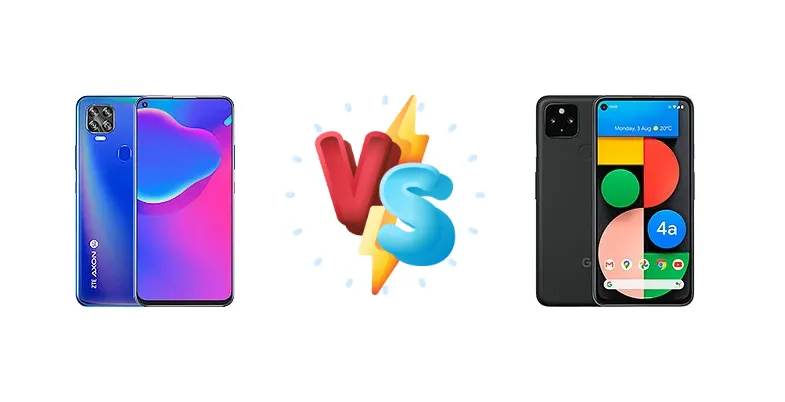
|
🏆 Quick Verdict
For the average user prioritizing camera quality and software experience, the Google Pixel 4a 5G is the clear winner. Its Snapdragon 765G offers a refined experience, and Google’s computational photography is unmatched in this price bracket. However, the ZTE Axon 11 SE 5G provides a strong value proposition for those prioritizing raw performance and don't mind a less polished software experience.
| PHONES | ||
|---|---|---|
| Phone Names | ZTE Axon 11 SE 5G | Google Pixel 4a 5G |
| Network | ||
|---|---|---|
| 2G bands | GSM 850 / 900 / 1800 / 1900 | GSM 850 / 900 / 1800 / 1900 |
| 3G bands | HSDPA 850 / 900 / 1900 / 2100 | HSDPA 850 / 900 / 1700(AWS) / 1900 / 2100 |
| 4G bands | 1, 3, 4, 5, 7, 8, 12, 17, 20, 34, 38, 39, 40, 41 | 1, 2, 3, 4, 5, 7, 8, 12, 13, 14, 17, 18, 19, 20, 25, 26, 28, 29, 30, 32, 38, 39, 40, 41, 42, 46, 48, 66, 71 |
| 5G bands | 1, 3, 28, 41, 78, 79 SA/NSA | 1, 2, 3, 5, 7, 8, 12, 28, 41, 66, 71, 77, 78 Sub6, mmWave (market dependant) |
| Speed | HSPA, LTE, 5G | HSPA, LTE, 5G |
| Technology | GSM / CDMA / HSPA / LTE / 5G | GSM / HSPA / LTE / 5G |
| CDMA 800 | - | |
| Launch | ||
|---|---|---|
| Announced | 2020, June 01. Released 2020, June 22 | 2020, September 30 |
| Status | Discontinued | Available. Released 2020, November 05 |
| Body | ||
|---|---|---|
| Build | - | Glass front (Gorilla Glass 3), plastic back, plastic frame |
| Dimensions | 162.7 x 76.3 x 8.8 mm (6.41 x 3.00 x 0.35 in) | 153.9 x 74 x 8.2 mm (Sub-6) or 8.5 mm (Sub-6 and mmWave) |
| SIM | Nano-SIM + Nano-SIM | Nano-SIM + eSIM |
| Weight | 184 g (6.49 oz) | 168 g (5G Sub-6); 171 g ( 5G Sub-6 and mmWave) (5.93 oz) |
| Display | ||
|---|---|---|
| Protection | - | Corning Gorilla Glass 3 |
| Resolution | 1080 x 2340 pixels, 19.5:9 ratio (~395 ppi density) | 1080 x 2340 pixels, 19.5:9 ratio (~413 ppi density) |
| Size | 6.53 inches, 104.7 cm2 (~84.3% screen-to-body ratio) | 6.2 inches, 95.7 cm2 (~84.1% screen-to-body ratio) |
| Type | IPS LCD | OLED, HDR |
| - | Always-on display | |
| Platform | ||
|---|---|---|
| CPU | Octa-core (4x2.0 GHz Cortex-A76 & 4x2.0 GHz Cortex-A55) | Octa-core (1x2.4 GHz Kryo 475 Prime & 1x2.2 GHz Kryo 475 Gold & 6x1.8 GHz Kryo 475 Silver) |
| Chipset | Mediatek Dimensity 800 (7 nm) | Qualcomm SM7250 Snapdragon 765G 5G (7 nm) |
| GPU | Mali-G57MP4 | Adreno 620 |
| OS | Android 10, MiFavor 10.1 | Android 11, upgradable to Android 14 |
| Memory | ||
|---|---|---|
| Card slot | microSDXC | No |
| Internal | 128GB 6GB RAM | 128GB 6GB RAM |
| UFS 2.1 | UFS 2.1 | |
| Main Camera | ||
|---|---|---|
| Dual | - | 12.2 MP, f/1.7, 27mm (wide), 1/2.55", 1.4µm, dual pixel PDAF, OIS 16 MP, f/2.2, 107˚ (ultrawide), 1.0µm |
| Features | LED flash, panorama, HDR | LED flash, Pixel Shift, Auto-HDR, panorama |
| Quad | 48 MP, f/1.8, (wide), 1/2.0", 0.8µm, PDAF 8 MP, f/2.2, 120˚ (ultrawide) 2 MP (macro) Auxiliary lens | - |
| Video | 4K@30fps, 1080p@30fps | 4K@30/60fps, 1080p@30/60/120/240fps; gyro-EIS |
| Selfie camera | ||
|---|---|---|
| Features | HDR | HDR |
| Single | 16 MP, f/2.0, (wide) | 8 MP, f/2.0, 24mm (wide), 1/4.0", 1.12µm |
| Video | 1080p@30fps | 1080p@30fps |
| Sound | ||
|---|---|---|
| 3.5mm jack | Yes | Yes |
| 35mm jack | Yes | Yes |
| Loudspeaker | Yes | Yes, with stereo speakers |
| Comms | ||
|---|---|---|
| Bluetooth | 5.0, A2DP, LE | 5.0, A2DP, LE, aptX HD |
| NFC | No | Yes |
| Positioning | GPS | GPS, GLONASS, GALILEO, QZSS, BDS |
| Radio | No | No |
| USB | USB Type-C 2.0, OTG | USB Type-C 3.1 |
| WLAN | Wi-Fi 802.11 a/b/g/n/ac, dual-band, Wi-Fi Direct | Wi-Fi 802.11 a/b/g/n/ac, dual-band, Wi-Fi Direct |
| Features | ||
|---|---|---|
| Sensors | Fingerprint (rear-mounted), accelerometer, proximity | Fingerprint (rear-mounted), accelerometer, gyro, proximity, compass, barometer |
| Battery | ||
|---|---|---|
| Charging | 18W wired, 50% in 30 min | 18W wired, PD2.0 |
| Type | Li-Ion 4000 mAh | Li-Po 3885 mAh |
| Misc | ||
|---|---|---|
| Colors | Aurora Glamour, Aurora Glacier | Just Black, Clearly White |
| Models | - | GD1YQ, G025I, G025E, G025H, G6QU3 |
| Price | About 250 EUR | About 140 EUR |
ZTE Axon 11 SE 5G
- Potentially stronger multi-core performance with Dimensity 800
- Competitive price point offering good value
- May offer faster raw processing speeds for certain tasks
- Software experience likely less refined than Pixel
- Camera performance likely inferior to Pixel 4a 5G
- Thermal throttling potential under sustained load
Google Pixel 4a 5G
- Exceptional camera quality thanks to Google’s software
- Clean and streamlined Android experience with guaranteed updates
- Efficient Snapdragon 765G chipset for good battery life
- Potentially lower raw processing power compared to Dimensity 800
- Slower charging speed (18W)
- May be slightly more expensive than the ZTE Axon 11 SE 5G
Display Comparison
Neither ZTE nor Google provided display specs beyond resolution in the context data. However, given the price point, both likely utilize LCD panels. The real differentiator will be color accuracy and brightness. Google’s Pixel line historically prioritizes accurate color reproduction, while ZTE often focuses on maximizing brightness. The absence of high refresh rate support on either device is typical for this segment, but the quality of the panel calibration will be crucial for everyday use.
Camera Comparison
While megapixel counts aren't provided, the Pixel 4a 5G’s strength lies in Google’s renowned computational photography. The Snapdragon 765G’s ISP is well-integrated with Google’s algorithms, enabling features like Night Sight and Super Res Zoom. The ZTE Axon 11 SE 5G, while potentially having a higher resolution sensor, will likely rely more on hardware capabilities. Without detailed sensor information, it’s difficult to assess dynamic range and low-light performance, but Google’s software processing is a significant advantage.
Performance
The core of the difference lies in the chipsets: the ZTE Axon 11 SE 5G features the Mediatek Dimensity 800 (7nm), while the Pixel 4a 5G uses the Qualcomm Snapdragon 765G (7nm). The Snapdragon 765G’s CPU configuration – a 1x2.4 GHz Kryo 475 Prime core, 1x2.2 GHz Kryo 475 Gold, and 6x1.8 GHz Kryo 475 Silver – suggests a focus on single-core performance, beneficial for responsive app launching and general UI fluidity. The Dimensity 800’s octa-core setup (4x2.0 GHz Cortex-A76 & 4x2.0 GHz Cortex-A55) leans towards sustained multi-core performance, potentially giving it an edge in tasks like video editing or prolonged gaming sessions. Both utilize 7nm fabrication, suggesting comparable power efficiency, but Qualcomm’s optimizations often result in better thermal management.
Battery Life
Both devices offer 18W wired charging, with the Pixel 4a 5G adding PD2.0 support for potentially faster charging with compatible chargers. The 18W charging speed is relatively slow by today’s standards, meaning a full charge will take over an hour. The actual battery life will depend on the battery capacity (not provided), but the Snapdragon 765G’s power efficiency could give the Pixel 4a 5G a slight edge in longevity, despite any potential capacity differences.
Buying Guide
Buy the ZTE Axon 11 SE 5G if you need a phone that excels in demanding tasks like gaming and multitasking, and are comfortable with a more customized Android experience. Buy the Google Pixel 4a 5G if you prioritize a clean, streamlined software experience, exceptional camera performance, and guaranteed timely software updates, even if it means slightly less raw processing power.