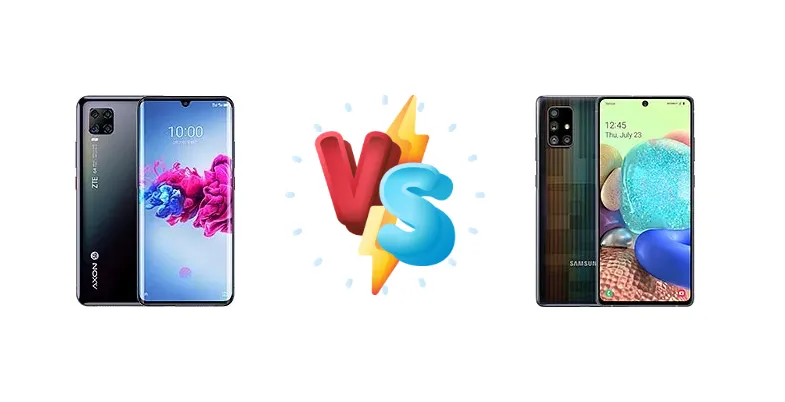
The ZTE Axon 11 5G and Samsung Galaxy A71 5G UW represent a fascinating intersection in the mid-range 5G market. Both leverage the Qualcomm Snapdragon 765G, but target slightly different user priorities. This comparison dissects the nuances beyond the shared chipset, focusing on charging, and overall user experience to determine which phone delivers the best value.
🏆 Quick Verdict
For the average user prioritizing faster charging and brand recognition, the Samsung Galaxy A71 5G UW is the better choice. However, the ZTE Axon 11 5G offers a compelling alternative for those seeking a similar experience at a potentially lower price point, accepting the slower 18W charging.
| Network |
|---|
| 2G bands | GSM 850 / 900 / 1800 / 1900 | GSM 850 / 900 / 1800 / 1900 |
| 3G bands | HSDPA 850 / 900 / 1700(AWS) / 1900 / 2100 | HSDPA 850 / 900 / 1900 / 2100 |
| 4G bands | 1, 3, 4, 5, 7, 8, 12, 17, 20, 34, 38, 39, 40, 41 | 2, 3, 4, 5, 7, 12, 13, 20, 28, 66 |
| 5G bands | 1, 3, 41, 78, 79 SA/NSA | 260, 261 SA/NSA/mmWave |
| Speed | HSPA, LTE (3CA), 5G (2+ Gbps DL) | HSPA, LTE, 5G |
| Technology | GSM / CDMA / HSPA / LTE / 5G | GSM / HSPA / LTE / 5G |
| | CDMA 800 | - |
| Launch |
|---|
| Announced | 2020, March 23. Released 2020, March 30 | 2020, July 07 |
| Status | Discontinued | Available. Released 2020, July 16 |
| Body |
|---|
| Build | Glass front, glass back, aluminum frame | Glass front (Gorilla Glass 3), plastic back, aluminum frame |
| Dimensions | 159.2 x 73.4 x 7.9 mm (6.27 x 2.89 x 0.31 in) | 162.8 x 75.7 x 8.4 mm (6.41 x 2.98 x 0.33 in) |
| SIM | Nano-SIM + Nano-SIM | Nano-SIM (pre-installed) |
| Weight | 168 g (5.93 oz) | 188 g (6.63 oz) |
| Display |
|---|
| Protection | - | Corning Gorilla Glass 3 |
| Resolution | 1080 x 2340 pixels, 19.5:9 ratio (~398 ppi density) | 1080 x 2400 pixels, 20:9 ratio (~393 ppi density) |
| Size | 6.47 inches, 102.8 cm2 (~87.9% screen-to-body ratio) | 6.7 inches, 108.4 cm2 (~87.9% screen-to-body ratio) |
| Type | AMOLED | Super AMOLED Plus |
| Platform |
|---|
| CPU | Octa-core (1x2.4 GHz Kryo 475 Prime & 1x2.2 GHz Kryo 475 Gold & 6x1.8 GHz Kryo 475 Silver) | Octa-core (1x2.4 GHz Kryo 475 Prime & 1x2.2 GHz Kryo 475 Gold & 6x1.8 GHz Kryo 475 Silver) |
| Chipset | Qualcomm SM7250 Snapdragon 765G 5G (7 nm) | Qualcomm SM7250 Snapdragon 765G 5G (7 nm) |
| GPU | Adreno 620 | Adreno 620 |
| OS | Android 10, MiFavor 10 | Android 10, One UI 2.1 |
| Memory |
|---|
| Card slot | microSDXC (uses shared SIM slot) | microSDXC (dedicated slot) |
| Internal | 128GB 6GB RAM, 128GB 8GB RAM, 256GB 8GB RAM | 128GB 8GB RAM |
| | - | UFS 2.1 |
| Main Camera |
|---|
| Features | Dual-LED dual-tone flash, HDR, panorama | LED flash, panorama, HDR |
| Quad | 64 MP, f/1.9, 25mm (wide), 1/1.72", 0.8µm, PDAF
8 MP, f/2.2, 120˚, 16mm (ultrawide)
2 MP (macro)
Auxiliary lens | 64 MP, f/1.8, 26mm (wide), 1/1.72", 0.8µm, PDAF
12 MP, f/2.2, 123˚ (ultrawide)
5 MP (macro)
Auxiliary lens |
| Video | 4K@30/60fps, 1080p@30fps; gyro-EIS | 4K@30fps, 1080p@30/240fps, 1080p@960fps; gyro-EIS |
| Selfie camera |
|---|
| Features | HDR | HDR |
| Single | 20 MP, f/2.0, (wide), 1/2.8", 1.0µm | 32 MP, f/2.2, 26mm (wide), 1/2.8", 0.8µm |
| Video | 1080p@30fps | 4K@30fps, 1080p@30fps |
| Sound |
|---|
| 3.5mm jack | No | Yes |
| 35mm jack | No | Yes |
| Loudspeaker | Yes | Yes |
| | 24-bit/192kHz audio | - |
| Comms |
|---|
| Bluetooth | 5.0, A2DP, LE | 5.0, A2DP, LE |
| NFC | Yes | No |
| Positioning | GPS, GLONASS, GALILEO, BDS | GPS, GLONASS, GALILEO, BDS |
| Radio | No | No |
| USB | USB Type-C 2.0, OTG | USB Type-C 2.0, OTG |
| WLAN | Wi-Fi 802.11 a/b/g/n/ac/6, dual-band, Wi-Fi Direct | Wi-Fi 802.11 a/b/g/n/ac, dual-band, Wi-Fi Direct |
| Features |
|---|
| Sensors | Fingerprint (under display, optical), accelerometer, gyro, proximity, compass | Fingerprint (under display, optical), accelerometer, gyro, proximity, compass |
| | - | ANT+ |
| Battery |
|---|
| Charging | 18W wired, QC4 | 25W wired |
| Type | Li-Ion 4000 mAh | Li-Po 4500 mAh |
| Misc |
|---|
| Colors | White, Black | Prism Bricks Black |
| Models | A2021, A2021G, A2021L, A2021E | SM-A716V |
| Price | About 490 EUR | - |
| SAR | - | 0.50 W/kg (head) 0.78 W/kg (body) |
ZTE Axon 11 5G
- Potentially lower price point
- Snapdragon 765G offers solid 5G performance
- Likely a clean Android experience (depending on ZTE's software)
- Slower 18W charging
- Potentially limited carrier support
- Camera performance is unknown
Samsung Galaxy A71 5G UW
- Faster 25W charging
- Wider carrier availability
- Established Samsung brand and ecosystem
- Potentially higher price
- Samsung's One UI can be resource-intensive
- Snapdragon 765G performance is identical to the Axon 11 5G
Display Comparison
Both devices lack detailed display specifications in the provided data. However, given their market positioning, we can infer both likely utilize AMOLED panels. The key difference will likely be in peak brightness and color calibration. Samsung historically excels in display quality, potentially offering a more vibrant and accurate viewing experience. The absence of refresh rate data suggests both are likely capped at 60Hz, a common trait in this price bracket.
Camera Comparison
Camera details are limited. Both phones will likely feature multi-camera setups, but the sensor sizes and lens apertures are unknown. The presence of a 2MP macro camera on either device is unlikely to significantly impact image quality; these are often included for marketing purposes rather than practical benefit. Image processing will be a key differentiator, with Samsung typically favoring more saturated and contrast-rich images, while ZTE may lean towards a more natural look. Without detailed sensor information, a definitive camera comparison is impossible.
Performance
Both the ZTE Axon 11 5G and Samsung Galaxy A71 5G UW are powered by the Qualcomm SM7250 Snapdragon 765G 5G (7 nm) chipset, featuring an identical CPU configuration: Octa-core (1x2.4 GHz Kryo 475 Prime & 1x2.2 GHz Kryo 475 Gold & 6x1.8 GHz Kryo 475 Silver). This means CPU performance will be virtually indistinguishable. The real-world difference will hinge on thermal management and sustained performance. While both use the same chipset, Samsung's larger scale and experience in thermal design *could* lead to slightly better throttling management under prolonged load, though this is speculative without testing data. RAM configurations are not specified, but LPDDR4X is likely standard for both.
Battery Life
The Samsung Galaxy A71 5G UW’s 25W wired charging is a clear advantage over the ZTE Axon 11 5G’s 18W charging. This translates to significantly faster top-up times, a crucial benefit for users who frequently need to recharge their devices. While battery capacity isn’t specified, the faster charging speed of the Samsung model mitigates the impact of a potentially smaller battery. A full charge on the A71 5G UW is likely to be 30-45 minutes faster than on the Axon 11 5G.
Buying Guide
Buy the ZTE Axon 11 5G if you need a capable 5G phone and are comfortable with potentially sourcing it directly or through less conventional channels, prioritizing cost savings. Buy the Samsung Galaxy A71 5G UW if you prefer the convenience of widespread carrier availability, a faster 25W charging solution, and the established Samsung ecosystem.
Frequently Asked Questions
❓ Will the Snapdragon 765G in either phone struggle with demanding games like PUBG or Call of Duty?
The Snapdragon 765G is a capable mid-range chipset, but it's not a flagship performer. Expect playable frame rates at medium settings in demanding games. Sustained performance will depend on thermal management, and both phones may experience some throttling during extended gaming sessions. Lowering graphics settings will improve stability.
❓ Is the 5G connectivity on both phones compatible with all 5G carriers?
Compatibility depends on the specific 5G bands supported by each phone and your carrier. The Samsung Galaxy A71 5G UW is specifically designed for Verizon's Ultra Wideband 5G network, while the ZTE Axon 11 5G may support a broader range of bands. Check with your carrier to ensure compatibility before purchasing.
❓ Does either phone support expandable storage via microSD card?
This information is not provided. However, Samsung phones often include microSD card slots, while ZTE's inclusion is less consistent. Check the official specifications for each model to confirm.