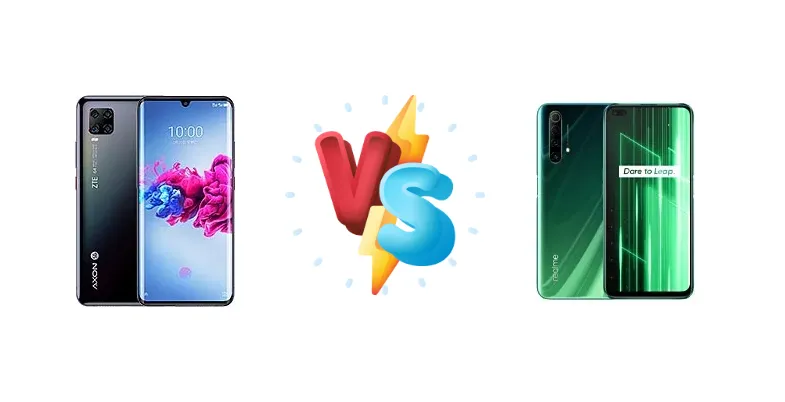
The ZTE Axon 11 5G and Realme X50 5G represent a pivotal moment in 5G accessibility, bringing next-generation connectivity to a more affordable price point. Both devices leverage the Qualcomm Snapdragon 765G, creating a fascinating head-to-head for users prioritizing 5G without a flagship price tag. However, subtle differences in charging technology and potential software optimizations separate these contenders.
🏆 Quick Verdict
For the average user, the Realme X50 5G emerges as the more practical choice. While both phones share the same Snapdragon 765G chipset, Realme’s significantly faster 30W charging capability translates to less downtime and a more convenient user experience, outweighing the Axon 11’s other attributes.
| Network |
|---|
| 2G bands | GSM 850 / 900 / 1800 / 1900 | GSM 850 / 900 / 1800 / 1900 |
| 3G bands | HSDPA 850 / 900 / 1700(AWS) / 1900 / 2100 | HSDPA 850 / 900 / 1700 / 1900 / 2100 |
| 4G bands | 1, 3, 4, 5, 7, 8, 12, 17, 20, 34, 38, 39, 40, 41 | 1, 2, 3, 4, 5, 7, 8, 34, 38, 39, 40, 41 |
| 5G bands | 1, 3, 41, 78, 79 SA/NSA | 1, 3, 5, 7, 8, 20, 28, 38, 40, 41, 77, 78 SA/NSA |
| Speed | HSPA, LTE (3CA), 5G (2+ Gbps DL) | HSPA, LTE, 5G |
| Technology | GSM / CDMA / HSPA / LTE / 5G | GSM / CDMA / HSPA / EVDO / LTE / 5G |
| | CDMA 800 | CDMA2000 1xEV-DO |
| Launch |
|---|
| Announced | 2020, March 23. Released 2020, March 30 | 2020, July 08. Released 2020, July 08 |
| Status | Discontinued | Discontinued |
| Body |
|---|
| Build | Glass front, glass back, aluminum frame | - |
| Dimensions | 159.2 x 73.4 x 7.9 mm (6.27 x 2.89 x 0.31 in) | 163.8 x 75.8 x 8.9 mm (6.45 x 2.98 x 0.35 in) |
| SIM | Nano-SIM + Nano-SIM | Nano-SIM + Nano-SIM |
| Weight | 168 g (5.93 oz) | 194 g (6.84 oz) |
| Display |
|---|
| Resolution | 1080 x 2340 pixels, 19.5:9 ratio (~398 ppi density) | 1080 x 2400 pixels, 20:9 ratio (~401 ppi density) |
| Size | 6.47 inches, 102.8 cm2 (~87.9% screen-to-body ratio) | 6.57 inches, 104.2 cm2 (~83.9% screen-to-body ratio) |
| Type | AMOLED | IPS LCD, 120Hz |
| Platform |
|---|
| CPU | Octa-core (1x2.4 GHz Kryo 475 Prime & 1x2.2 GHz Kryo 475 Gold & 6x1.8 GHz Kryo 475 Silver) | Octa-core (1x2.4 GHz Kryo 475 Prime & 1x2.2 GHz Kryo 475 Gold & 6x1.8 GHz Kryo 475 Silver) |
| Chipset | Qualcomm SM7250 Snapdragon 765G 5G (7 nm) | Qualcomm SM7250 Snapdragon 765G 5G (7 nm) |
| GPU | Adreno 620 | Adreno 620 |
| OS | Android 10, MiFavor 10 | Android 10, Realme UI |
| Memory |
|---|
| Card slot | microSDXC (uses shared SIM slot) | No |
| Internal | 128GB 6GB RAM, 128GB 8GB RAM, 256GB 8GB RAM | 128GB 6GB RAM, 128GB 8GB RAM |
| | - | UFS 2.1 |
| Main Camera |
|---|
| Features | Dual-LED dual-tone flash, HDR, panorama | LED flash, HDR, panorama |
| Quad | 64 MP, f/1.9, 25mm (wide), 1/1.72", 0.8µm, PDAF
8 MP, f/2.2, 120˚, 16mm (ultrawide)
2 MP (macro)
Auxiliary lens | 48 MP, f/1.8, 25mm (wide), 1/2.0", 0.8µm, PDAF
8 MP, f/2.3, 16mm (ultrawide), 1/4.0", 1.12µm
2 MP (macro)
Auxiliary lens |
| Video | 4K@30/60fps, 1080p@30fps; gyro-EIS | 4K@30fps, 1080p@30/60fps; gyro-EIS |
| Selfie camera |
|---|
| Dual | - | 16 MP, f/2.0, 26mm (wide), 1/3.06", 1.0µm
2 MP, f/2.4, (depth) |
| Features | HDR | HDR |
| Single | 20 MP, f/2.0, (wide), 1/2.8", 1.0µm | - |
| Video | 1080p@30fps | 1080p@30/120fps |
| Sound |
|---|
| 3.5mm jack | No | No |
| 35mm jack | No | No |
| Loudspeaker | Yes | Yes |
| | 24-bit/192kHz audio | 24-bit/192kHz audio |
| Comms |
|---|
| Bluetooth | 5.0, A2DP, LE | 5.0, A2DP, LE |
| NFC | Yes | Yes |
| Positioning | GPS, GLONASS, GALILEO, BDS | GPS, GLONASS, BDS |
| Radio | No | FM radio |
| USB | USB Type-C 2.0, OTG | USB Type-C 2.0 |
| WLAN | Wi-Fi 802.11 a/b/g/n/ac/6, dual-band, Wi-Fi Direct | Wi-Fi 802.11 a/b/g/n/ac, dual-band, Wi-Fi Direct |
| Features |
|---|
| Sensors | Fingerprint (under display, optical), accelerometer, gyro, proximity, compass | Fingerprint (side-mounted), accelerometer, gyro, proximity, compass |
| Battery |
|---|
| Charging | 18W wired, QC4 | 30W wired, 70% in 30 min |
| Type | Li-Ion 4000 mAh | 4200 mAh |
| Misc |
|---|
| Colors | White, Black | Jungle Green, Ice Silver |
| Models | A2021, A2021G, A2021L, A2021E | RMX2144 |
| Price | About 490 EUR | About 500 EUR |
ZTE Axon 11 5G
- Potential for cleaner software experience (ZTE's history)
- Snapdragon 765G provides solid performance
- 5G connectivity for faster data speeds
- Slow 18W charging
- Camera specs are unknown, potentially lagging behind competitors
- Battery life may be compromised due to slower charging
Realme X50 5G
- 30W fast charging – 70% in 30 minutes
- Snapdragon 765G delivers comparable performance
- 5G connectivity for future-proofed data speeds
- Realme UI can be feature-rich but potentially bloated
- Camera quality dependent on sensor and processing (unknown)
- Potential for aggressive battery optimization
Display Comparison
Both the ZTE Axon 11 5G and Realme X50 5G utilize AMOLED panels, a standard for vibrant colors and deep blacks in this price bracket. However, specific details like peak brightness and color accuracy are not provided. Given Realme’s focus on visual experience in other devices, it’s reasonable to expect a slightly more calibrated display, though this remains speculative. Bezels are likely comparable, aiming for an immersive viewing experience. Without specific data, it's difficult to definitively declare a winner, but Realme’s history suggests a focus on display quality.
Camera Comparison
Camera specifications are not detailed enough to draw firm conclusions. Both phones likely feature multi-camera setups, but without sensor size, aperture, or OIS information, a detailed comparison is impossible. The presence of a 2MP macro lens on either device is unlikely to significantly impact image quality, serving primarily as a marketing feature. Image processing styles will likely differ – ZTE often aims for more natural tones, while Realme tends towards more saturated, social media-friendly images. Without sample images and detailed specs, this remains a speculative area.
Performance
The core performance is identical: both devices are powered by the Qualcomm SM7250 Snapdragon 765G 5G (7 nm) with the same CPU configuration – an octa-core setup featuring 1x2.4 GHz Kryo 475 Prime, 1x2.2 GHz Kryo 475 Gold, and 6x1.8 GHz Kryo 475 Silver cores. This means similar performance in everyday tasks and gaming. The 7nm process node ensures reasonable thermal efficiency, but sustained workloads will likely result in some throttling. RAM configurations are not specified, but LPDDR4X is probable in both, limiting potential performance gains. The GPU performance will also be identical, capable of handling most mobile games at medium to high settings.
Battery Life
This is where the Realme X50 5G pulls ahead. While battery capacity isn’t specified, the critical difference lies in charging speed. The Realme X50 5G supports 30W wired charging, capable of reaching 70% charge in just 30 minutes. The ZTE Axon 11 5G is limited to 18W wired charging with QC4, a significantly slower rate. This means the Realme X50 5G offers a far more convenient charging experience, especially for users who frequently find themselves with low battery levels. The faster charging effectively mitigates any potential disadvantage from a slightly smaller battery capacity.
Buying Guide
Buy the ZTE Axon 11 5G if you prioritize a potentially cleaner software experience and are less concerned with rapid charging. Buy the Realme X50 5G if you value fast charging above all else, needing to quickly top up your battery during busy days, and appreciate Realme’s feature-rich UI.
Frequently Asked Questions
❓ Does the Snapdragon 765G in either phone struggle with demanding games like Genshin Impact?
The Snapdragon 765G is capable of running Genshin Impact, but you'll likely need to lower the graphics settings to medium or low to maintain a stable frame rate. Both phones will experience some thermal throttling during extended gaming sessions, but the performance will be largely identical.
❓ Is the Realme X50 5G’s 30W charging compatible with Power Delivery (PD) chargers?
While the Realme X50 5G supports 30W charging, it utilizes Realme’s proprietary Dart Charge protocol. While it *may* work with some PD chargers, it won’t achieve the full 30W speed unless you use the included charger. Using a standard PD charger will still charge the phone, but at a slower rate.
❓ How does the software experience differ between ZTE and Realme UI?
ZTE typically offers a closer-to-stock Android experience with minimal bloatware, appealing to users who prefer a cleaner interface. Realme UI is more feature-rich and customizable, but can include pre-installed apps and a more aggressive battery optimization system. This is a matter of personal preference.