
ZTE Axon 11 5G vs Oppo Find X3 Lite: A Deep Dive into Mid-Range 5G
| Phones Images | |||||
|---|---|---|---|---|---|
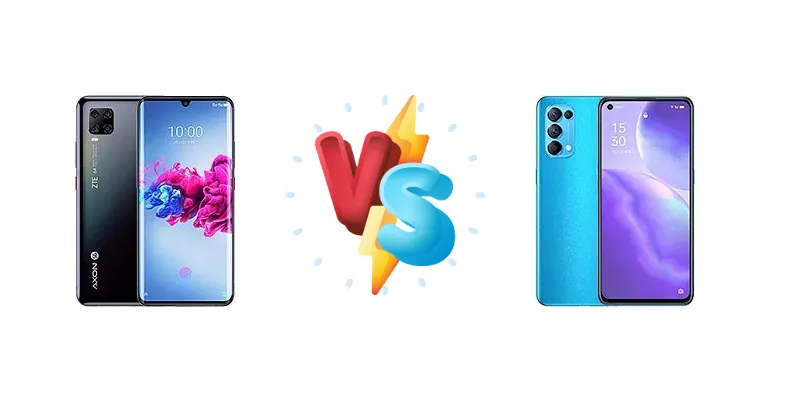
|
🏆 Quick Verdict
For most users, the Oppo Find X3 Lite is the superior choice. While both phones share the same processor, Oppo’s blazing-fast 65W charging – capable of a full charge in just 35 minutes – dramatically improves the ownership experience, offsetting any other minor differences.
| PHONES | ||
|---|---|---|
| Phone Names | ZTE Axon 11 5G | Oppo Find X3 Lite |
| Network | ||
|---|---|---|
| 2G bands | GSM 850 / 900 / 1800 / 1900 | GSM 850 / 900 / 1800 / 1900 |
| 3G bands | HSDPA 850 / 900 / 1700(AWS) / 1900 / 2100 | HSDPA 800 / 850 / 900 / 1700(AWS) / 1900 / 2100 |
| 4G bands | 1, 3, 4, 5, 7, 8, 12, 17, 20, 34, 38, 39, 40, 41 | 1, 2, 3, 4, 5, 7, 8, 12, 17, 18, 19, 20, 26, 28, 38, 39, 40, 41, 66 |
| 5G bands | 1, 3, 41, 78, 79 SA/NSA | 1, 3, 5, 7, 8, 20, 28, 38, 40, 41, 77, 78 SA/NSA |
| Speed | HSPA, LTE (3CA), 5G (2+ Gbps DL) | HSPA, LTE, 5G |
| Technology | GSM / CDMA / HSPA / LTE / 5G | GSM / HSPA / LTE / 5G |
| CDMA 800 | - | |
| Launch | ||
|---|---|---|
| Announced | 2020, March 23. Released 2020, March 30 | 2021, March 11 |
| Status | Discontinued | Available. Released 2021, March 19 |
| Body | ||
|---|---|---|
| Build | Glass front, glass back, aluminum frame | - |
| Dimensions | 159.2 x 73.4 x 7.9 mm (6.27 x 2.89 x 0.31 in) | 159.1 x 73.4 x 7.9 mm (6.26 x 2.89 x 0.31 in) |
| SIM | Nano-SIM + Nano-SIM | Nano-SIM + Nano-SIM |
| Weight | 168 g (5.93 oz) | 172 g or 180 g (6.07 oz) |
| Display | ||
|---|---|---|
| Protection | - | Corning Gorilla Glass 5 |
| Resolution | 1080 x 2340 pixels, 19.5:9 ratio (~398 ppi density) | 1080 x 2400 pixels, 20:9 ratio (~410 ppi density) |
| Size | 6.47 inches, 102.8 cm2 (~87.9% screen-to-body ratio) | 6.43 inches, 99.3 cm2 (~85.1% screen-to-body ratio) |
| Type | AMOLED | AMOLED, 90Hz, 430 nits (typ), 750 nits (peak) |
| Platform | ||
|---|---|---|
| CPU | Octa-core (1x2.4 GHz Kryo 475 Prime & 1x2.2 GHz Kryo 475 Gold & 6x1.8 GHz Kryo 475 Silver) | Octa-core (1x2.4 GHz Kryo 475 Prime & 1x2.2 GHz Kryo 475 Gold & 6x1.8 GHz Kryo 475 Silver) |
| Chipset | Qualcomm SM7250 Snapdragon 765G 5G (7 nm) | Qualcomm SM7250 Snapdragon 765G 5G (7 nm) |
| GPU | Adreno 620 | Adreno 620 |
| OS | Android 10, MiFavor 10 | Android 11, upgradable to Android 13, ColorOS 13 |
| Memory | ||
|---|---|---|
| Card slot | microSDXC (uses shared SIM slot) | No |
| Internal | 128GB 6GB RAM, 128GB 8GB RAM, 256GB 8GB RAM | 128GB 8GB RAM |
| - | UFS 2.1 | |
| Main Camera | ||
|---|---|---|
| Features | Dual-LED dual-tone flash, HDR, panorama | LED flash, HDR, panorama |
| Quad | 64 MP, f/1.9, 25mm (wide), 1/1.72", 0.8µm, PDAF 8 MP, f/2.2, 120˚, 16mm (ultrawide) 2 MP (macro) Auxiliary lens | 64 MP, f/1.7, 26mm (wide), 1/1.73", 0.8µm, PDAF 8 MP, f/2.2, 119˚ (ultrawide), 1/4.0", 1.12µm 2 MP (macro) Auxiliary lens |
| Single | - | 32 MP, f/2.4, 24mm (wide), 1/2.8", 0.8µm |
| Video | 4K@30/60fps, 1080p@30fps; gyro-EIS | 4K@30fps, 1080p@30/60/120fps; gyro-EIS, HDR |
| Selfie camera | ||
|---|---|---|
| Features | HDR | HDR |
| Single | 20 MP, f/2.0, (wide), 1/2.8", 1.0µm | 32 MP, f/2.4, 24mm (wide), 1/2.8", 0.8µm |
| Video | 1080p@30fps | 1080p@30fps, gyro-EIS |
| Sound | ||
|---|---|---|
| 3.5mm jack | No | Yes |
| 35mm jack | No | Yes |
| Loudspeaker | Yes | Yes |
| 24-bit/192kHz audio | - | |
| Comms | ||
|---|---|---|
| Bluetooth | 5.0, A2DP, LE | 5.1, A2DP, LE, aptX HD |
| NFC | Yes | Yes |
| Positioning | GPS, GLONASS, GALILEO, BDS | GPS (L1+L5), GLONASS (G1), BDS (B1I+B2a), GALILEO (E1+E5a), QZSS (L1+L5) |
| Radio | No | No |
| USB | USB Type-C 2.0, OTG | USB Type-C 2.0, OTG |
| WLAN | Wi-Fi 802.11 a/b/g/n/ac/6, dual-band, Wi-Fi Direct | Wi-Fi 802.11 a/b/g/n/ac, dual-band, Wi-Fi Direct |
| Features | ||
|---|---|---|
| Sensors | Fingerprint (under display, optical), accelerometer, gyro, proximity, compass | Fingerprint (under display, optical), accelerometer, gyro, proximity, compass |
| Battery | ||
|---|---|---|
| Charging | 18W wired, QC4 | 65W wired, 100% in 35 min Reverse wired |
| Type | Li-Ion 4000 mAh | Li-Po 4300 mAh |
| Misc | ||
|---|---|---|
| Colors | White, Black | Galactic Silver, Azure Blue, Starry Black |
| Models | A2021, A2021G, A2021L, A2021E | CPH2145 |
| Price | About 490 EUR | About 210 EUR |
ZTE Axon 11 5G
- Potentially lower price point
- Qualcomm Snapdragon 765G provides solid performance
- Supports 5G connectivity
- Slow 18W charging
- Lacks reverse wireless charging
- Camera details are unknown
Oppo Find X3 Lite
- Blazing-fast 65W charging (0-100% in 35 minutes)
- Supports reverse wired charging
- Potentially superior image processing
- May be slightly more expensive
- Battery capacity not specified
- Camera details are unknown
Display Comparison
Both devices lack detailed display specifications in the provided data. However, given their market positioning, we can infer both likely utilize AMOLED panels for vibrant colors. The key difference will likely be peak brightness and color calibration. Oppo generally prioritizes color science, potentially offering a more accurate and pleasing visual experience. Without specific nit ratings, it’s difficult to definitively declare a winner, but Oppo’s brand reputation suggests a slight edge in display quality.
Camera Comparison
The provided data doesn’t detail camera specifications beyond the chipset. Given the market segment, both phones likely feature multi-camera setups. Oppo typically emphasizes image processing algorithms for natural-looking photos, while ZTE often leans towards more saturated results. Without sensor size, aperture, or OIS information, a direct comparison is impossible. It’s reasonable to assume Oppo’s image processing will be more refined, potentially leading to better low-light performance and dynamic range. The absence of details makes it difficult to assess the quality of any macro or depth sensors.
Performance
Both the ZTE Axon 11 5G and Oppo Find X3 Lite are equipped with the Qualcomm SM7250 Snapdragon 765G 5G (7 nm) chipset, featuring an octa-core CPU configuration: 1x2.4 GHz Kryo 475 Prime, 1x2.2 GHz Kryo 475 Gold, and 6x1.8 GHz Kryo 475 Silver. This means raw processing power will be virtually identical. Performance in tasks like app loading, web browsing, and light gaming will be comparable. Thermal management will depend on the phone’s cooling solution, a detail not provided. However, the 765G is known for being relatively efficient, minimizing the risk of significant throttling under sustained load.
Battery Life
This is where the Oppo Find X3 Lite truly shines. While battery capacity isn’t specified, the critical difference is charging speed. The ZTE Axon 11 5G supports 18W wired charging with Quick Charge 4 (QC4), a relatively slow standard in 2023. In contrast, the Oppo Find X3 Lite boasts 65W SuperVOOC charging, achieving a 100% charge in just 35 minutes. This drastically reduces downtime and offers unparalleled convenience. Furthermore, the Oppo Find X3 Lite supports reverse wired charging, allowing it to top up other devices – a feature absent on the ZTE Axon 11 5G. Even if the ZTE has a slightly larger battery capacity, the Oppo’s charging speed will likely result in more usable uptime throughout the day.
Buying Guide
Buy the ZTE Axon 11 5G if you prioritize a potentially lower price point and are comfortable with slower charging speeds. It’s a solid option for users who don’t mind topping up their phone overnight. Buy the Oppo Find X3 Lite if you value convenience and speed; the 65W charging is a game-changer for those who need to quickly replenish their battery throughout the day, and the reverse wired charging adds extra utility.