
ZTE Axon 11 5G vs Nokia 8.3 5G: A Tale of Two 765Gs
| Phones Images | |||||
|---|---|---|---|---|---|
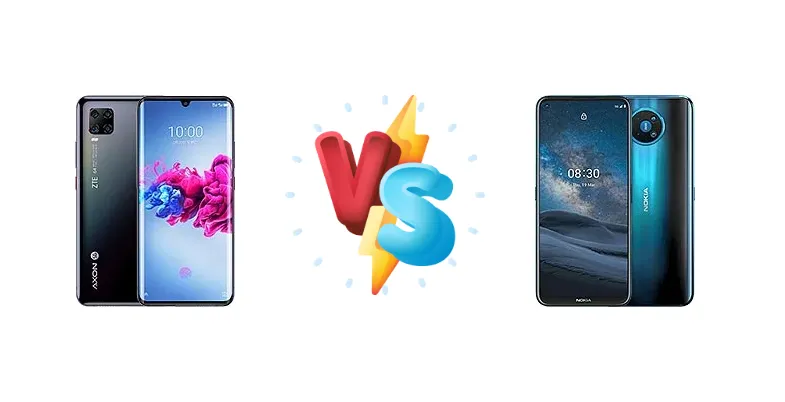
|
🏆 Quick Verdict
For the average user prioritizing value and potentially faster charging speeds, the ZTE Axon 11 5G emerges as the slightly better choice. While both phones offer identical processing power, the Axon 11 5G’s Quick Charge 4 support provides a marginal advantage in topping up the battery, and historically has been available at a lower price point.
| PHONES | ||
|---|---|---|
| Phone Names | ZTE Axon 11 5G | Nokia 8.3 5G |
| Network | ||
|---|---|---|
| 2G bands | GSM 850 / 900 / 1800 / 1900 | GSM 850 / 900 / 1800 / 1900 |
| 3G bands | HSDPA 850 / 900 / 1700(AWS) / 1900 / 2100 | HSDPA 850 / 900 / 1700(AWS) / 1900 / 2100 |
| 4G bands | 1, 3, 4, 5, 7, 8, 12, 17, 20, 34, 38, 39, 40, 41 | 1, 2, 3, 4, 5, 7, 8, 12, 13, 17, 20, 28, 32, 38, 39, 40, 41, 66, 71 |
| 5G bands | 1, 3, 41, 78, 79 SA/NSA | 1, 2, 3, 5, 7, 8, 28, 38, 40, 41, 66, 71, 78 SA/NSA |
| Speed | HSPA, LTE (3CA), 5G (2+ Gbps DL) | HSPA 42.2/5.76 Mbps, LTE (4CA) Cat18 1200/150 Mbps, 5G 2.4/1.2 Gbps |
| Technology | GSM / CDMA / HSPA / LTE / 5G | GSM / HSPA / LTE / 5G |
| CDMA 800 | - | |
| Launch | ||
|---|---|---|
| Announced | 2020, March 23. Released 2020, March 30 | 2020, March 19. Released 2020, September 15 |
| Status | Discontinued | Discontinued |
| Body | ||
|---|---|---|
| Build | Glass front, glass back, aluminum frame | Glass front, plastic frame, glass back |
| Dimensions | 159.2 x 73.4 x 7.9 mm (6.27 x 2.89 x 0.31 in) | 171.9 x 78.6 x 9 mm (6.77 x 3.09 x 0.35 in) |
| SIM | Nano-SIM + Nano-SIM | · Nano-SIM· Nano-SIM + Nano-SIM |
| Weight | 168 g (5.93 oz) | 220 g (7.76 oz) |
| Display | ||
|---|---|---|
| Resolution | 1080 x 2340 pixels, 19.5:9 ratio (~398 ppi density) | 1080 x 2400 pixels, 20:9 ratio (~386 ppi density) |
| Size | 6.47 inches, 102.8 cm2 (~87.9% screen-to-body ratio) | 6.81 inches, 112.0 cm2 (~82.9% screen-to-body ratio) |
| Type | AMOLED | IPS LCD |
| Platform | ||
|---|---|---|
| CPU | Octa-core (1x2.4 GHz Kryo 475 Prime & 1x2.2 GHz Kryo 475 Gold & 6x1.8 GHz Kryo 475 Silver) | Octa-core (1x2.4 GHz Kryo 475 Prime & 1x2.2 GHz Kryo 475 Gold & 6x1.8 GHz Kryo 475 Silver) |
| Chipset | Qualcomm SM7250 Snapdragon 765G 5G (7 nm) | Qualcomm SM7250 Snapdragon 765G 5G (7 nm) |
| GPU | Adreno 620 | Adreno 620 |
| OS | Android 10, MiFavor 10 | Android 10, upgradable to Android 12, Android One |
| Memory | ||
|---|---|---|
| Card slot | microSDXC (uses shared SIM slot) | microSDXC (uses shared SIM slot) |
| Internal | 128GB 6GB RAM, 128GB 8GB RAM, 256GB 8GB RAM | 64GB 6GB RAM, 64GB 8GB RAM, 128GB 8GB RAM |
| Main Camera | ||
|---|---|---|
| Features | Dual-LED dual-tone flash, HDR, panorama | Zeiss optics, Dual-LED flash, panorama, HDR |
| Quad | 64 MP, f/1.9, 25mm (wide), 1/1.72", 0.8µm, PDAF 8 MP, f/2.2, 120˚, 16mm (ultrawide) 2 MP (macro) Auxiliary lens | 64 MP, f/1.9, (wide), 1/1.72", 0.8µm, PDAF 12 MP, f/2.2, 120˚ (ultrawide), 1/2.43", 1.4µm, AF 2 MP (macro) Auxiliary lens |
| Video | 4K@30/60fps, 1080p@30fps; gyro-EIS | 4K@30/60fps, 1080p@30/240fps, 720p@960fps, gyro-EIS |
| Selfie camera | ||
|---|---|---|
| Features | HDR | Zeiss optics, HDR |
| Single | 20 MP, f/2.0, (wide), 1/2.8", 1.0µm | 24 MP, f/2.0, (wide), 1/2.8", 0.9µm |
| Video | 1080p@30fps | 1080p@30fps |
| Sound | ||
|---|---|---|
| 3.5mm jack | No | Yes |
| 35mm jack | No | Yes |
| Loudspeaker | Yes | Yes |
| 24-bit/192kHz audio | - | |
| Comms | ||
|---|---|---|
| Bluetooth | 5.0, A2DP, LE | 5.0, A2DP, EDR, LE |
| NFC | Yes | Yes |
| Positioning | GPS, GLONASS, GALILEO, BDS | GPS, GLONASS, BDS |
| Radio | No | FM radio |
| USB | USB Type-C 2.0, OTG | USB Type-C 2.0, OTG |
| WLAN | Wi-Fi 802.11 a/b/g/n/ac/6, dual-band, Wi-Fi Direct | Wi-Fi 802.11 a/b/g/n/ac, dual-band, Wi-Fi Direct |
| Features | ||
|---|---|---|
| Sensors | Fingerprint (under display, optical), accelerometer, gyro, proximity, compass | Fingerprint (side-mounted), accelerometer, gyro, proximity, compass |
| Battery | ||
|---|---|---|
| Charging | 18W wired, QC4 | 18W wired |
| Type | Li-Ion 4000 mAh | Li-Po 4500 mAh |
| Misc | ||
|---|---|---|
| Colors | White, Black | Polar Night |
| Models | A2021, A2021G, A2021L, A2021E | TA-1243, TA-1251 |
| Price | About 490 EUR | About 470 EUR |
| SAR | - | 0.96 W/kg (head) 1.41 W/kg (body) |
| SAR EU | - | 0.96 W/kg (head) 1.41 W/kg (body) |
ZTE Axon 11 5G
- Quick Charge 4 support for potentially faster charging.
- Historically lower price point offering better value.
- Streamlined Android experience with less bloatware.
- Brand recognition is lower than Nokia.
- Software update commitment is less clear than Nokia.
Nokia 8.3 5G
- Near-stock Android experience with guaranteed updates.
- Strong brand reputation for reliability and longevity.
- Potentially larger display for a more immersive experience.
- Lacks Quick Charge 4 support, potentially slower charging.
- May be priced higher than the ZTE Axon 11 5G.
- Software can be perceived as 'vanilla' by some users.
Display Comparison
Both the ZTE Axon 11 5G and Nokia 8.3 5G lack detailed display specifications in the provided data. However, given their market positioning, we can infer both likely utilize AMOLED panels for vibrant colors. The absence of information regarding refresh rates (60Hz vs 90Hz or 120Hz) or peak brightness is a significant omission. Without this data, it’s impossible to definitively state which device offers a superior viewing experience, but the Nokia 8.3 5G’s larger 6.81-inch display *could* offer a more immersive experience, assuming similar pixel density.
Camera Comparison
Detailed camera specifications are absent, making a thorough comparison challenging. Both phones likely feature multi-camera setups to leverage the Snapdragon 765G’s ISP capabilities. However, without knowing sensor sizes, lens apertures, or the presence of Optical Image Stabilization (OIS), it’s difficult to assess image quality. The inclusion of a dedicated night mode and HDR processing will be crucial for low-light performance. We can assume both phones will offer a standard wide, ultrawide, and potentially macro lens, but the quality of these lenses will vary significantly.
Performance
The core performance of both devices is identical, powered by the Qualcomm SM7250 Snapdragon 765G 5G (7 nm) chipset. This octa-core CPU configuration – 1x2.4 GHz Kryo 475 Prime, 1x2.2 GHz Kryo 475 Gold, and 6x1.8 GHz Kryo 475 Silver – delivers comparable processing power for everyday tasks and moderate gaming. The 7nm process node ensures reasonable thermal efficiency, but sustained heavy workloads will likely result in some throttling on both devices. The lack of LPDDR5 or LPDDR4X RAM specification prevents a deeper analysis of memory bandwidth, but it’s unlikely to be a significant differentiator.
Battery Life
Both the ZTE Axon 11 5G and Nokia 8.3 5G support 18W wired charging. While the wattage is the same, the ZTE Axon 11 5G benefits from Quick Charge 4 (QC4) compatibility. This allows it to potentially draw more power and charge faster than the Nokia 8.3 5G, which doesn’t explicitly mention QC support. The actual 0-100% charging time will depend on the battery capacity of each device (which is not provided), but the QC4 support gives the Axon 11 5G a slight edge. Without battery capacity data, it’s impossible to determine which phone offers better battery life.
Buying Guide
Buy the ZTE Axon 11 5G if you need a reliable 5G experience at the lowest possible price, and appreciate a more streamlined, less software-heavy Android experience. Buy the Nokia 8.3 5G if you prefer a near-stock Android experience with guaranteed software updates and value the Nokia brand’s commitment to longevity, even if it means potentially paying a slight premium.