
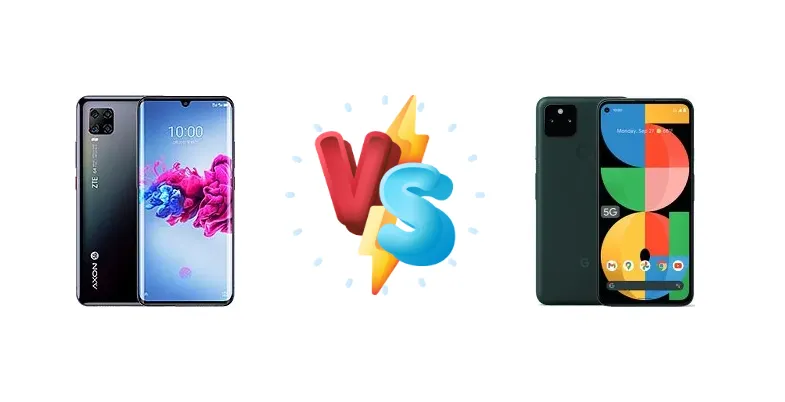
Google Pixel 5a 5G vs. ZTE Axon 11 5G: A Detailed Comparison
| Phones Images | |||||
|---|---|---|---|---|---|
|
🏆 Quick Verdict
For the average user prioritizing camera quality and software support, the Google Pixel 5a 5G is the clear winner. Its superior image processing and guaranteed updates outweigh the ZTE Axon 11 5G’s slightly more aggressive pricing. However, the Axon 11 5G remains a viable alternative for those seeking a larger display and faster charging.
| PHONES | ||
|---|---|---|
| Phone Names | ZTE Axon 11 5G | Google Pixel 5a 5G |
| Network | ||
|---|---|---|
| 2G bands | GSM 850 / 900 / 1800 / 1900 | GSM 850 / 900 / 1800 / 1900 |
| 3G bands | HSDPA 850 / 900 / 1700(AWS) / 1900 / 2100 | HSDPA 850 / 900 / 1700(AWS) / 1900 / 2100 |
| 4G bands | 1, 3, 4, 5, 7, 8, 12, 17, 20, 34, 38, 39, 40, 41 | 1, 2, 3, 4, 5, 7, 8, 12, 13, 14, 17, 18, 19, 20, 25, 26, 28, 29, 30, 32, 38, 39, 40, 41, 42, 46, 48, 66, 71 |
| 5G bands | 1, 3, 41, 78, 79 SA/NSA | 1, 2, 5, 12, 25, 28, 41, 66, 71, 77, 78 SA/NSA/Sub6 |
| Speed | HSPA, LTE (3CA), 5G (2+ Gbps DL) | HSPA, LTE, 5G |
| Technology | GSM / CDMA / HSPA / LTE / 5G | GSM / HSPA / EVDO / LTE / 5G |
| CDMA 800 | CDMA2000 1xEV-DO | |
| Launch | ||
|---|---|---|
| Announced | 2020, March 23. Released 2020, March 30 | 2021, August 17 |
| Status | Discontinued | Available. Released 2021, August 26 |
| Body | ||
|---|---|---|
| Build | Glass front, glass back, aluminum frame | Glass front (Gorilla Glass 3), aluminum frame, aluminum back |
| Dimensions | 159.2 x 73.4 x 7.9 mm (6.27 x 2.89 x 0.31 in) | 156.2 x 73.2 x 8.8 mm (6.15 x 2.88 x 0.35 in) |
| SIM | Nano-SIM + Nano-SIM | Nano-SIM + eSIM |
| Weight | 168 g (5.93 oz) | 183 g (6.46 oz) |
| - | IP67 dust/water resistant (up to 1m for 30 min) | |
| Display | ||
|---|---|---|
| Protection | - | Corning Gorilla Glass 3 |
| Resolution | 1080 x 2340 pixels, 19.5:9 ratio (~398 ppi density) | 1080 x 2400 pixels, 20:9 ratio (~415 ppi density) |
| Size | 6.47 inches, 102.8 cm2 (~87.9% screen-to-body ratio) | 6.34 inches, 97.0 cm2 (~84.9% screen-to-body ratio) |
| Type | AMOLED | OLED, HDR |
| - | Always-on display | |
| Platform | ||
|---|---|---|
| CPU | Octa-core (1x2.4 GHz Kryo 475 Prime & 1x2.2 GHz Kryo 475 Gold & 6x1.8 GHz Kryo 475 Silver) | Octa-core (1x2.4 GHz Kryo 475 Prime & 1x2.2 GHz Kryo 475 Gold & 6x1.8 GHz Kryo 475 Silver) |
| Chipset | Qualcomm SM7250 Snapdragon 765G 5G (7 nm) | Qualcomm SM7250 Snapdragon 765G 5G (7 nm) |
| GPU | Adreno 620 | Adreno 620 |
| OS | Android 10, MiFavor 10 | Android 11, upgradable to Android 14 |
| Memory | ||
|---|---|---|
| Card slot | microSDXC (uses shared SIM slot) | No |
| Internal | 128GB 6GB RAM, 128GB 8GB RAM, 256GB 8GB RAM | 128GB 6GB RAM |
| Main Camera | ||
|---|---|---|
| Dual | - | 12.2 MP, f/1.7, 27mm, (wide), 1/2.55", 1.4µm, dual pixel PDAF, OIS 16 MP, f/2.2, 119˚ (ultrawide), 1.0µm |
| Features | Dual-LED dual-tone flash, HDR, panorama | LED flash, Pixel Shift, Auto-HDR, panorama |
| Quad | 64 MP, f/1.9, 25mm (wide), 1/1.72", 0.8µm, PDAF 8 MP, f/2.2, 120˚, 16mm (ultrawide) 2 MP (macro) Auxiliary lens | - |
| Single | - | 8 MP, f/2.0, 24mm (wide), 1.12µm |
| Video | 4K@30/60fps, 1080p@30fps; gyro-EIS | 4K@30/60fps, 1080p@30/60/120/240fps; gyro-EIS |
| Selfie camera | ||
|---|---|---|
| Features | HDR | HDR |
| Single | 20 MP, f/2.0, (wide), 1/2.8", 1.0µm | 8 MP, f/2.0, 24mm (wide), 1.12µm |
| Video | 1080p@30fps | 1080p@30fps |
| Sound | ||
|---|---|---|
| 3.5mm jack | No | Yes |
| 35mm jack | No | Yes |
| Loudspeaker | Yes | Yes, with stereo speakers |
| 24-bit/192kHz audio | - | |
| Comms | ||
|---|---|---|
| Bluetooth | 5.0, A2DP, LE | 5.0, A2DP, LE, aptX HD |
| NFC | Yes | Yes |
| Positioning | GPS, GLONASS, GALILEO, BDS | GPS, GLONASS, GALILEO, QZSS, BDS |
| Radio | No | No |
| USB | USB Type-C 2.0, OTG | USB Type-C 3.1 |
| WLAN | Wi-Fi 802.11 a/b/g/n/ac/6, dual-band, Wi-Fi Direct | Wi-Fi 802.11 a/b/g/n/ac, dual-band, Wi-Fi Direct |
| Features | ||
|---|---|---|
| Sensors | Fingerprint (under display, optical), accelerometer, gyro, proximity, compass | Fingerprint (rear-mounted), accelerometer, gyro, proximity, compass, barometer |
| Battery | ||
|---|---|---|
| Charging | 18W wired, QC4 | 18W wired, PD2.0 |
| Type | Li-Ion 4000 mAh | Li-Po 4680 mAh |
| Misc | ||
|---|---|---|
| Colors | White, Black | Mostly Black |
| Models | A2021, A2021G, A2021L, A2021E | G1F8F, G4S1M |
| Price | About 490 EUR | $ 189.00 / C$ 249.99 |
| Tests | ||
|---|---|---|
| Battery life | - | Endurance rating 122h |
| Display | - | Contrast ratio: Infinite (nominal) |
| Performance | - | AnTuTu: 291303 (v8) GeekBench: 1337 (v5.1) GFXBench: 19fps (ES 3.1 onscreen) |
ZTE Axon 11 5G
- Superior camera image processing
- Guaranteed software updates from Google
- Brighter display for outdoor visibility
- Slower charging speed compared to Axon 11 5G
- Potentially less aggressive pricing
Google Pixel 5a 5G
- Faster charging with QC4
- Potentially larger display size
- More affordable price point
- Inferior camera software and image quality
- Less certain software update schedule
Display Comparison
The Google Pixel 5a 5G boasts a significantly brighter display, reaching a measured 861 nits, compared to an unspecified brightness for the Axon 11 5G. This higher peak brightness translates to better outdoor visibility, a crucial advantage for users frequently exposed to sunlight. Both displays feature an 'infinite' (nominal) contrast ratio, suggesting excellent black levels. While neither phone utilizes advanced panel technology like LTPO, the Pixel 5a’s brightness advantage is a clear win for everyday usability.
Camera Comparison
While both phones likely feature similar camera hardware on paper, the Pixel 5a 5G’s strength lies in Google’s computational photography prowess. The Pixel’s image processing algorithms are renowned for their dynamic range, detail preservation, and accurate color reproduction. The Axon 11 5G, while capable, will likely rely more on hardware specifications and less on software enhancements. Without detailed sensor size information for the Axon 11 5G, it’s difficult to assess a hardware advantage, but the Pixel’s software is a significant differentiator.
Performance
Both the ZTE Axon 11 5G and the Google Pixel 5a 5G are powered by the Qualcomm SM7250 Snapdragon 765G 5G (7 nm) chipset, featuring an octa-core CPU configuration with the same Kryo 475 core arrangement (1x2.4 GHz Prime, 1x2.2 GHz Gold, and 6x1.8 GHz Silver). This means CPU performance will be virtually identical in most tasks. The real-world difference will likely come down to thermal management and software optimization, areas where Google typically excels. RAM configurations are not specified, but the Pixel’s software efficiency may mitigate the need for larger RAM capacities.
Battery Life
Both devices share an endurance rating of 122 hours, indicating comparable battery life under similar usage conditions. However, they differ in charging technology. The Pixel 5a 5G supports 18W charging with PD2.0, while the Axon 11 5G utilizes 18W charging with QC4. While both are 18W, PD2.0 is generally considered a more universal and efficient standard. The similar endurance ratings suggest that despite the different charging standards, real-world 0-100% charge times will be comparable.
Buying Guide
Buy the ZTE Axon 11 5G if you prioritize a larger screen for media consumption and value faster charging speeds, even if it means sacrificing Google’s renowned camera software. Buy the Google Pixel 5a 5G if you demand exceptional camera performance, long-term software support, and a consistently bright, easily viewable display, even if it means slightly slower charging.