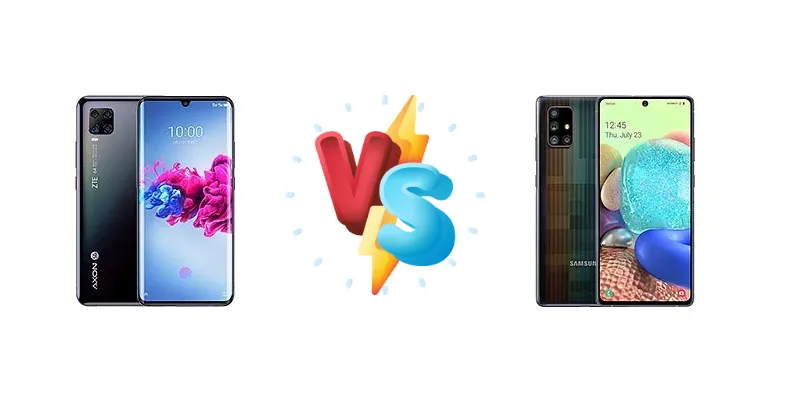
The ZTE Axon 11 4G and Samsung Galaxy A71 5G UW represent different approaches to the mid-range smartphone market. The Axon 11 4G, while older, aimed for value, while the A71 5G UW brought 5G connectivity and a more modern chipset to a wider audience. This comparison dissects their core differences to determine which device delivers the best experience.
🏆 Quick Verdict
For the average user, the Samsung Galaxy A71 5G UW is the superior choice. Its Qualcomm Snapdragon 765G chipset, built on a 7nm process, provides significantly better performance and future-proofs the device with 5G support. While the Axon 11 4G offers a potentially lower price, the performance gap is substantial.
| Network |
|---|
| 2G bands | GSM 850 / 900 / 1800 / 1900 | GSM 850 / 900 / 1800 / 1900 |
| 3G bands | HSDPA 850 / 900 / 2100 | HSDPA 850 / 900 / 1900 / 2100 |
| 4G bands | 1, 3, 5, 7, 8, 20, 28, 32, 38 | 2, 3, 4, 5, 7, 12, 13, 20, 28, 66 |
| 5G bands | - | 260, 261 SA/NSA/mmWave |
| Speed | HSPA, LTE | HSPA, LTE, 5G |
| Technology | GSM / HSPA / LTE | GSM / HSPA / LTE / 5G |
| Launch |
|---|
| Announced | 2020, June 04. Released 2020, June 17 | 2020, July 07 |
| Status | Discontinued | Available. Released 2020, July 16 |
| Body |
|---|
| Build | Glass front, glass back, aluminum frame | Glass front (Gorilla Glass 3), plastic back, aluminum frame |
| Dimensions | 159.2 x 73.4 x 7.9 mm (6.27 x 2.89 x 0.31 in) | 162.8 x 75.7 x 8.4 mm (6.41 x 2.98 x 0.33 in) |
| SIM | Nano-SIM + Nano-SIM | Nano-SIM (pre-installed) |
| Weight | 168 g (5.93 oz) | 188 g (6.63 oz) |
| Display |
|---|
| Protection | - | Corning Gorilla Glass 3 |
| Resolution | 1080 x 2340 pixels, 19.5:9 ratio (~398 ppi density) | 1080 x 2400 pixels, 20:9 ratio (~393 ppi density) |
| Size | 6.47 inches, 102.8 cm2 (~87.9% screen-to-body ratio) | 6.7 inches, 108.4 cm2 (~87.9% screen-to-body ratio) |
| Type | AMOLED | Super AMOLED Plus |
| Platform |
|---|
| CPU | Octa-core (4x2.1 GHz Cortex-A73 & 4x2.0 GHz Cortex-A53) | Octa-core (1x2.4 GHz Kryo 475 Prime & 1x2.2 GHz Kryo 475 Gold & 6x1.8 GHz Kryo 475 Silver) |
| Chipset | Mediatek MT6771 Helio P70 (12 nm) | Qualcomm SM7250 Snapdragon 765G 5G (7 nm) |
| GPU | Mali-G72 MP3 | Adreno 620 |
| OS | Android 10, MiFavor 10 | Android 10, One UI 2.1 |
| Memory |
|---|
| Card slot | microSDXC (uses shared SIM slot) | microSDXC (dedicated slot) |
| Internal | 128GB 6GB RAM | 128GB 8GB RAM |
| | eMMC 5.1 | UFS 2.1 |
| Main Camera |
|---|
| Features | Dual-LED dual-tone flash, HDR, panorama | LED flash, panorama, HDR |
| Quad | 48 MP, f/1.8, 25mm (wide), 1/2.0", 0.8µm, PDAF
8 MP, f/2.2, 120˚, 16mm (ultrawide)
2 MP (macro)
Auxiliary lens | 64 MP, f/1.8, 26mm (wide), 1/1.72", 0.8µm, PDAF
12 MP, f/2.2, 123˚ (ultrawide)
5 MP (macro)
Auxiliary lens |
| Video | 1080p@30fps; gyro-EIS | 4K@30fps, 1080p@30/240fps, 1080p@960fps; gyro-EIS |
| Selfie camera |
|---|
| Features | HDR | HDR |
| Single | 20 MP, f/2.0, (wide), 1/2.8", 1.0µm | 32 MP, f/2.2, 26mm (wide), 1/2.8", 0.8µm |
| Video | 1080p@30fps | 4K@30fps, 1080p@30fps |
| Sound |
|---|
| 3.5mm jack | No | Yes |
| 35mm jack | No | Yes |
| Loudspeaker | Yes | Yes |
| Comms |
|---|
| Bluetooth | 5.0, A2DP, LE | 5.0, A2DP, LE |
| NFC | Unspecified | No |
| Positioning | GPS, GLONASS, GALILEO, BDS | GPS, GLONASS, GALILEO, BDS |
| Radio | - | No |
| USB | USB Type-C 2.0, OTG | USB Type-C 2.0, OTG |
| WLAN | Wi-Fi 802.11 a/b/g/n/ac, dual-band, Wi-Fi Direct | Wi-Fi 802.11 a/b/g/n/ac, dual-band, Wi-Fi Direct |
| Features |
|---|
| Sensors | Fingerprint (under display, optical), accelerometer, gyro, proximity, compass | Fingerprint (under display, optical), accelerometer, gyro, proximity, compass |
| | - | ANT+ |
| Battery |
|---|
| Charging | Wired | 25W wired |
| Type | Li-Ion 4000 mAh | Li-Po 4500 mAh |
| Misc |
|---|
| Colors | White, Black | Prism Bricks Black |
| Models | - | SM-A716V |
| Price | About 280 EUR | - |
| SAR | - | 0.50 W/kg (head) 0.78 W/kg (body) |
ZTE Axon 11 4G
- Potentially lower price point
- Functional for basic smartphone tasks
- May offer expandable storage (market dependent)
- Significantly weaker performance
- Older chipset and architecture
- Lacks 5G connectivity
- Less efficient power consumption
Samsung Galaxy A71 5G UW
- Superior performance with Snapdragon 765G
- 5G connectivity for faster data speeds
- Faster 25W charging
- Likely better camera image processing
- Higher price compared to Axon 11 4G
- May have limited storage options
- Software updates may be less frequent than flagship models
Display Comparison
Neither device boasts a particularly standout display. While specific display specs (resolution, panel type) are missing for the Axon 11 4G, its market positioning suggests an LCD panel. The A71 5G UW likely features a Super AMOLED display, common for Samsung's A-series. The A71 5G UW’s AMOLED panel will offer superior contrast and color vibrancy. The absence of high refresh rates on either device means neither will deliver the fluid scrolling experience found on higher-end phones.
Camera Comparison
Without detailed camera specs, a direct comparison is limited. However, Samsung generally excels in image processing, and the A71 5G UW likely benefits from this. The Snapdragon 765G also includes an ISP (Image Signal Processor) capable of handling more complex image processing algorithms. The Axon 11 4G, relying on the Helio P70’s ISP, will likely produce less refined images, particularly in low-light conditions. The presence of OIS (Optical Image Stabilization) on the A71 5G UW, if equipped, would further enhance image quality.
Performance
The core difference lies in the chipsets. The Samsung Galaxy A71 5G UW’s Qualcomm Snapdragon 765G (7nm) is a significant leap over the ZTE Axon 11 4G’s MediaTek Helio P70 (12nm). The 7nm process node of the Snapdragon 765G translates to greater transistor density and improved power efficiency, resulting in better sustained performance and less heat generation. The Snapdragon 765G’s CPU configuration – a prime core, gold core, and silver cores – is designed for optimized performance across various workloads, while the Helio P70’s Cortex-A73/A53 combination is less efficient. This difference will be most noticeable in demanding tasks like gaming and video editing.
Battery Life
Battery capacity is not specified for either device. However, the Snapdragon 765G’s superior power efficiency gives the A71 5G UW an advantage. While the A71 5G UW supports 25W wired charging, the Axon 11 4G is limited to standard wired charging. This means the A71 5G UW will likely charge significantly faster, reducing downtime. Even with a similar battery capacity, the A71 5G UW will likely offer longer battery life due to the more efficient chipset.
Buying Guide
Buy the ZTE Axon 11 4G if your primary need is a functional smartphone for basic tasks and you are constrained by a very tight budget, and 5G connectivity is not a priority. Buy the Samsung Galaxy A71 5G UW if you prioritize smoother multitasking, gaming, and the benefits of 5G connectivity, even if it means spending a bit more. The A71 5G UW is the better long-term investment.
Frequently Asked Questions
❓ Will the Snapdragon 765G in the A71 5G UW handle demanding games like PUBG or Call of Duty Mobile smoothly?
Yes, the Snapdragon 765G is capable of running PUBG and Call of Duty Mobile at medium to high settings with stable frame rates. While it's not a flagship-level gaming chip, it provides a significantly better gaming experience than the Helio P70 in the Axon 11 4G.
❓ Does the 5G connectivity on the A71 5G UW actually make a noticeable difference in everyday use?
The benefit of 5G depends on network availability in your area. If you have access to a robust 5G network, you'll experience significantly faster download and upload speeds, as well as lower latency, which is particularly beneficial for streaming, gaming, and video calls. However, if 5G coverage is limited, you'll primarily be using 4G LTE.
❓ Is the difference in performance between the Helio P70 and Snapdragon 765G noticeable for everyday tasks like browsing and social media?
While both phones can handle basic tasks, the Snapdragon 765G provides a much smoother and more responsive experience. Multitasking, app loading times, and overall system fluidity will be noticeably faster on the A71 5G UW. The Helio P70 may exhibit occasional lag or stuttering with multiple apps open.