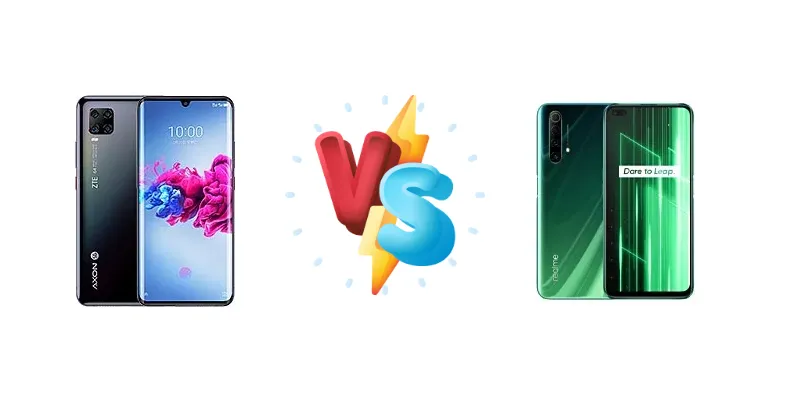
The ZTE Axon 11 4G and Realme X50 5G represent distinct approaches to the mid-range smartphone market. The Axon 11 prioritizes value and a clean software experience within a 4G framework, while the X50 5G aggressively targets future-proofing with 5G connectivity and a more powerful chipset. This comparison dissects their key differences to determine which device best suits your needs.
🏆 Quick Verdict
For most users, the Realme X50 5G is the superior choice. Its Qualcomm Snapdragon 765G chipset, built on a 7nm process, delivers significantly better performance and efficiency than the ZTE Axon 11’s MediaTek Helio P70. The inclusion of 30W fast charging is a further advantage, despite the Axon 11’s potential for longer software support.
| Network |
|---|
| 2G bands | GSM 850 / 900 / 1800 / 1900 | GSM 850 / 900 / 1800 / 1900 |
| 3G bands | HSDPA 850 / 900 / 2100 | HSDPA 850 / 900 / 1700 / 1900 / 2100 |
| 4G bands | 1, 3, 5, 7, 8, 20, 28, 32, 38 | 1, 2, 3, 4, 5, 7, 8, 34, 38, 39, 40, 41 |
| 5G bands | - | 1, 3, 5, 7, 8, 20, 28, 38, 40, 41, 77, 78 SA/NSA |
| Speed | HSPA, LTE | HSPA, LTE, 5G |
| Technology | GSM / HSPA / LTE | GSM / CDMA / HSPA / EVDO / LTE / 5G |
| | - | CDMA2000 1xEV-DO |
| Launch |
|---|
| Announced | 2020, June 04. Released 2020, June 17 | 2020, July 08. Released 2020, July 08 |
| Status | Discontinued | Discontinued |
| Body |
|---|
| Build | Glass front, glass back, aluminum frame | - |
| Dimensions | 159.2 x 73.4 x 7.9 mm (6.27 x 2.89 x 0.31 in) | 163.8 x 75.8 x 8.9 mm (6.45 x 2.98 x 0.35 in) |
| SIM | Nano-SIM + Nano-SIM | Nano-SIM + Nano-SIM |
| Weight | 168 g (5.93 oz) | 194 g (6.84 oz) |
| Display |
|---|
| Resolution | 1080 x 2340 pixels, 19.5:9 ratio (~398 ppi density) | 1080 x 2400 pixels, 20:9 ratio (~401 ppi density) |
| Size | 6.47 inches, 102.8 cm2 (~87.9% screen-to-body ratio) | 6.57 inches, 104.2 cm2 (~83.9% screen-to-body ratio) |
| Type | AMOLED | IPS LCD, 120Hz |
| Platform |
|---|
| CPU | Octa-core (4x2.1 GHz Cortex-A73 & 4x2.0 GHz Cortex-A53) | Octa-core (1x2.4 GHz Kryo 475 Prime & 1x2.2 GHz Kryo 475 Gold & 6x1.8 GHz Kryo 475 Silver) |
| Chipset | Mediatek MT6771 Helio P70 (12 nm) | Qualcomm SM7250 Snapdragon 765G 5G (7 nm) |
| GPU | Mali-G72 MP3 | Adreno 620 |
| OS | Android 10, MiFavor 10 | Android 10, Realme UI |
| Memory |
|---|
| Card slot | microSDXC (uses shared SIM slot) | No |
| Internal | 128GB 6GB RAM | 128GB 6GB RAM, 128GB 8GB RAM |
| | eMMC 5.1 | UFS 2.1 |
| Main Camera |
|---|
| Features | Dual-LED dual-tone flash, HDR, panorama | LED flash, HDR, panorama |
| Quad | 48 MP, f/1.8, 25mm (wide), 1/2.0", 0.8µm, PDAF
8 MP, f/2.2, 120˚, 16mm (ultrawide)
2 MP (macro)
Auxiliary lens | 48 MP, f/1.8, 25mm (wide), 1/2.0", 0.8µm, PDAF
8 MP, f/2.3, 16mm (ultrawide), 1/4.0", 1.12µm
2 MP (macro)
Auxiliary lens |
| Video | 1080p@30fps; gyro-EIS | 4K@30fps, 1080p@30/60fps; gyro-EIS |
| Selfie camera |
|---|
| Dual | - | 16 MP, f/2.0, 26mm (wide), 1/3.06", 1.0µm
2 MP, f/2.4, (depth) |
| Features | HDR | HDR |
| Single | 20 MP, f/2.0, (wide), 1/2.8", 1.0µm | - |
| Video | 1080p@30fps | 1080p@30/120fps |
| Sound |
|---|
| 3.5mm jack | No | No |
| 35mm jack | No | No |
| Loudspeaker | Yes | Yes |
| | - | 24-bit/192kHz audio |
| Comms |
|---|
| Bluetooth | 5.0, A2DP, LE | 5.0, A2DP, LE |
| NFC | Unspecified | Yes |
| Positioning | GPS, GLONASS, GALILEO, BDS | GPS, GLONASS, BDS |
| Radio | - | FM radio |
| USB | USB Type-C 2.0, OTG | USB Type-C 2.0 |
| WLAN | Wi-Fi 802.11 a/b/g/n/ac, dual-band, Wi-Fi Direct | Wi-Fi 802.11 a/b/g/n/ac, dual-band, Wi-Fi Direct |
| Features |
|---|
| Sensors | Fingerprint (under display, optical), accelerometer, gyro, proximity, compass | Fingerprint (side-mounted), accelerometer, gyro, proximity, compass |
| Battery |
|---|
| Charging | Wired | 30W wired, 70% in 30 min |
| Type | Li-Ion 4000 mAh | 4200 mAh |
| Misc |
|---|
| Colors | White, Black | Jungle Green, Ice Silver |
| Models | - | RMX2144 |
| Price | About 280 EUR | About 500 EUR |
ZTE Axon 11 4G
- Potentially longer software support due to simpler hardware.
- May offer a more streamlined software experience.
- Likely more affordable price point.
- Significantly weaker performance compared to the Snapdragon 765G.
- Lacks 5G connectivity.
- Slower charging speeds.
Realme X50 5G
- Faster and more efficient Snapdragon 765G chipset.
- 5G connectivity for future-proofing.
- 30W fast charging for quick top-ups.
- Potentially shorter software support lifecycle.
- May have more pre-installed bloatware (typical of Realme).
- Higher price compared to the Axon 11.
Display Comparison
Neither device boasts a standout display. While specific panel details (like peak brightness or color gamut coverage) are absent, the core difference lies in the underlying processing power needed to drive them. The more capable Snapdragon 765G in the Realme X50 5G will likely handle complex display tasks, like HDR content, with greater ease. Bezels are likely comparable given the market segment, and both will likely utilize IPS LCD panels.
Camera Comparison
Without detailed camera specs, a direct comparison is difficult. However, the processing power of the Snapdragon 765G in the Realme X50 5G will likely enable more advanced image processing algorithms, potentially resulting in better dynamic range and low-light performance. The Axon 11’s Helio P70 will be limited in its ability to handle complex computational photography tasks. The absence of OIS information suggests both phones may rely heavily on software stabilization.
Performance
The performance gap is the most significant differentiator. The Realme X50 5G’s Qualcomm Snapdragon 765G (7nm) is a substantial upgrade over the ZTE Axon 11’s MediaTek Helio P70 (12nm). The 7nm process allows for higher transistor density and improved power efficiency, translating to better sustained performance and less thermal throttling. The Snapdragon 765G’s Kryo CPU architecture (1x2.4 GHz Prime, 1x2.2 GHz Gold, 6x1.8 GHz Silver) is also more sophisticated than the Helio P70’s Cortex-A73/A53 configuration, offering superior single-core and multi-core performance. This benefits demanding applications, gaming, and multitasking.
Battery Life
The Realme X50 5G’s 30W fast charging is a clear advantage, promising a 70% charge in just 30 minutes. While the Axon 11 offers only wired charging, its battery capacity is not specified. The Snapdragon 765G’s superior power efficiency will also contribute to longer battery life in the X50 5G, even if the Axon 11 has a slightly larger battery. The faster charging speed of the X50 5G significantly reduces downtime.
Buying Guide
Buy the ZTE Axon 11 4G if you primarily need a reliable smartphone for everyday tasks, prioritize a clean software experience, and don't require 5G connectivity. Buy the Realme X50 5G if you want a faster, more future-proof device capable of handling demanding games and applications, and you plan to leverage 5G networks when available. The X50 5G is the better option for power users and mobile gamers.
Frequently Asked Questions
❓ Will the Realme X50 5G's 5G connectivity actually make a difference in my daily use?
Currently, 5G coverage is limited. However, the Realme X50 5G future-proofs your investment. As 5G networks expand, you'll experience significantly faster download and upload speeds, lower latency, and a more responsive online experience. If you live in or frequently travel to areas with 5G coverage, the X50 5G offers a tangible benefit.
❓ Is the MediaTek Helio P70 in the ZTE Axon 11 4G sufficient for playing popular mobile games like PUBG or Call of Duty?
The Helio P70 can handle less demanding games, but you'll likely experience reduced graphics settings and potential frame rate drops in more graphically intensive titles like PUBG or Call of Duty. The Snapdragon 765G in the Realme X50 5G provides a much smoother and more consistent gaming experience.
❓ How does the software experience differ between the ZTE Axon 11 4G and the Realme X50 5G?
ZTE typically offers a cleaner, closer-to-stock Android experience, while Realme's UI (based on ColorOS) is more heavily customized and often includes pre-installed apps (bloatware). If you prefer a minimalist interface and greater control over your device, the Axon 11 is likely the better choice. If you don't mind a more feature-rich, but potentially cluttered, interface, the X50 5G is acceptable.