
Motorola Edge 70 vs ZTE Axon 11 4G: A Generational Leap in Performance and Efficiency
| Phones Images | |||||
|---|---|---|---|---|---|
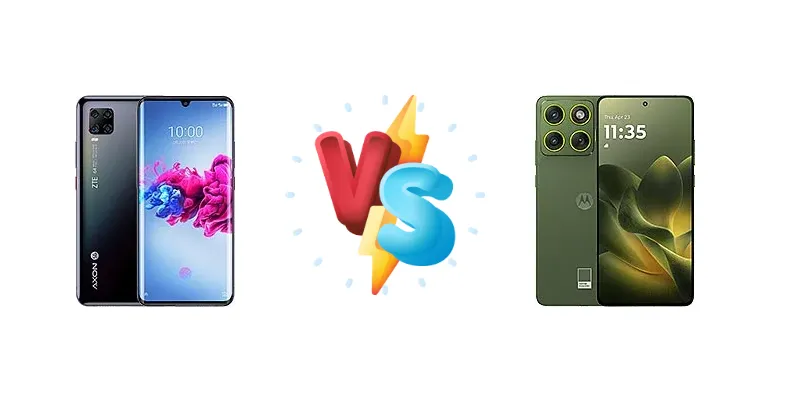
|
🏆 Quick Verdict
For the vast majority of users, the Motorola Edge 70 is the clear winner. Its Snapdragon 7 Gen 4 chipset offers a substantial performance boost over the Axon 11 4G’s Helio P70, coupled with significantly faster 68W wired and 15W wireless charging. While the Axon 11 4G may appeal to those on a very tight budget, the Edge 70 provides a far more future-proof and enjoyable experience.
| PHONES | ||
|---|---|---|
| Phone Names | ZTE Axon 11 4G | Motorola Edge 70 |
| Network | ||
|---|---|---|
| 2G bands | GSM 850 / 900 / 1800 / 1900 | GSM 850 / 900 / 1800 / 1900 |
| 3G bands | HSDPA 850 / 900 / 2100 | HSDPA 850 / 900 / 1700(AWS) / 1900 / 2100 |
| 4G bands | 1, 3, 5, 7, 8, 20, 28, 32, 38 | 1, 2, 3, 4, 5, 7, 8, 12, 13, 17, 18, 19, 20, 25, 26, 28, 32, 34, 38, 39, 40, 41, 42, 43, 48, 66 |
| 5G bands | - | 1, 2, 3, 5, 7, 8, 20, 26, 28, 38, 40, 41, 66, 75, 77, 78 SA/NSA/Sub6 |
| Speed | HSPA, LTE | HSPA, LTE, 5G |
| Technology | GSM / HSPA / LTE | GSM / CDMA / HSPA / LTE / 5G |
| Launch | ||
|---|---|---|
| Announced | 2020, June 04. Released 2020, June 17 | 2025, October 29 |
| Status | Discontinued | Available. Released 2025, October 29 |
| Body | ||
|---|---|---|
| Build | Glass front, glass back, aluminum frame | Glass front (Gorilla Glass 7i), aluminum frame |
| Dimensions | 159.2 x 73.4 x 7.9 mm (6.27 x 2.89 x 0.31 in) | 159.9 x 74 x 6 mm (6.30 x 2.91 x 0.24 in) |
| SIM | Nano-SIM + Nano-SIM | · Nano-SIM + eSIM - International· Nano-SIM + Nano-SIM - China |
| Weight | 168 g (5.93 oz) | 159 g (5.61 oz) |
| Display | ||
|---|---|---|
| Protection | - | Corning Gorilla Glass 7i, Mohs level 4 |
| Resolution | 1080 x 2340 pixels, 19.5:9 ratio (~398 ppi density) | 1220 x 2712 pixels, 20:9 ratio (~446 ppi density) |
| Size | 6.47 inches, 102.8 cm2 (~87.9% screen-to-body ratio) | 6.7 inches, 107.4 cm2 (~90.8% screen-to-body ratio) |
| Type | AMOLED | P-OLED, 1B colors, 120Hz, PWM, HDR10+, 4500 nits (peak) |
| Platform | ||
|---|---|---|
| CPU | Octa-core (4x2.1 GHz Cortex-A73 & 4x2.0 GHz Cortex-A53) | Octa-core (1x2.8 GHz Cortex-720 & 4x2.4 GHz Cortex-720 & 3x1.8 GHz Cortex-520) |
| Chipset | Mediatek MT6771 Helio P70 (12 nm) | Qualcomm SM7750-AB Snapdragon 7 Gen 4 (4 nm) |
| GPU | Mali-G72 MP3 | Adreno 722 |
| OS | Android 10, MiFavor 10 | Android 16, up to 4 major Android upgrades |
| Memory | ||
|---|---|---|
| Card slot | microSDXC (uses shared SIM slot) | No |
| Internal | 128GB 6GB RAM | 256GB 12GB RAM, 512GB 12GB RAM |
| eMMC 5.1 | - | |
| Main Camera | ||
|---|---|---|
| Dual | - | 50 MP, f/1.8, 24mm (wide), 1/1.56", 1.0µm, multi-directional PDAF, OIS 50 MP, f/2.0, 12mm, 120˚ (ultrawide), 1/2.76", 0.64µm, PDAF |
| Features | Dual-LED dual-tone flash, HDR, panorama | LED flash, HDR, panorama |
| Quad | 48 MP, f/1.8, 25mm (wide), 1/2.0", 0.8µm, PDAF 8 MP, f/2.2, 120˚, 16mm (ultrawide) 2 MP (macro) Auxiliary lens | - |
| Video | 1080p@30fps; gyro-EIS | 4K@30/60fps, 1080p@30/60/120/240fps, gyro-EIS |
| Selfie camera | ||
|---|---|---|
| Features | HDR | HDR |
| Single | 20 MP, f/2.0, (wide), 1/2.8", 1.0µm | 50 MP, f/2.0, (wide), 0.64µm |
| Video | 1080p@30fps | 4K@30fps, 1080p@30/120fps |
| Sound | ||
|---|---|---|
| 3.5mm jack | No | - |
| 35mm jack | No | No |
| Loudspeaker | Yes | Yes, with stereo speakers (with Dolby Atmos) |
| Comms | ||
|---|---|---|
| Bluetooth | 5.0, A2DP, LE | 5.4, A2DP, LE |
| NFC | Unspecified | Yes |
| Positioning | GPS, GLONASS, GALILEO, BDS | GPS, GALILEO, GLONASS, BDS, QZSS |
| Radio | - | No |
| USB | USB Type-C 2.0, OTG | USB Type-C 2.0, OTG |
| WLAN | Wi-Fi 802.11 a/b/g/n/ac, dual-band, Wi-Fi Direct | Wi-Fi 802.11 a/b/g/n/ac/6e, dual-band or tri-band |
| Features | ||
|---|---|---|
| Sensors | Fingerprint (under display, optical), accelerometer, gyro, proximity, compass | Fingerprint (under display, optical), accelerometer, gyro, proximity, compass |
| Battery | ||
|---|---|---|
| Charging | Wired | 68W wired 15W wireless |
| Type | Li-Ion 4000 mAh | Si/C Li-Ion 4800 mAh |
| Misc | ||
|---|---|---|
| Colors | White, Black | Pantone: Gadget Gray, Lily Pad, Bronze Green |
| Models | - | XT2601-2, XT2603-2 |
| Price | About 280 EUR | £ 799.00 |
| EU LABEL | ||
|---|---|---|
| Battery | - | 50:14h endurance, 1000 cycles |
| Energy | - | Class A |
| Free fall | - | Class A (270 falls) |
| Repairability | - | Class B |
ZTE Axon 11 4G
- Potentially lower price point
- May be sufficient for basic smartphone tasks
- Simple, straightforward user experience (assumed)
- Outdated chipset (Helio P70)
- Slower charging speeds
- Likely inferior camera performance
- Potential for performance throttling
Motorola Edge 70
- Significantly faster Snapdragon 7 Gen 4 chipset
- 68W wired and 15W wireless charging
- Longer battery life and endurance
- Improved image processing capabilities
- Higher price point
- May have features not needed by all users
- Potential for software bloat (Motorola's history)
Display Comparison
While display specifications aren't provided for the Axon 11 4G, it's reasonable to assume a standard LCD panel given its market positioning. The Motorola Edge 70, however, benefits from a more modern display technology, though specifics are missing. The key differentiator here is likely to be color accuracy and brightness. The Edge 70’s potential for a higher peak brightness would translate to better visibility in direct sunlight, a common pain point for LCD-equipped phones.
Camera Comparison
Without detailed camera specs for either device, a direct comparison is limited. However, the Motorola Edge 70 likely benefits from Qualcomm’s image signal processor (ISP) integrated within the Snapdragon 7 Gen 4, offering improved image processing capabilities. The Axon 11 4G’s ISP, tied to the Helio P70, is less advanced. The Edge 70’s potential for better low-light performance and dynamic range is therefore higher. We can assume the Edge 70 will have more advanced computational photography features.
Performance
The performance gap between the Mediatek Helio P70 (12nm) and the Qualcomm Snapdragon 7 Gen 4 (4nm) is substantial. The Snapdragon 7 Gen 4’s newer architecture – featuring a Cortex-720 prime core and a more efficient 4nm process – delivers significantly improved CPU and GPU performance. The Axon 11 4G’s Cortex-A73 cores, while capable, are several generations behind. This translates to faster app loading times, smoother multitasking, and a more responsive overall experience on the Edge 70. The 4nm process also contributes to better thermal management, reducing the likelihood of performance throttling during extended use.
Battery Life
The Motorola Edge 70 boasts a significant advantage in charging speed with its 68W wired and 15W wireless capabilities, compared to the Axon 11 4G’s wired-only charging. The Edge 70’s reported 50:14h endurance and 13:36h active use score demonstrate a focus on battery life. While the Axon 11 4G’s battery capacity is unknown, the Edge 70’s faster charging allows for quick top-ups, minimizing downtime. The 1000 cycle rating on the Edge 70 also suggests a longer lifespan for the battery itself.
Buying Guide
Buy the ZTE Axon 11 4G if you prioritize absolute affordability and are willing to compromise on performance and charging speed for basic smartphone tasks. Buy the Motorola Edge 70 if you value a responsive user experience, fast charging, and longer battery life, even if it means spending a bit more upfront. The Edge 70 is ideal for users who multitask, game occasionally, or simply want a phone that keeps up with their daily demands.