
ZTE Axon 11 4G vs. Google Pixel 4a 5G: A Detailed Comparison of Mid-Range Contenders
| Phones Images | |||||
|---|---|---|---|---|---|
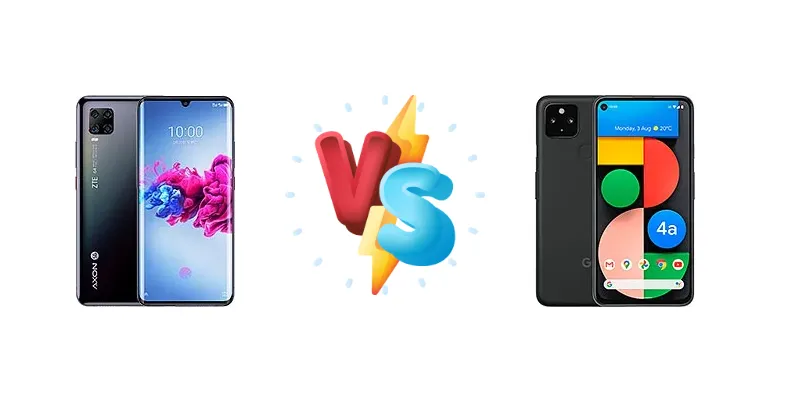
|
🏆 Quick Verdict
For the average user prioritizing camera quality, software experience, and future-proofing with 5G, the Google Pixel 4a 5G is the clear winner. However, the ZTE Axon 11 4G remains a viable option for those on a tighter budget who don't require 5G or Google's computational photography.
| PHONES | ||
|---|---|---|
| Phone Names | ZTE Axon 11 4G | Google Pixel 4a 5G |
| Network | ||
|---|---|---|
| 2G bands | GSM 850 / 900 / 1800 / 1900 | GSM 850 / 900 / 1800 / 1900 |
| 3G bands | HSDPA 850 / 900 / 2100 | HSDPA 850 / 900 / 1700(AWS) / 1900 / 2100 |
| 4G bands | 1, 3, 5, 7, 8, 20, 28, 32, 38 | 1, 2, 3, 4, 5, 7, 8, 12, 13, 14, 17, 18, 19, 20, 25, 26, 28, 29, 30, 32, 38, 39, 40, 41, 42, 46, 48, 66, 71 |
| 5G bands | - | 1, 2, 3, 5, 7, 8, 12, 28, 41, 66, 71, 77, 78 Sub6, mmWave (market dependant) |
| Speed | HSPA, LTE | HSPA, LTE, 5G |
| Technology | GSM / HSPA / LTE | GSM / HSPA / LTE / 5G |
| Launch | ||
|---|---|---|
| Announced | 2020, June 04. Released 2020, June 17 | 2020, September 30 |
| Status | Discontinued | Available. Released 2020, November 05 |
| Body | ||
|---|---|---|
| Build | Glass front, glass back, aluminum frame | Glass front (Gorilla Glass 3), plastic back, plastic frame |
| Dimensions | 159.2 x 73.4 x 7.9 mm (6.27 x 2.89 x 0.31 in) | 153.9 x 74 x 8.2 mm (Sub-6) or 8.5 mm (Sub-6 and mmWave) |
| SIM | Nano-SIM + Nano-SIM | Nano-SIM + eSIM |
| Weight | 168 g (5.93 oz) | 168 g (5G Sub-6); 171 g ( 5G Sub-6 and mmWave) (5.93 oz) |
| Display | ||
|---|---|---|
| Protection | - | Corning Gorilla Glass 3 |
| Resolution | 1080 x 2340 pixels, 19.5:9 ratio (~398 ppi density) | 1080 x 2340 pixels, 19.5:9 ratio (~413 ppi density) |
| Size | 6.47 inches, 102.8 cm2 (~87.9% screen-to-body ratio) | 6.2 inches, 95.7 cm2 (~84.1% screen-to-body ratio) |
| Type | AMOLED | OLED, HDR |
| - | Always-on display | |
| Platform | ||
|---|---|---|
| CPU | Octa-core (4x2.1 GHz Cortex-A73 & 4x2.0 GHz Cortex-A53) | Octa-core (1x2.4 GHz Kryo 475 Prime & 1x2.2 GHz Kryo 475 Gold & 6x1.8 GHz Kryo 475 Silver) |
| Chipset | Mediatek MT6771 Helio P70 (12 nm) | Qualcomm SM7250 Snapdragon 765G 5G (7 nm) |
| GPU | Mali-G72 MP3 | Adreno 620 |
| OS | Android 10, MiFavor 10 | Android 11, upgradable to Android 14 |
| Memory | ||
|---|---|---|
| Card slot | microSDXC (uses shared SIM slot) | No |
| Internal | 128GB 6GB RAM | 128GB 6GB RAM |
| eMMC 5.1 | UFS 2.1 | |
| Main Camera | ||
|---|---|---|
| Dual | - | 12.2 MP, f/1.7, 27mm (wide), 1/2.55", 1.4µm, dual pixel PDAF, OIS 16 MP, f/2.2, 107˚ (ultrawide), 1.0µm |
| Features | Dual-LED dual-tone flash, HDR, panorama | LED flash, Pixel Shift, Auto-HDR, panorama |
| Quad | 48 MP, f/1.8, 25mm (wide), 1/2.0", 0.8µm, PDAF 8 MP, f/2.2, 120˚, 16mm (ultrawide) 2 MP (macro) Auxiliary lens | - |
| Video | 1080p@30fps; gyro-EIS | 4K@30/60fps, 1080p@30/60/120/240fps; gyro-EIS |
| Selfie camera | ||
|---|---|---|
| Features | HDR | HDR |
| Single | 20 MP, f/2.0, (wide), 1/2.8", 1.0µm | 8 MP, f/2.0, 24mm (wide), 1/4.0", 1.12µm |
| Video | 1080p@30fps | 1080p@30fps |
| Sound | ||
|---|---|---|
| 3.5mm jack | No | Yes |
| 35mm jack | No | Yes |
| Loudspeaker | Yes | Yes, with stereo speakers |
| Comms | ||
|---|---|---|
| Bluetooth | 5.0, A2DP, LE | 5.0, A2DP, LE, aptX HD |
| NFC | Unspecified | Yes |
| Positioning | GPS, GLONASS, GALILEO, BDS | GPS, GLONASS, GALILEO, QZSS, BDS |
| Radio | - | No |
| USB | USB Type-C 2.0, OTG | USB Type-C 3.1 |
| WLAN | Wi-Fi 802.11 a/b/g/n/ac, dual-band, Wi-Fi Direct | Wi-Fi 802.11 a/b/g/n/ac, dual-band, Wi-Fi Direct |
| Features | ||
|---|---|---|
| Sensors | Fingerprint (under display, optical), accelerometer, gyro, proximity, compass | Fingerprint (rear-mounted), accelerometer, gyro, proximity, compass, barometer |
| Battery | ||
|---|---|---|
| Charging | Wired | 18W wired, PD2.0 |
| Type | Li-Ion 4000 mAh | Li-Po 3885 mAh |
| Misc | ||
|---|---|---|
| Colors | White, Black | Just Black, Clearly White |
| Models | - | GD1YQ, G025I, G025E, G025H, G6QU3 |
| Price | About 280 EUR | About 140 EUR |
ZTE Axon 11 4G
- Potentially lower price point
- Decent performance for basic tasks
- Functional smartphone experience
- Older and less efficient chipset
- Inferior camera performance
- No 5G connectivity
Google Pixel 4a 5G
- Superior performance with Snapdragon 765G
- Excellent camera quality with Google’s software
- 5G connectivity for faster data speeds
- Higher price point
- Battery life may be slightly shorter under heavy use
- May not be significantly faster for very basic tasks
Display Comparison
While specific display specs for the Axon 11 4G are not provided, it's reasonable to assume it utilizes an AMOLED panel, common for the price bracket. The Pixel 4a 5G features a 6.2-inch OLED display. The key differentiator lies in the underlying chipsets impacting graphics processing, which will affect visual fidelity in games and videos. The Pixel 4a 5G’s Snapdragon 765G, with its Adreno 620 GPU, will deliver a smoother experience than the Axon 11 4G’s Helio P70 and its Mali-G72 MP3 GPU. The 7nm process of the Snapdragon also contributes to better power efficiency during display usage.
Camera Comparison
The Pixel 4a 5G’s camera system benefits immensely from Google’s renowned computational photography. While specific sensor details aren't provided for the Axon 11 4G, the Pixel 4a 5G’s image processing algorithms excel in dynamic range, low-light performance, and overall image quality. The Snapdragon 765G’s ISP (Image Signal Processor) is also more advanced, enabling features like faster image processing and better video stabilization. The Pixel 4a 5G’s focus on software optimization will consistently deliver more pleasing results, even with potentially similar hardware.
Performance
The performance gap between these two phones is significant. The Qualcomm Snapdragon 765G (7nm) in the Pixel 4a 5G is a substantial upgrade over the MediaTek Helio P70 (12nm) found in the Axon 11 4G. The Snapdragon 765G’s Kryo CPU architecture – a prime core, a gold core, and six silver cores – offers a more balanced and efficient performance profile. The Helio P70’s Cortex-A73 and A53 cores, while capable, are older and less efficient. This translates to faster app loading times, smoother multitasking, and better gaming performance on the Pixel 4a 5G. The 7nm process node of the Snapdragon also generates less heat, reducing the likelihood of performance throttling during sustained workloads.
Battery Life
Battery capacity isn't specified for the Axon 11 4G, but the Pixel 4a 5G packs a 3885 mAh battery. The Pixel 4a 5G also supports 18W wired charging with PD2.0, offering faster and more efficient charging compared to the Axon 11 4G’s unspecified wired charging. The Snapdragon 765G’s 7nm process contributes to better power efficiency, potentially offsetting the Pixel 4a 5G’s slightly larger battery requirement due to 5G connectivity. Users prioritizing all-day battery life and quick top-ups will find the Pixel 4a 5G more appealing.
Buying Guide
Buy the ZTE Axon 11 4G if you need a functional smartphone with a decent display and are primarily concerned with minimizing cost. It's a good choice for basic users who don't heavily rely on demanding apps or mobile gaming. Buy the Google Pixel 4a 5G if you prioritize a superior camera experience, a clean and regularly updated Android experience, and the benefits of 5G connectivity, even if it means spending a bit more.