
ZTE Axon 10s Pro 5G vs Xiaomi Mi 10 Pro 5G: A Detailed Comparison
| Phones Images | |||||
|---|---|---|---|---|---|
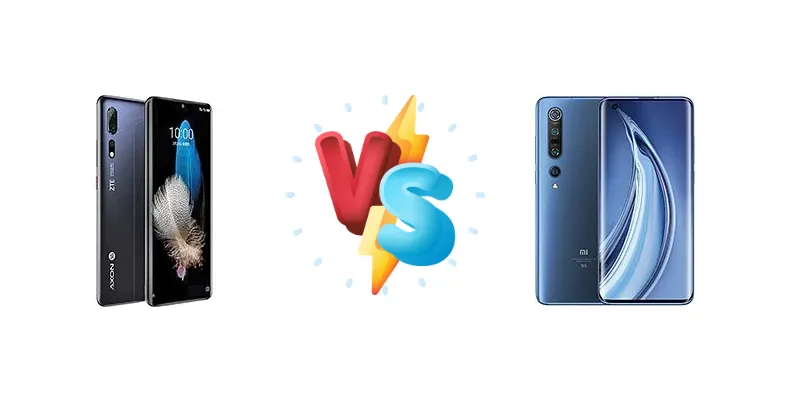
|
🏆 Quick Verdict
For the average user prioritizing fast charging and a brighter, more vibrant display, the Xiaomi Mi 10 Pro 5G is the clear winner. While the ZTE Axon 10s Pro 5G offers a solid experience, Xiaomi’s superior charging speeds (50W wired, 30W wireless) and 858 nit display brightness provide a tangible advantage.
| PHONES | ||
|---|---|---|
| Phone Names | ZTE Axon 10s Pro 5G | Xiaomi Mi 10 Pro 5G |
| Network | ||
|---|---|---|
| 2G bands | GSM 850 / 900 / 1800 / 1900 | GSM 850 / 900 / 1800 / 1900 |
| 3G bands | HSDPA 850 / 900 / 1700(AWS) / 1900 / 2100 | HSDPA 850 / 900 / 1700(AWS) / 1900 / 2100 |
| 4G bands | 1, 2, 3, 4, 5, 7, 8, 12, 13, 17, 18, 19, 20, 26, 28, 34, 38, 39, 40, 41 | 1, 2, 3, 4, 5, 7, 8, 20, 28, 32, 38, 40 - Global |
| 5G bands | 41, 78 SA/NSA | 1, 3, 7, 28, 77, 78 Sub6 - Global |
| Speed | HSPA, LTE, 5G (2+ Gbps DL) | HSPA, LTE, 5G (2+ Gbps DL) |
| Technology | GSM / CDMA / HSPA / LTE / 5G | GSM / HSPA / LTE / 5G |
| CDMA 800 / 1900 & TD-SCDMA | 1, 3, 41, 78, 79 SA/NSA - China | |
| Launch | ||
|---|---|---|
| Announced | 2020, February 06 | 2020, February 13. Released 2020, February 18 |
| Status | Discontinued | Discontinued |
| Body | ||
|---|---|---|
| Build | Glass front, glass back, aluminum frame | Glass front (Gorilla Glass 5), glass back, aluminum frame |
| Dimensions | 159.2 x 73.4 x 7.9 mm (6.27 x 2.89 x 0.31 in) | 162.5 x 74.8 x 9 mm (6.40 x 2.94 x 0.35 in) |
| SIM | Nano-SIM + Nano-SIM | · Nano-SIM· Nano-SIM + Nano-SIM |
| Weight | 175 g (6.17 oz) | 208 g (7.34 oz) |
| Display | ||
|---|---|---|
| Protection | - | Corning Gorilla Glass 5 |
| Resolution | 1080 x 2340 pixels, 19.5:9 ratio (~398 ppi density) | 1080 x 2340 pixels, 19.5:9 ratio (~386 ppi density) |
| Size | 6.47 inches, 102.8 cm2 (~87.9% screen-to-body ratio) | 6.67 inches, 109.2 cm2 (~89.8% screen-to-body ratio) |
| Type | AMOLED, HDR10 | Super AMOLED, 90Hz, HDR10+, 500 nits (typ) |
| Platform | ||
|---|---|---|
| CPU | Octa-core (1x2.84 GHz Cortex-A77 & 3x2.42 GHz Cortex-A77 & 4x1.80 GHz Cortex-A55) | Octa-core (1x2.84 GHz Cortex-A77 & 3x2.42 GHz Cortex-A77 & 4x1.80 GHz Cortex-A55) |
| Chipset | Qualcomm SM8250 Snapdragon 865 5G (7 nm+) | Qualcomm SM8250 Snapdragon 865 5G (7 nm+) |
| GPU | Adreno 650 | Adreno 650 |
| OS | Android 10, MiFavor 10 | Android 10, upgradable to Android 13, MIUI 14 |
| Memory | ||
|---|---|---|
| Card slot | microSDXC (uses shared SIM slot) | No |
| Internal | 128GB 6GB RAM, 256GB 12GB RAM | 256GB 8GB RAM, 256GB 12GB RAM, 512GB 12GB RAM |
| UFS 3.0 | UFS 3.0 | |
| Main Camera | ||
|---|---|---|
| Features | Dual-LED dual-tone flash, HDR, panorama | Laser AF, Triple-LED dual-tone flash, HDR, panorama |
| Quad | - | 108 MP, f/1.7, (wide), 1/1.33", 0.8µm, PDAF, OIS 12 MP, f/2.0, 50mm (telephoto), 1/2.55", 1.4µm, dual pixel PDAF, 2x optical zoom 8 MP, f/2.0, (telephoto), 1.0µm, PDAF, OIS, 3.7x optical zoom, 5x hybrid zoom 20 MP, f/2.2, 13mm (ultrawide), 1/2.8", 1.0µm |
| Triple | 48 MP, f/1.7, 28mm (wide), 1/2.0", 0.8µm, PDAF, OIS 8 MP, f/2.4, 80mm (telephoto), PDAF, OIS, 3x optical zoom 20 MP, f/2.2, 125˚, 16mm (ultrawide) | - |
| Video | 4K@30fps, 1080p@30fps | 8K@30fps, 4K@30/60fps, 1080p@30/60/120/240/960fps; gyro-EIS |
| Selfie camera | ||
|---|---|---|
| Features | HDR | HDR |
| Single | 20 MP, f/2.0, (wide), 1/2.8", 1.0µm | 20 MP, f/2.0, (wide), 1/3", 0.9µm |
| Video | 1080p@30fps | 1080p@30fps, 720p@120fps |
| Sound | ||
|---|---|---|
| 3.5mm jack | No | No |
| 35mm jack | No | No |
| Loudspeaker | Yes, with stereo speakers | Yes, with stereo speakers |
| 24-bit/192kHz audio | 24-bit/192kHz audio | |
| Comms | ||
|---|---|---|
| Bluetooth | 5.0, A2DP, LE | 5.1, A2DP, LE, aptX HD, aptX Adaptive |
| Infrared port | - | Yes |
| NFC | Yes | Yes |
| Positioning | GPS, GLONASS, GALILEO, BDS | GPS (L1+L5), GLONASS (G1), BDS (B1), GALILEO (E1+E5a) |
| Radio | No | No |
| USB | USB Type-C 2.0 | USB Type-C 2.0, OTG |
| WLAN | Wi-Fi 802.11 a/b/g/n/ac/6, dual-band, Wi-Fi Direct | Wi-Fi 802.11 a/b/g/n/ac/6, dual-band, Wi-Fi Direct, DLNA |
| Features | ||
|---|---|---|
| Sensors | Fingerprint (under display, optical), accelerometer, gyro, proximity, compass | Fingerprint (under display, optical), accelerometer, gyro, compass, barometer |
| - | Virtual proximity sensing | |
| Battery | ||
|---|---|---|
| Charging | 18W wired, QC4 Wireless (Qi) | 50W wired, PD3.0 30W wireless 5W reverse wireless |
| Type | Li-Ion 4000 mAh, non-removable | Li-Po 4500 mAh |
| Misc | ||
|---|---|---|
| Colors | Blue, Black | Alpine White, Solstice Grey |
| Models | - | M2001J1G |
| Price | - | About 930 EUR |
| SAR | - | 1.09 W/kg (head) 1.02 W/kg (body) |
| SAR EU | - | 0.69 W/kg (head) 0.99 W/kg (body) |
| Tests | ||
|---|---|---|
| Battery life | - | Endurance rating 101h |
| Camera | - | Photo / Video |
| Display | - | Contrast ratio: Infinite (nominal) |
| Loudspeaker | - | -25.2 LUFS (Very good) |
| Performance | - | AnTuTu: 595246 (v8) GeekBench: 3331 (v5.1) GFXBench: 42fps (ES 3.1 onscreen) |
ZTE Axon 10s Pro 5G
- Clean software experience (likely)
- Understated design
- 5G connectivity
- Slow charging speeds (18W)
- Less bright display
- Limited camera details
Xiaomi Mi 10 Pro 5G
- Extremely fast charging (50W wired, 30W wireless)
- Bright and vibrant display (858 nits)
- Advanced camera features (likely)
- MIUI software can be polarizing
- Larger and heavier design
- Potential for software bloat
Display Comparison
The Xiaomi Mi 10 Pro boasts a significantly brighter display, reaching a measured 858 nits, compared to the Axon 10s Pro’s unspecified peak brightness. This translates to better outdoor visibility. While both likely utilize AMOLED panels, the Mi 10 Pro’s infinite contrast ratio suggests a more refined panel with deeper blacks. The lack of refresh rate information for the Axon 10s Pro suggests it’s limited to 60Hz, while the Mi 10 Pro likely supports a higher refresh rate, enhancing smoothness. This difference is crucial for gamers and users who consume a lot of video content.
Camera Comparison
Both phones feature capable camera systems, but detailed sensor information is limited. The Xiaomi Mi 10 Pro likely benefits from a more advanced image processing pipeline, typical of Xiaomi’s flagship devices. The absence of specific details on the Axon 10s Pro’s camera system makes a direct comparison difficult. However, the Mi 10 Pro’s reputation for strong dynamic range and color accuracy suggests a superior photographic experience. The focus should be on the primary sensor and its capabilities, as the inclusion of 2MP macro lenses on either device offers minimal practical benefit.
Performance
Both the ZTE Axon 10s Pro 5G and the Xiaomi Mi 10 Pro 5G are powered by the Qualcomm Snapdragon 865 5G (7nm+). This means they share the same CPU configuration: an octa-core setup with 1x2.84 GHz Cortex-A77, 3x2.42 GHz Cortex-A77, and 4x1.80 GHz Cortex-A55 cores. Performance will be largely identical in CPU-bound tasks. However, thermal management could differ. Xiaomi’s larger chassis might allow for more effective heat dissipation, potentially leading to sustained performance during prolonged gaming sessions. Both devices utilize LPDDR5 RAM, but the speed and configuration are not specified, making it difficult to determine a clear advantage.
Battery Life
Both devices share an endurance rating of 101 hours, suggesting similar overall battery life despite differing charging capabilities. However, the Xiaomi Mi 10 Pro’s charging prowess is a game-changer. Its 50W wired charging, utilizing PD3.0, significantly reduces charging times compared to the Axon 10s Pro’s 18W QC4 charging. Furthermore, the Mi 10 Pro offers 30W wireless charging and 5W reverse wireless charging, features absent on the Axon 10s Pro. This makes the Mi 10 Pro far more convenient for users who frequently top up their battery.
Buying Guide
Buy the ZTE Axon 10s Pro 5G if you prioritize a more understated design and are content with slower charging speeds. It’s a good choice for users who value a clean software experience and don’t heavily rely on wireless charging. Buy the Xiaomi Mi 10 Pro 5G if you demand the fastest possible charging, a brighter and more visually striking display, and are comfortable with Xiaomi’s MIUI software.