
ZTE Axon 10s Pro 5G vs OnePlus 8 Pro: A Detailed Snapdragon 865 Flagship Comparison
| Phones Images | |||||
|---|---|---|---|---|---|
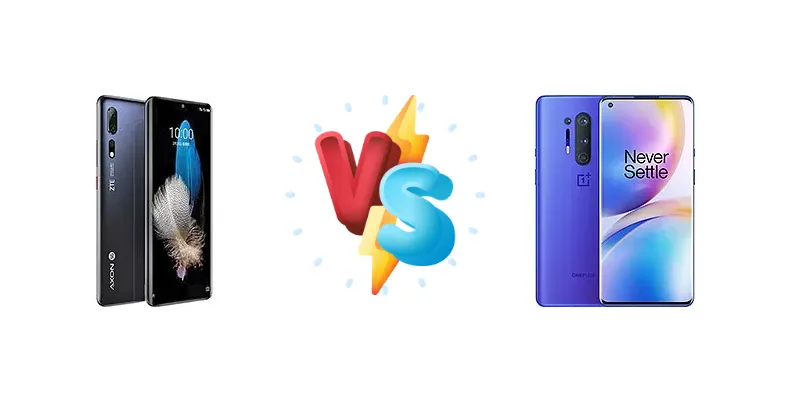
|
🏆 Quick Verdict
For most users, the OnePlus 8 Pro is the superior choice. While both phones share the Snapdragon 865 chipset, the OnePlus 8 Pro’s significantly faster 30W wired and wireless charging, coupled with its comparable 103-hour endurance rating, provides a more convenient and reliable daily experience. The Axon 10s Pro offers a compelling value proposition, but compromises in charging and overall refinement hold it back.
| PHONES | ||
|---|---|---|
| Phone Names | ZTE Axon 10s Pro 5G | OnePlus 8 Pro |
| Network | ||
|---|---|---|
| 2G bands | GSM 850 / 900 / 1800 / 1900 | GSM 850 / 900 / 1800 / 1900 |
| 3G bands | HSDPA 850 / 900 / 1700(AWS) / 1900 / 2100 | HSDPA 800 / 850 / 900 / 1700(AWS) / 1800 / 1900 / 2100 |
| 4G bands | 1, 2, 3, 4, 5, 7, 8, 12, 13, 17, 18, 19, 20, 26, 28, 34, 38, 39, 40, 41 | 1, 2, 3, 4, 5, 7, 8, 12, 13, 17, 18, 19, 20, 25, 26, 28, 32, 34, 38, 39, 40, 41, 42, 46, 66 - EU |
| 5G bands | 41, 78 SA/NSA | 1, 3, 7, 28, 78 SA/NSA - EU |
| Speed | HSPA, LTE, 5G (2+ Gbps DL) | HSPA 42.2/5.76 Mbps, LTE (5CA) Cat18 1200/150 Mbps, 5G 7.5 Gbps DL |
| Technology | GSM / CDMA / HSPA / LTE / 5G | GSM / CDMA / HSPA / LTE / 5G |
| CDMA 800 / 1900 & TD-SCDMA | 78 SA/NSA - IN | |
| Launch | ||
|---|---|---|
| Announced | 2020, February 06 | 2020, April 14 |
| Status | Discontinued | Available. Released 2020, April 21 |
| Body | ||
|---|---|---|
| Build | Glass front, glass back, aluminum frame | Glass front (Gorilla Glass 5), glass back (Gorilla Glass 5), aluminum frame |
| Dimensions | 159.2 x 73.4 x 7.9 mm (6.27 x 2.89 x 0.31 in) | 165.3 x 74.4 x 8.5 mm (6.51 x 2.93 x 0.33 in) |
| SIM | Nano-SIM + Nano-SIM | Nano-SIM + Nano-SIM |
| Weight | 175 g (6.17 oz) | 199 g (7.02 oz) |
| - | IP68 dust/water resistant | |
| Display | ||
|---|---|---|
| Protection | - | Corning Gorilla Glass 5 |
| Resolution | 1080 x 2340 pixels, 19.5:9 ratio (~398 ppi density) | 1440 x 3168 pixels (~513 ppi density) |
| Size | 6.47 inches, 102.8 cm2 (~87.9% screen-to-body ratio) | 6.78 inches, 111.7 cm2 (~90.8% screen-to-body ratio) |
| Type | AMOLED, HDR10 | Fluid AMOLED, 1B colors, 120Hz, HDR10+ |
| Platform | ||
|---|---|---|
| CPU | Octa-core (1x2.84 GHz Cortex-A77 & 3x2.42 GHz Cortex-A77 & 4x1.80 GHz Cortex-A55) | Octa-core (1x2.84 GHz Cortex-A77 & 3x2.42 GHz Cortex-A77 & 4x1.80 GHz Cortex-A55) |
| Chipset | Qualcomm SM8250 Snapdragon 865 5G (7 nm+) | Qualcomm SM8250 Snapdragon 865 5G (7 nm+) |
| GPU | Adreno 650 | Adreno 650 |
| OS | Android 10, MiFavor 10 | Android 10, upgradable to Android 13, OxygenOS 13 |
| Memory | ||
|---|---|---|
| Card slot | microSDXC (uses shared SIM slot) | No |
| Internal | 128GB 6GB RAM, 256GB 12GB RAM | 128GB 8GB RAM, 256GB 12GB RAM |
| UFS 3.0 | UFS 3.0 | |
| Main Camera | ||
|---|---|---|
| Features | Dual-LED dual-tone flash, HDR, panorama | Laser AF, Dual-LED flash, HDR, panorama |
| Quad | - | 48 MP, f/1.8, 25mm (wide), 1/1.43", 1.12µm, multi-directional PDAF, OIS 8 MP, f/2.4, (telephoto), 1/1.0µm, PDAF, OIS, 3x optical zoom 48 MP, f/2.2, 14mm, 116˚ (ultrawide), 1/2.0", 0.8µm, PDAF 5 MP, f/2.4, (Color filter camera) |
| Triple | 48 MP, f/1.7, 28mm (wide), 1/2.0", 0.8µm, PDAF, OIS 8 MP, f/2.4, 80mm (telephoto), PDAF, OIS, 3x optical zoom 20 MP, f/2.2, 125˚, 16mm (ultrawide) | - |
| Video | 4K@30fps, 1080p@30fps | 4K@30/60fps, 1080p@30/60/240fps, Auto HDR, gyro-EIS |
| Selfie camera | ||
|---|---|---|
| Features | HDR | HDR |
| Single | 20 MP, f/2.0, (wide), 1/2.8", 1.0µm | 16 MP, f/2.5, (wide), 1/3.06", 1.0µm |
| Video | 1080p@30fps | 1080p@30fps, gyro-EIS |
| Sound | ||
|---|---|---|
| 3.5mm jack | No | No |
| 35mm jack | No | No |
| Loudspeaker | Yes, with stereo speakers | Yes, with stereo speakers |
| 24-bit/192kHz audio | - | |
| Comms | ||
|---|---|---|
| Bluetooth | 5.0, A2DP, LE | 5.1, A2DP, LE, aptX HD |
| NFC | Yes | Yes |
| Positioning | GPS, GLONASS, GALILEO, BDS | GPS (L1+L5), GLONASS (G1), BDS (B1), GALILEO (E1+E5a) |
| Radio | No | No |
| USB | USB Type-C 2.0 | USB Type-C 3.1, OTG |
| WLAN | Wi-Fi 802.11 a/b/g/n/ac/6, dual-band, Wi-Fi Direct | Wi-Fi 802.11 a/b/g/n/ac/6, dual-band, Wi-Fi Direct, DLNA |
| Features | ||
|---|---|---|
| Sensors | Fingerprint (under display, optical), accelerometer, gyro, proximity, compass | Fingerprint (under display, optical), accelerometer, gyro, proximity, compass |
| Battery | ||
|---|---|---|
| Charging | 18W wired, QC4 Wireless (Qi) | 30W wired, 50% in 23 min 30W wireless, 50% in 30 min 3W reverse wireless |
| Type | Li-Ion 4000 mAh, non-removable | Li-Po 4510 mAh, non-removable |
| Misc | ||
|---|---|---|
| Colors | Blue, Black | Glacial Green, Ultramarine Blue, Onyx Black |
| Models | - | IN2023, IN2020, IN2021, IN2025 |
| Price | - | About 310 EUR |
| Pricing | ||
|---|---|---|
| 128GB 8GB RAM | - | $ 428.39 |
| 256GB 12GB RAM | - | $ 853.51 |
| RENEWED | - | $ 486.00 |
| Tests | ||
|---|---|---|
| Battery life | - | Endurance rating 103h |
| Camera | - | Photo / Video |
| Display | - | Contrast ratio: Infinite (nominal) |
| Loudspeaker | - | -23.5 LUFS (Very good) |
| Performance | - | AnTuTu: 573276 (v8) GeekBench: 3374 (v5.1) GFXBench: 24fps (ES 3.1 onscreen) |
ZTE Axon 10s Pro 5G
- Potentially lower price point
- Snapdragon 865 5G chipset
- 5G connectivity
- Slow 18W charging
- Limited battery endurance information
- Less refined software experience (likely)
OnePlus 8 Pro
- 30W wired and wireless charging
- 103-hour endurance rating
- Versatile camera system
- Smooth 120Hz display
- Higher price tag
- Can be prone to software bloat (historically)
- Larger size and weight
Display Comparison
Both the ZTE Axon 10s Pro 5G and OnePlus 8 Pro feature displays with an 'Infinite' (nominal) contrast ratio, suggesting excellent black levels. However, detailed specifications like peak brightness and panel technology (LTPO) are missing for the Axon 10s Pro. The OnePlus 8 Pro’s display is known for its vibrant colors and smooth 120Hz refresh rate, which the Axon 10s Pro likely lacks. Without further data, it’s safe to assume the OnePlus 8 Pro offers a more visually impressive and responsive display experience.
Camera Comparison
Both phones feature capable camera systems, but detailed sensor information is limited for the Axon 10s Pro. The OnePlus 8 Pro is known for its versatile camera setup, including a 48MP main sensor with OIS, an ultra-wide lens, and a telephoto lens. Image processing leans towards natural colors and dynamic range. Without specifics on the Axon 10s Pro’s sensor sizes and lens apertures, it’s difficult to make a direct comparison. However, the OnePlus 8 Pro’s established reputation for image quality and video recording gives it an edge.
Performance
Both devices are powered by the Qualcomm SM8250 Snapdragon 865 5G (7 nm+), utilizing the same octa-core CPU configuration (1x2.84 GHz Cortex-A77, 3x2.42 GHz Cortex-A77, 4x1.80 GHz Cortex-A55). This means raw processing power will be nearly identical. The key difference lies in thermal management and sustained performance. OnePlus has a strong track record of optimizing software and hardware for efficient cooling, potentially leading to less throttling during extended gaming sessions. RAM configurations are also a factor, with the OnePlus 8 Pro offering up to 12GB, while the Axon 10s Pro’s maximum RAM is unknown. The OnePlus 8 Pro’s use of LPDDR5 RAM further enhances memory bandwidth.
Battery Life
The OnePlus 8 Pro boasts an endurance rating of 103 hours, indicating excellent battery life. It supports 30W wired charging, achieving 50% charge in just 23 minutes, and an impressive 30W wireless charging, reaching 50% in 30 minutes. It also includes 3W reverse wireless charging. The ZTE Axon 10s Pro, in contrast, is limited to 18W wired charging with QC4 and standard Qi wireless charging. This slower charging speed is a significant disadvantage, especially for users who frequently need to top up their battery. While the Axon 10s Pro’s battery capacity is unknown, the OnePlus 8 Pro’s combination of capacity and charging speed provides a more convenient and efficient experience.
Buying Guide
Buy the ZTE Axon 10s Pro 5G if you prioritize maximizing value and are comfortable with slower charging speeds. It’s a solid performer for the price, offering flagship-level processing power without the premium cost. Buy the OnePlus 8 Pro if you value fast charging, long battery life, and a more polished software experience. It’s the better choice for power users and those who demand convenience.