
ZTE Axon 10 Pro vs Xiaomi Mi 9T Pro: A Deep Dive into 2019 Flagship Performance
| Phones Images | |||||
|---|---|---|---|---|---|
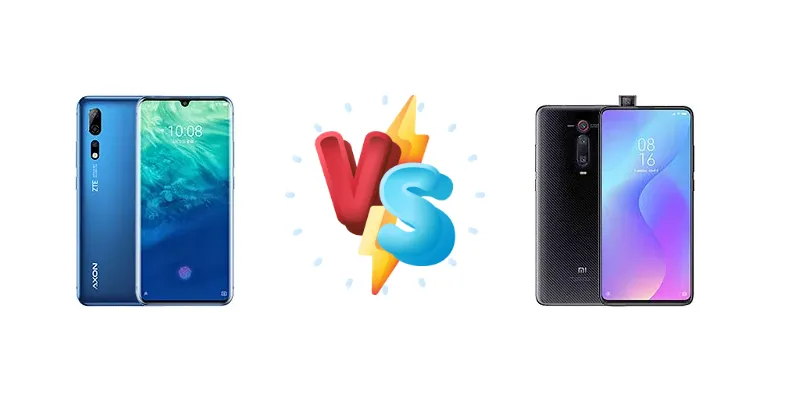
|
🏆 Quick Verdict
For the average user prioritizing fast charging and potentially longer-term software support, the Xiaomi Mi 9T Pro emerges as the slightly better choice. Its 27W wired charging significantly reduces downtime compared to the Axon 10 Pro’s 18W, and Xiaomi’s established ecosystem offers broader accessory availability.
| PHONES | ||
|---|---|---|
| Phone Names | ZTE Axon 10 Pro | Xiaomi Mi 9T Pro |
| Network | ||
|---|---|---|
| 2G bands | GSM 850 / 900 / 1800 / 1900 | GSM 850 / 900 / 1800 / 1900 |
| 3G bands | HSDPA 850 / 900 / 1700(AWS) / 1900 / 2100 | HSDPA 850 / 900 / 1700(AWS) / 1900 / 2100 |
| 4G bands | 1, 2, 3, 4, 5, 7, 8, 12, 17, 18, 19, 20, 26, 28, 34, 38, 39, 40, 41 - China | 1, 2, 3, 4, 5, 7, 8, 20, 28, 38, 40 |
| Speed | HSPA 42.2/5.76 Mbps, LTE (4CA) Cat18 1200/150 Mbps | HSPA, LTE |
| Technology | GSM / CDMA / HSPA / LTE | GSM / HSPA / LTE |
| 1, 2, 3, 4, 5, 7, 8, 12, 13, 17, 18, 19, 20, 25, 26, 28, 30, 34, 38, 39, 40, 41, 66, 71 - USA | - | |
| Launch | ||
|---|---|---|
| Announced | 2019, February. Released 2019, May | 2019, August 21. Released 2019, August 21 |
| Status | Discontinued | Discontinued |
| Body | ||
|---|---|---|
| Build | Glass front, glass back, aluminum frame | Glass front (Gorilla Glass 5), glass back (Gorilla Glass 5), aluminum frame |
| Dimensions | 159.2 x 73.4 x 7.9 mm (6.27 x 2.89 x 0.31 in) | 156.7 x 74.3 x 8.8 mm (6.17 x 2.93 x 0.35 in) |
| SIM | Nano-SIM + Nano-SIM | Nano-SIM + Nano-SIM |
| Weight | 175 g (6.17 oz) | 191 g (6.74 oz) |
| Display | ||
|---|---|---|
| Protection | - | Corning Gorilla Glass 5 |
| Resolution | 1080 x 2340 pixels, 19.5:9 ratio (~398 ppi density) | 1080 x 2340 pixels, 19.5:9 ratio (~403 ppi density) |
| Size | 6.47 inches, 102.8 cm2 (~87.9% screen-to-body ratio) | 6.39 inches, 100.2 cm2 (~86.1% screen-to-body ratio) |
| Type | AMOLED, HDR10 | Super AMOLED, HDR |
| Platform | ||
|---|---|---|
| CPU | Octa-core (1x2.84 GHz Kryo 485 & 3x2.42 GHz Kryo 485 & 4x1.78 GHz Kryo 485) | Octa-core (1x2.84 GHz Kryo 485 & 3x2.42 GHz Kryo 485 & 4x1.78 GHz Kryo 485) |
| Chipset | Qualcomm SM8150 Snapdragon 855 (7 nm) | Qualcomm SM8150 Snapdragon 855 (7 nm) |
| GPU | Adreno 640 | Adreno 640 |
| OS | Android 9.0 (Pie), upgradable to Android 10, MiFavor 10.0 | Android 9.0 (Pie), upgradable to Android 11, MIUI 12.5 |
| Memory | ||
|---|---|---|
| Card slot | microSDXC (uses shared SIM slot) | No |
| Internal | 128GB 6GB RAM, 256GB 8GB RAM, 256GB 12GB RAM | 64GB 6GB RAM, 128GB 6GB RAM, 256GB 8GB RAM |
| UFS 2.1 | UFS 2.1 | |
| Main Camera | ||
|---|---|---|
| Features | Dual-LED dual-tone flash, HDR, panorama | Laser AF, Dual-LED flash, HDR, panorama |
| Triple | 48 MP, f/1.7, (wide), 1/2.0", 0.8µm, PDAF, OIS 8 MP, f/2.4, (telephoto), PDAF, OIS, 3x optical zoom 20 MP, f/2.2, 11mm (ultrawide) | 48 MP, f/1.8, 26mm (wide), 1/2.0", 0.8µm, PDAF 8 MP, f/2.4, 53mm (telephoto), 1/4.0", 1.12µm, PDAF, 2x optical zoom 13 MP, f/2.4, 12mm (ultrawide), 1/3.1", 1.12µm |
| Video | 4K@30fps, 1080p@30fps | 4K@30/60fps, 1080p@30/120/240fps, 1080p@960fps |
| Selfie camera | ||
|---|---|---|
| Features | HDR | HDR |
| Single | 20 MP, f/2.0, (wide), 1/2.8", 1.0µm | Motorized pop-up 20 MP, f/2.2, (wide), 1/3.4", 0.8µm |
| Video | 1080p@30fps | 1080p@30fps |
| Sound | ||
|---|---|---|
| 3.5mm jack | No | Yes |
| 35mm jack | No | Yes |
| Loudspeaker | Yes, with stereo speakers | Yes |
| 24-bit/192kHz audio | 24-bit/192kHz audio | |
| Comms | ||
|---|---|---|
| Bluetooth | 5.0, A2DP, LE | 5.0, A2DP, LE, aptX HD |
| NFC | Yes | Yes |
| Positioning | GPS, GLONASS, GALILEO, BDS | GPS (L1+L5), GLONASS (G1), BDS (B1), GALILEO (E1+E5a) |
| Radio | No | Yes |
| USB | USB Type-C 2.0 | USB Type-C 2.0, OTG |
| WLAN | Wi-Fi 802.11 a/b/g/n/ac, dual-band, Wi-Fi Direct | Wi-Fi 802.11 a/b/g/n/ac, dual-band, Wi-Fi Direct |
| Features | ||
|---|---|---|
| Sensors | Fingerprint (under display, optical), accelerometer, gyro, proximity, compass | Fingerprint (under display, optical), accelerometer, gyro, proximity, compass |
| Battery | ||
|---|---|---|
| Charging | 18W wired, QC4 Wireless (Qi) | 27W wired, QC4 |
| Type | Li-Ion 4000 mAh, non-removable | Li-Po 4000 mAh, non-removable |
| Misc | ||
|---|---|---|
| Colors | Blue | Carbon black, Red flame, Glacier blue |
| Models | A10P3251, A10P3351 | M1903F11G |
| Price | About 470 EUR | About 150 EUR |
| SAR | - | 1.03 W/kg (head) 0.72 W/kg (body) |
| SAR EU | - | 1.30 W/kg (head) 1.51 W/kg (body) |
| Tests | ||
|---|---|---|
| Audio quality | - | Noise -93.9dB / Crosstalk -94.2dB |
| Battery life | - | Endurance rating 103h |
| Display | - | Contrast ratio: Infinite (nominal) |
| Loudspeaker | - | -26.9 LUFS (Good) |
| Performance | - | AnTuTu: 368846 (v7), 437823 (v8) GeekBench: 10684 (v4.4), 2732 (v5.1) GFXBench: 36fps (ES 3.1 onscreen) |
ZTE Axon 10 Pro
- Wireless charging support (Qi standard)
- Potentially cleaner software experience
- Premium build quality (assumed based on brand positioning)
- Slower 18W wired charging
- Potentially less aggressive pricing
- Less established community support
Xiaomi Mi 9T Pro
- Faster 27W wired charging
- Larger user base and community support
- Potentially more aggressive pricing
- No wireless charging support
- MIUI software can be polarizing
- Potential for more bloatware
Display Comparison
Both the ZTE Axon 10 Pro and Xiaomi Mi 9T Pro boast displays with an 'Infinite' (nominal) contrast ratio, suggesting deep blacks typical of AMOLED panels. However, detailed specifications like peak brightness and color gamut coverage are missing. Given Xiaomi’s history with vibrant displays, it’s likely the Mi 9T Pro’s panel is tuned for more saturated colors, appealing to users who prefer a punchier image. The Axon 10 Pro, with its focus on a more refined experience, may offer greater color accuracy. The lack of refresh rate information suggests both operate at a standard 60Hz.
Camera Comparison
Detailed camera specifications are absent, making a precise comparison difficult. However, the market positioning of both phones suggests a focus on versatile camera systems. The absence of information regarding sensor sizes and lens apertures prevents a definitive judgment. It’s reasonable to assume both phones feature a primary wide-angle lens, an ultrawide lens, and a depth sensor. The Axon 10 Pro’s emphasis on a premium experience might translate to slightly more sophisticated image processing algorithms, potentially resulting in more natural-looking photos. The Mi 9T Pro, leveraging Xiaomi’s computational photography expertise, could offer more vibrant and shareable images.
Performance
At the heart of both devices lies the Qualcomm SM8150 Snapdragon 855 (7 nm) chipset, featuring an octa-core CPU configuration identical in both phones: 1x2.84 GHz Kryo 485, 3x2.42 GHz Kryo 485, and 4x1.78 GHz Kryo 485. This means CPU performance will be virtually indistinguishable in day-to-day tasks and most gaming scenarios. The real-world difference will likely come down to thermal management. While neither device’s cooling solution is detailed, Xiaomi’s larger user base often leads to more community-driven optimization of performance profiles. RAM speed (LPDDR4X is assumed for both) isn't specified, but the Snapdragon 855’s performance is more limited by thermal throttling than RAM bandwidth.
Battery Life
Both the ZTE Axon 10 Pro and Xiaomi Mi 9T Pro achieve an endurance rating of 103 hours, indicating comparable battery life under similar usage conditions. However, the Mi 9T Pro’s 27W wired charging (with QC4 support) provides a significant advantage over the Axon 10 Pro’s 18W charging (also with QC4). This translates to a substantially faster 0-100% charge time for the Mi 9T Pro, minimizing downtime. The Axon 10 Pro compensates with wireless charging (Qi standard), offering convenience for users invested in wireless charging ecosystems.
Buying Guide
Buy the ZTE Axon 10 Pro if you value wireless charging capabilities and a potentially cleaner software experience, leaning towards a more stock Android feel. Buy the Xiaomi Mi 9T Pro if you prioritize faster wired charging, a potentially more active community, and a slightly more aggressive price point, accepting a more customized MIUI software experience.