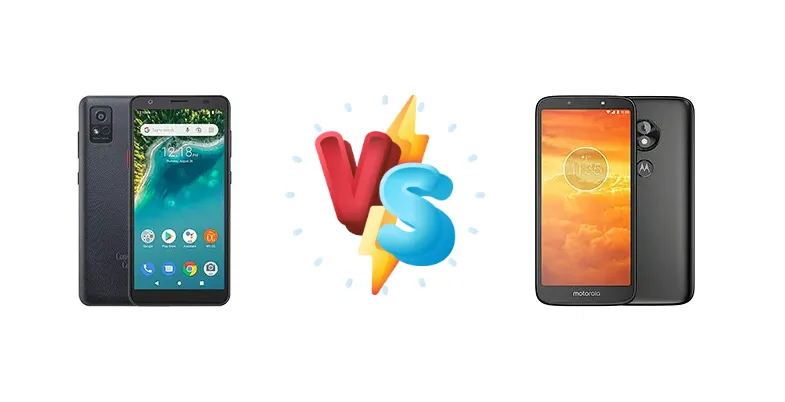
The ZTE Avid 589 and Motorola Moto E5 Play Go represent the extreme end of the smartphone price spectrum. Both aim to deliver essential smartphone functionality at a minimal cost, but they achieve this through vastly different approaches to hardware. This comparison dissects their core components to determine which device offers the best value for users prioritizing affordability.
🏆 Quick Verdict
For the average user seeking a slightly more responsive experience, the ZTE Avid 589 emerges as the better choice. Its Mediatek Helio P22 chipset, built on a smaller 12nm process, provides a noticeable performance advantage over the Motorola Moto E5 Play Go’s Snapdragon 425, despite the core count difference. However, the E5 Play Go’s Android Go edition may appeal to those wanting a streamlined experience.
| Network |
|---|
| 2G bands | GSM 850 / 900 / 1800 / 1900 | GSM 850 / 900 / 1800 / 1900 |
| 3G bands | HSDPA 850 / 1700(AWS) / 1900 | HSDPA 850 / 900 / 1700(AWS) / 1900 / 2100 |
| 4G bands | 2, 4, 5, 12, 41, 66, 71 | 2, 4, 5, 13 |
| Speed | HSPA, LTE | HSPA, LTE |
| Technology | GSM / HSPA / LTE | GSM / CDMA / HSPA / LTE |
| | - | CDMA 800 / 1900 |
| Launch |
|---|
| Announced | 2021, November 18 | 2018, July. Released 2018, August |
| Status | Available. Released 2021, November 18 | Discontinued |
| Body |
|---|
| Dimensions | 142.2 x 70.9 x 7.9 mm (5.60 x 2.79 x 0.31 in) | 7.6 mm thickness |
| SIM | Nano-SIM | Nano-SIM |
| Weight | 167 g (5.89 oz) | 150.3 g (5.29 oz) |
| Display |
|---|
| Resolution | 720 x 1440 pixels, 18:9 ratio (~293 ppi density) | 480 x 960 pixels, 18:9 ratio (~206 ppi density) |
| Size | 5.5 inches, 5.5, 78.1 cm2 (~77.4% screen-to-body ratio) | 5.2 inches, 69.8 cm2 |
| Type | IPS LCD | IPS LCD |
| Platform |
|---|
| CPU | Octa-core 1.8 GHz Cortex-A53 | Quad-core 1.4 GHz Cortex-A53 |
| Chipset | Mediatek MT6762D Helio P22 (12 nm) | Qualcomm MSM8917 Snapdragon 425 (28 nm) |
| GPU | PowerVR GE8320 | Adreno 308 |
| OS | Android 11 (Go edition) | Android 8.0 Oreo (Go edition) |
| Memory |
|---|
| Card slot | microSDXC | microSDXC (dedicated slot) |
| Internal | 32GB 2GB RAM | 16GB 1GB RAM |
| | - | eMMC 5.1 |
| Main Camera |
|---|
| Features | LED flash | LED flash, panorama, HDR |
| Single | 8 MP, AF | 8 MP, f/2.0, 1.12 µm, AF |
| Video | 720p@30fps | 1080p@30fps |
| Selfie camera |
|---|
| Features | - | LED flash |
| Single | 2 MP | 5 MP |
| Sound |
|---|
| 3.5mm jack | Yes | Yes |
| 35mm jack | Yes | Yes |
| Loudspeaker | Yes | Yes |
| Comms |
|---|
| Bluetooth | 5.0, A2DP | 4.2, A2DP |
| NFC | No | No |
| Positioning | GPS | GPS, GLONASS |
| Radio | No | FM radio |
| USB | USB Type-C 2.0 | microUSB 2.0 |
| WLAN | Wi-Fi 802.11 b/g/n | Wi-Fi 802.11 b/g/n |
| Features |
|---|
| Sensors | Accelerometer, proximity | Accelerometer |
| Battery |
|---|
| Type | Li-Ion 3000 mAh, removable | Li-Ion 2800 mAh battery |
| Misc |
|---|
| Colors | Black | Black, Dark lake, Flash gray |
| Models | - | XT1921, MOTXT19218PP |
| Price | About 60 EUR | About 70 EUR |
ZTE Avid 589
- More powerful processor for smoother multitasking
- More efficient 12nm fabrication process
- Octa-core CPU offers better multi-tasking capability
- Potentially shorter battery life under heavy load
- May run a less optimized version of Android
Motorola Moto E5 Play Go
- Android Go edition provides a clean and streamlined experience
- Potentially longer battery life due to lower power consumption
- Qualcomm’s optimizations for power efficiency
- Significantly less powerful processor
- 28nm process is less efficient, generating more heat
Display Comparison
Neither device boasts a standout display. Details regarding panel type, resolution, and brightness are unavailable, but given the price point, both likely utilize LCD panels with 720p+ resolutions. The key difference lies in the underlying architecture of the chipsets powering them, which indirectly impacts display responsiveness. The Avid 589’s more powerful GPU may translate to slightly smoother scrolling and animations, though this will be subtle.
Camera Comparison
Camera performance on both devices is expected to be basic. Without specific sensor details, it’s safe to assume both feature low-resolution primary sensors. The focus should be on usability for quick snapshots in good lighting conditions, rather than expecting high-quality images. Any additional sensors (likely 2MP depth or macro) will offer limited practical benefit on either device. Image processing will likely be minimal on both, relying heavily on software algorithms to enhance photos.
Performance
The core of the difference lies in the chipsets. The ZTE Avid 589’s Mediatek Helio P22 (12nm) features an octa-core CPU clocked at 1.8 GHz, while the Motorola Moto E5 Play Go utilizes the Qualcomm Snapdragon 425 (28nm) with a quad-core CPU at 1.4 GHz. The 12nm fabrication process of the Helio P22 is significantly more efficient than the 28nm process of the Snapdragon 425, meaning the Avid 589 will generate less heat and potentially sustain performance for longer periods. While the Snapdragon 425 benefits from Qualcomm’s optimizations, the sheer core count and process node advantage give the Helio P22 a clear edge in multi-threaded tasks and overall responsiveness. The E5 Play Go’s Android Go edition, however, is designed to run efficiently on lower-spec hardware.
Battery Life
Battery capacity details are missing for both devices. However, the Snapdragon 425’s lower power consumption could translate to slightly longer battery life on the Moto E5 Play Go, despite potentially having a smaller battery. The Helio P22, while more efficient than older chips, demands more power under load. Charging speeds are also unknown, but likely slow on both devices, relying on micro-USB connectivity.
Buying Guide
Buy the ZTE Avid 589 if you need a phone capable of handling basic multitasking and light app usage with a bit more fluidity. It’s ideal for users who occasionally browse social media, check email, and use navigation apps. Buy the Motorola Moto E5 Play Go if you prioritize a clean, uncluttered Android experience and are willing to trade performance for the simplicity of Android Go, and potentially longer battery life due to the less powerful processor.
Frequently Asked Questions
❓ Will the ZTE Avid 589 struggle with popular apps like Facebook or YouTube?
While the Helio P22 can handle these apps, expect some lag and slower loading times, especially with multiple apps open simultaneously. It's best suited for light usage of these platforms.
❓ Is Android Go on the Moto E5 Play Go a significant benefit for older users?
Yes, Android Go simplifies the interface and reduces clutter, making it easier to navigate for users unfamiliar with modern smartphones. It also conserves resources, potentially improving performance on the limited hardware.
❓ Can either of these phones handle basic mobile games?
Simple 2D games will run adequately on both devices. However, more demanding 3D games will likely experience significant frame rate drops and may be unplayable. The Avid 589 has a slight advantage due to its more powerful GPU.