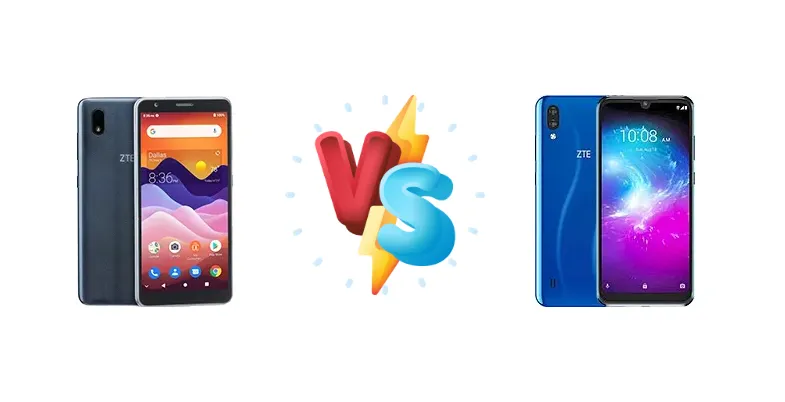
Both the ZTE Avid 579 and the ZTE Blade A5 2020 occupy the ultra-budget smartphone segment, aiming to provide essential functionality at the lowest possible price. However, they diverge significantly in their core processing hardware, making a direct comparison crucial for consumers prioritizing performance or efficiency. This analysis will dissect the differences between the Mediatek Helio A20 and the Unisoc SC9863A to determine which device delivers the better user experience.
🏆 Quick Verdict
For users prioritizing multi-tasking and a slightly smoother experience, the ZTE Blade A5 2020 is the better choice. Its octa-core processor, despite being built on an older 28nm process, offers a performance advantage over the quad-core Helio A20 in the Avid 579. However, the Avid 579 may exhibit slightly better battery life due to the more efficient 12nm node.
| Network |
|---|
| 2G bands | GSM 850 / 900 / 1800 / 1900 | GSM 850 / 900 / 1800 / 1900 |
| 3G bands | HSDPA 850 / 1700(AWS) / 1900 | HSDPA 850 / 900 / 1900 / 2100 |
| 4G bands | 2, 4, 5, 12, 41, 66, 71 | 1, 3, 5, 7, 8, 20, 38 - International |
| Speed | HSPA, LTE | HSPA 42.2/5.76 Mbps, LTE Cat4 150/50 Mbps |
| Technology | GSM / HSPA / LTE | GSM / HSPA / LTE |
| | - | 2, 4, 5, 7, 28, 66 - USA |
| Launch |
|---|
| Announced | 2020, June 24. Released 2020, June 24 | 2020, July 16. Released 2020, July 16 |
| Status | Discontinued | Discontinued |
| Body |
|---|
| Dimensions | 147 x 71 x 9.6 mm (5.79 x 2.80 x 0.38 in) | 156.7 x 72.6 x 8 mm (6.17 x 2.86 x 0.31 in) |
| SIM | Nano-SIM | Nano-SIM + Nano-SIM |
| Weight | 160 g (5.64 oz) | 155 g (5.47 oz) |
| Display |
|---|
| Resolution | 720 x 1440 pixels, 18:9 ratio (~295 ppi density) | 720 x 1560 pixels, 19.5:9 ratio (~282 ppi density) |
| Size | 5.45 inches, 5.45, 76.7 cm2 (~73.4% screen-to-body ratio) | 6.09 inches, 91.0 cm2 (~80.0% screen-to-body ratio) |
| Type | TFT LCD | IPS LCD |
| Platform |
|---|
| CPU | Quad-core 1.8 GHz Cortex-A53 | Octa-core (4x1.6 GHz Cortex-A55 & 4x1.2 GHz Cortex-A55) |
| Chipset | Mediatek MT6761D Helio A20 (12 nm) | Unisoc SC9863A (28 nm) |
| GPU | PowerVR GE8320 | IMG8322 |
| OS | Android 10 | Android 9.0/ Android 10 (Go edition) |
| Memory |
|---|
| Card slot | microSDXC | microSDXC |
| Internal | 32GB 2GB RAM | 32GB 2GB RAM, 64GB 2GB RAM |
| | - | eMMC 5.1 |
| Main Camera |
|---|
| Dual | - | 13 MP, f/2.0, (wide), AF
Auxiliary lens |
| Features | LED flash | LED flash, HDR |
| Single | 8 MP | 8 MP, f/2.4 |
| Video | - | 1080p@30fps |
| Selfie camera |
|---|
| Single | 2 MP | 8 MP, f/2.4 |
| Video | - | 1080p@30fps |
| Sound |
|---|
| 3.5mm jack | Yes | Yes |
| 35mm jack | Yes | Yes |
| Loudspeaker | Yes | Yes |
| Comms |
|---|
| Bluetooth | 4.2, A2DP | 4.2, A2DP |
| NFC | No | No |
| Positioning | GPS | GPS |
| Radio | FM Radio | Unspecified |
| USB | microUSB | microUSB 2.0 |
| WLAN | Wi-Fi 802.11 b/g/n | Wi-Fi 802.11 b/g/n |
| Features |
|---|
| Sensors | Accelerometer, proximity | Accelerometer, proximity |
| Battery |
|---|
| Type | Li-Ion 2660 mAh, removable | Li-Ion 3200 mAh |
| Misc |
|---|
| Colors | Black | Black, Blue, Green |
| Price | About 20 EUR | About 120 EUR |
| SAR EU | - | 0.48 W/kg (head) |
ZTE Avid 579
- Potentially better battery life due to 12nm process
- Simpler processor may result in lower heat output
- Likely more affordable
- Slower performance in multi-tasking and demanding apps
- Older processor architecture
- Limited gaming capabilities
ZTE Blade A5 2020
- Octa-core processor offers better multi-tasking performance
- More modern CPU architecture (Cortex-A55)
- Smoother user experience with multiple apps open
- Less power efficient due to 28nm process
- Potentially shorter battery life
- May run slightly warmer under load
Display Comparison
Neither ZTE provides detailed display specifications. Given their price point, both likely utilize LCD panels with 720p+ resolutions. The absence of information regarding peak brightness, color gamut coverage, or refresh rates suggests a focus on cost reduction over display quality. Bezels are expected to be substantial on both devices, typical of this market segment. Color accuracy is likely to be standard, prioritizing visibility over fidelity.
Camera Comparison
Detailed camera specifications are unavailable. Both devices likely feature a primary camera and potentially a secondary depth sensor. Given the price bracket, image quality will be limited, particularly in low-light conditions. Expect basic image processing with minimal computational photography features. The absence of OIS (Optical Image Stabilization) on either device suggests reliance on software stabilization, which is less effective. Any secondary cameras (often 2MP macro lenses) are unlikely to provide significant value.
Performance
The core difference lies in the chipsets. The ZTE Avid 579’s Mediatek Helio A20 (MT6761D) is a quad-core processor built on a more modern 12nm process. This smaller node generally translates to improved power efficiency. Conversely, the ZTE Blade A5 2020 features the Unisoc SC9863A, an octa-core processor fabricated on a larger 28nm node. While the 28nm process is less efficient, the eight cores (four Cortex-A55 at 1.6GHz and four at 1.2GHz) provide a significant advantage in multi-threaded workloads. The A55 architecture is also more efficient per core than the A53 found in the Helio A20. This means the Blade A5 2020 will likely handle app switching and multitasking more smoothly, though at the cost of potentially shorter battery life. The lack of dedicated GPU information suggests integrated graphics on both, limiting gaming performance to basic titles.
Battery Life
Battery capacity details are missing for both devices. However, the Helio A20’s 12nm process in the Avid 579 suggests it will consume less power than the Blade A5 2020’s SC9863A. This could translate to longer battery life, even with a slightly smaller battery capacity. Charging wattage is also unknown, but likely limited to 5W or 10W on both devices, resulting in relatively slow charging times – expect several hours to reach a full charge from empty.
Buying Guide
Buy the ZTE Avid 579 if you need a basic smartphone for calls, texts, and light app usage, and battery life is a primary concern. Its simpler processor demands less power. Buy the ZTE Blade A5 2020 if you prefer a device capable of handling more demanding tasks like social media scrolling, light gaming, and running multiple apps simultaneously, even if it means sacrificing some battery endurance.
Frequently Asked Questions
❓ Will the ZTE Blade A5 2020 struggle with popular social media apps like Facebook and Instagram?
While the Unisoc SC9863A is an entry-level processor, its octa-core configuration should provide a reasonably smooth experience with Facebook and Instagram. However, expect some occasional lag when loading images or videos, especially with multiple apps running in the background. The Avid 579 may exhibit more noticeable slowdowns.
❓ Is either phone suitable for playing mobile games like PUBG Mobile or Call of Duty Mobile?
Neither the ZTE Avid 579 nor the ZTE Blade A5 2020 are well-suited for demanding games like PUBG Mobile or Call of Duty Mobile. The integrated graphics and limited processing power will result in low frame rates and significant lag, even on the lowest settings. These phones are best reserved for casual gaming with less graphically intensive titles.
❓ How much storage does each phone offer, and can it be expanded?
Storage capacity details are not provided. However, given the price point, both devices likely offer 16GB or 32GB of internal storage. It's highly probable that both include a microSD card slot for storage expansion, allowing users to add more space for photos, videos, and apps.