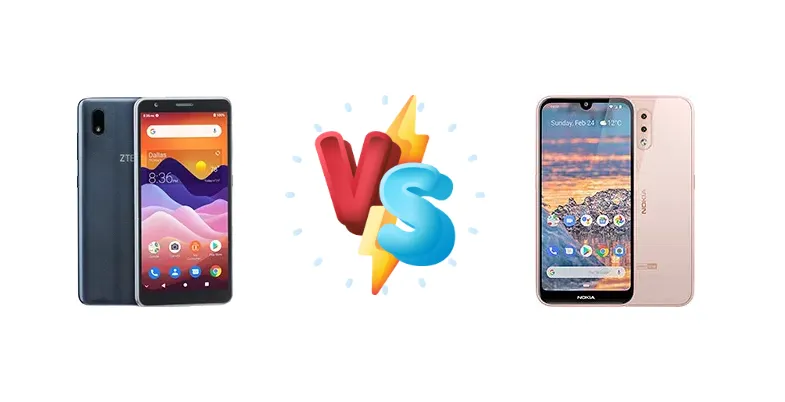
The ZTE Avid 579 and Nokia 4.2 represent the lower end of the Android smartphone market, often serving as first phones or reliable backups. Both devices aim for affordability, but they take different approaches to achieving it, primarily through their chipset choices. This comparison dissects the Mediatek Helio A20 in the Avid 579 against the Qualcomm Snapdragon 439 in the Nokia 4.2, revealing which offers a better user experience for the price.
🏆 Quick Verdict
For the average user prioritizing responsiveness and multitasking, the Nokia 4.2 emerges as the better choice. Its octa-core Snapdragon 439 provides a noticeable performance advantage over the quad-core Helio A20 in the ZTE Avid 579, making everyday tasks smoother and more enjoyable. While the Avid 579 is cheaper, the performance trade-off is significant.
| Network |
|---|
| 2G bands | GSM 850 / 900 / 1800 / 1900 | GSM 850 / 900 / 1800 / 1900 |
| 3G bands | HSDPA 850 / 1700(AWS) / 1900 | HSDPA 850 / 900 / 2100 - Global |
| 4G bands | 2, 4, 5, 12, 41, 66, 71 | 1, 3, 5, 7, 8, 20, 28, 38, 40, 41 - EMEA, APAC, MENA |
| Speed | HSPA, LTE | HSPA 42.2/5.76 Mbps, LTE Cat4 150/50 Mbps |
| Technology | GSM / HSPA / LTE | GSM / HSPA / LTE |
| | - | 1, 3, 5, 8, 40, 41 - India |
| Launch |
|---|
| Announced | 2020, June 24. Released 2020, June 24 | 2019, February 24. Released 2019, May 07 |
| Status | Discontinued | Discontinued |
| Body |
|---|
| Build | - | Glass front, glass back, plastic frame |
| Dimensions | 147 x 71 x 9.6 mm (5.79 x 2.80 x 0.38 in) | 149 x 71.3 x 8.4 mm (5.87 x 2.81 x 0.33 in) |
| SIM | Nano-SIM | Nano-SIM + Nano-SIM |
| Weight | 160 g (5.64 oz) | 161 g (5.68 oz) |
| Display |
|---|
| Resolution | 720 x 1440 pixels, 18:9 ratio (~295 ppi density) | 720 x 1520 pixels, 19:9 ratio (~295 ppi density) |
| Size | 5.45 inches, 5.45, 76.7 cm2 (~73.4% screen-to-body ratio) | 5.71 inches, 81.4 cm2 (~76.6% screen-to-body ratio) |
| Type | TFT LCD | IPS LCD |
| Platform |
|---|
| CPU | Quad-core 1.8 GHz Cortex-A53 | Octa-core (4x1.95 GHz Cortex-A53 & 4x1.45 GHz Cortex A53) |
| Chipset | Mediatek MT6761D Helio A20 (12 nm) | Qualcomm SDM439 Snapdragon 439 (12 nm) |
| GPU | PowerVR GE8320 | Adreno 505 |
| OS | Android 10 | Android 9.0 (Pie), upgradable to Android 11, Android One |
| Memory |
|---|
| Card slot | microSDXC | microSDXC (dedicated slot) |
| Internal | 32GB 2GB RAM | 16GB 2GB RAM, 32GB 3GB RAM |
| | - | eMMC 5.1 |
| Main Camera |
|---|
| Dual | - | 13 MP, f/2.2, 1/3.1", 1.12µm, PDAF
Auxiliary lens |
| Features | LED flash | LED flash |
| Single | 8 MP | - |
| Video | - | 1080p@30fps |
| Selfie camera |
|---|
| Single | 2 MP | 8 MP, f/2.0, 1/4.0", 1.12µm |
| Video | - | 1080p@30fps |
| Sound |
|---|
| 3.5mm jack | Yes | Yes |
| 35mm jack | Yes | Yes |
| Loudspeaker | Yes | Yes |
| Comms |
|---|
| Bluetooth | 4.2, A2DP | 4.2, A2DP, LE, aptX |
| NFC | No | Yes (market dependent) |
| Positioning | GPS | GPS, GLONASS, BDS |
| Radio | FM Radio | FM radio |
| USB | microUSB | microUSB 2.0, OTG |
| WLAN | Wi-Fi 802.11 b/g/n | Wi-Fi 802.11 b/g/n |
| Features |
|---|
| Sensors | Accelerometer, proximity | Fingerprint (rear-mounted), accelerometer, proximity |
| Battery |
|---|
| Type | Li-Ion 2660 mAh, removable | Li-Ion 3000 mAh, non-removable |
| Misc |
|---|
| Colors | Black | Black, Pink Sand |
| Models | - | TA-1184, TA-1133, TA-1149, TA-1150, TA-1157, TA-1152 |
| Price | About 20 EUR | About 130 EUR |
| SAR | - | 0.43 W/kg (head) 1.08 W/kg (body) |
| SAR EU | - | 0.45 W/kg (head) 1.53 W/kg (body) |
ZTE Avid 579
- Lower price point makes it highly accessible.
- Decent battery life for basic usage.
- Simple and straightforward Android experience.
- Significantly slower performance compared to the Nokia 4.2.
- Struggles with multitasking and demanding apps.
- Likely inferior camera quality.
Nokia 4.2
- Faster and more responsive performance thanks to the Snapdragon 439.
- Better multitasking capabilities.
- Potentially better camera quality.
- Slightly higher price point.
- May not offer significantly better battery life.
- Still an entry-level device with limitations.
Display Comparison
Neither device boasts a standout display. Both utilize a 12nm process, suggesting similar power efficiency in display operation. However, detailed display specs (resolution, brightness, panel type) are missing. Given the price point, both likely employ IPS LCD panels. The Nokia 4.2, being slightly more premium, *may* have better color calibration, but this is speculative. The real difference lies in the processing power driving the UI *on* the display, which we'll cover in the performance section.
Camera Comparison
Without detailed camera specifications, a direct comparison is difficult. Both phones likely feature basic camera setups geared towards casual photography. The absence of information regarding sensor size and aperture suggests neither device will excel in low-light conditions. It's reasonable to assume the Nokia 4.2, given its slightly higher market positioning, *may* have a marginally better camera module, but this is largely conjecture. The presence of a 2MP macro lens on either device is largely marketing fluff and shouldn't be a deciding factor.
Performance
The core difference between these phones is the chipset. The Nokia 4.2’s Snapdragon 439 features an octa-core CPU (4x1.95 GHz Cortex-A53 & 4x1.45 GHz Cortex A53), while the ZTE Avid 579 is equipped with a quad-core 1.8 GHz Cortex-A53 Mediatek Helio A20. This difference in core count is substantial. The Snapdragon 439’s architecture allows for better parallel processing, resulting in smoother multitasking and faster app loading times. While both use Cortex-A53 cores, the Snapdragon’s higher clock speeds and additional cores provide a clear advantage. The Helio A20 is geared towards extremely basic tasks, and will struggle with demanding applications. Users intending to play even moderately complex games will find the Nokia 4.2 a far more capable device.
Battery Life
Battery capacity data is missing for both devices. However, given the power efficiency of the 12nm process and the relatively low-performance chipsets, both phones should offer all-day battery life with moderate usage. Charging wattage is also unknown. The Nokia 4.2’s more efficient Snapdragon 439 *could* translate to slightly longer battery life, but without concrete numbers, this remains speculative. The real-world impact will depend heavily on user habits and app usage.
Buying Guide
Buy the ZTE Avid 579 if you need an extremely affordable smartphone for basic communication – calls, texts, and light app usage – and are willing to accept slower performance. It’s ideal for users on a very tight budget or those needing a simple, reliable device. Buy the Nokia 4.2 if you prefer a more responsive experience for social media, web browsing, and occasional gaming. The Snapdragon 439 offers a more future-proof platform and a smoother user interface, justifying the slightly higher price.
Frequently Asked Questions
❓ Will the ZTE Avid 579 struggle with popular apps like Facebook and WhatsApp?
While the ZTE Avid 579 can run these apps, expect slower loading times and occasional lag, especially when multitasking. The Helio A20 chipset is designed for basic tasks, and these apps can be resource-intensive.
❓ Can the Nokia 4.2 handle light gaming, like Candy Crush or Angry Birds?
Yes, the Nokia 4.2’s Snapdragon 439 is capable of handling light gaming without significant issues. However, don’t expect to play graphically demanding games at high settings. Frame rates will likely be lower than on more powerful devices.
❓ Is the difference in performance between these two phones noticeable in everyday use?
Absolutely. The Nokia 4.2 will feel significantly smoother and more responsive when navigating the user interface, opening apps, and switching between tasks. The Avid 579 will exhibit noticeable lag in these scenarios.
❓ Which phone is better for someone who primarily uses their phone for calls and texts?
The ZTE Avid 579 is perfectly adequate for basic communication. Its lower price point makes it a sensible choice if calls and texts are your primary use case, and you don't require advanced features or performance.