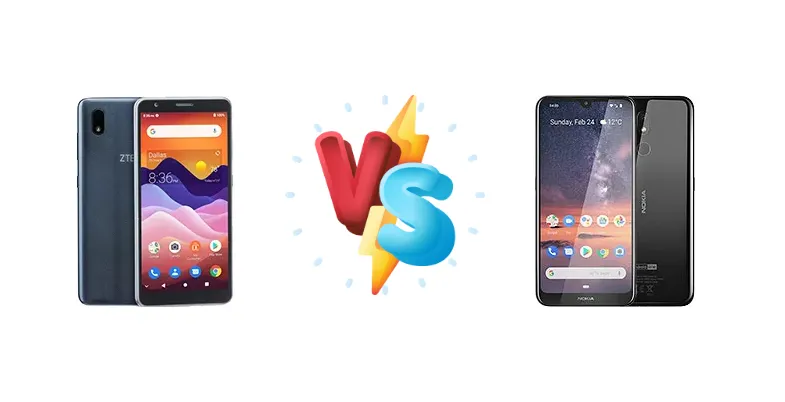
The ZTE Avid 579 and Nokia 3.2 represent the lower end of the smartphone market, targeting users prioritizing affordability. Both devices aim to deliver a functional Android experience without breaking the bank, but they achieve this with different chipsets and feature sets. This comparison dissects their key specifications to determine which offers the best value for your money.
🏆 Quick Verdict
For the average user seeking a slightly more responsive experience, the Nokia 3.2 edges out the ZTE Avid 579. While both utilize quad-core Cortex-A53 CPUs, the Qualcomm Snapdragon 429 generally exhibits better sustained performance and includes 10W charging, a feature absent in the Avid 579’s specifications.
| Network |
|---|
| 2G bands | GSM 850 / 900 / 1800 / 1900 | GSM 850 / 900 / 1800 / 1900 |
| 3G bands | HSDPA 850 / 1700(AWS) / 1900 | HSDPA 850 / 900 / 2100 |
| 4G bands | 2, 4, 5, 12, 41, 66, 71 | 1, 3, 5, 7, 8, 20, 28, 38, 40 - EMEA, APAC, MENA |
| Speed | HSPA, LTE | HSPA 42.2/5.76 Mbps, LTE Cat4 150/50 Mbps |
| Technology | GSM / HSPA / LTE | GSM / HSPA / LTE |
| | - | 1, 3, 5, 8, 40, 41 - India |
| Launch |
|---|
| Announced | 2020, June 24. Released 2020, June 24 | 2019, February 24. Released 2019, May 22 |
| Status | Discontinued | Discontinued |
| Body |
|---|
| Build | - | Glass front, plastic back, plastic frame |
| Dimensions | 147 x 71 x 9.6 mm (5.79 x 2.80 x 0.38 in) | 159.4 x 76.2 x 8.6 mm (6.28 x 3.00 x 0.34 in) |
| SIM | Nano-SIM | Nano-SIM + Nano-SIM |
| Weight | 160 g (5.64 oz) | 181 g (6.38 oz) |
| Display |
|---|
| Resolution | 720 x 1440 pixels, 18:9 ratio (~295 ppi density) | 720 x 1520 pixels, 19:9 ratio (~269 ppi density) |
| Size | 5.45 inches, 5.45, 76.7 cm2 (~73.4% screen-to-body ratio) | 6.26 inches, 97.8 cm2 (~80.5% screen-to-body ratio) |
| Type | TFT LCD | IPS LCD |
| Platform |
|---|
| CPU | Quad-core 1.8 GHz Cortex-A53 | Quad-core 1.8 GHz Cortex-A53 |
| Chipset | Mediatek MT6761D Helio A20 (12 nm) | Qualcomm SDM429 Snapdragon 429 (12 nm) |
| GPU | PowerVR GE8320 | Adreno 504 |
| OS | Android 10 | Android 9.0 (Pie), upgradable to Android 11, Android One |
| Memory |
|---|
| Card slot | microSDXC | microSDXC (dedicated slot) |
| Internal | 32GB 2GB RAM | 16GB 2GB RAM, 32GB 3GB RAM, 64GB 3GB RAM |
| | - | eMMC 5.1 |
| Main Camera |
|---|
| Features | LED flash | LED flash |
| Single | 8 MP | 13 MP, f/2.2, 1/3.1", 1.12µm, AF |
| Video | - | 1080p@30fps |
| Selfie camera |
|---|
| Single | 2 MP | 5 MP, f/2.2, 27mm (wide), 1/5.0", 1.12µm |
| Sound |
|---|
| 3.5mm jack | Yes | Yes |
| 35mm jack | Yes | Yes |
| Loudspeaker | Yes | Yes |
| Comms |
|---|
| Bluetooth | 4.2, A2DP | 4.2, A2DP, LE, aptX |
| NFC | No | No |
| Positioning | GPS | GPS, GLONASS, BDS |
| Radio | FM Radio | FM radio |
| USB | microUSB | microUSB 2.0, OTG |
| WLAN | Wi-Fi 802.11 b/g/n | Wi-Fi 802.11 b/g/n |
| Features |
|---|
| Sensors | Accelerometer, proximity | Fingerprint (rear-mounted, 32/3GB only), accelerometer, proximity |
| Battery |
|---|
| Charging | - | 10W wired |
| Type | Li-Ion 2660 mAh, removable | Li-Ion 4000 mAh, non-removable |
| Misc |
|---|
| Colors | Black | Black, Steel |
| Models | - | TA-1156, TA-1159, TA-1164 |
| Price | About 20 EUR | About 140 EUR |
| SAR EU | - | 0.24 W/kg (head) 1.63 W/kg (body) |
ZTE Avid 579
- Potentially lower price point.
- Functional for basic smartphone tasks.
- 12nm process for reasonable power efficiency.
- Helio A20 chipset offers lower performance than Snapdragon 429.
- No charging specifications provided.
- RAM specifications are unknown.
Nokia 3.2
- Qualcomm Snapdragon 429 provides better performance.
- 10W wired charging for faster top-ups.
- Generally more refined software experience.
- Still an entry-level device with limited capabilities.
- May be slightly more expensive than the ZTE Avid 579.
- Limited RAM options (2GB/3GB).
Display Comparison
Neither ZTE nor Nokia provide display specifications beyond the device dimensions. Given their price point, both likely employ LCD panels with 720p+ resolutions. Without knowing the panel technology or brightness levels, it’s difficult to assess visual quality. However, the Nokia 3.2’s brand reputation suggests a slightly more refined display calibration, though this is speculative. Bezels are expected to be substantial on both devices, reflecting their budget nature.
Camera Comparison
Camera performance on both devices is expected to be limited. Neither phone is likely to excel in low-light conditions. Without detailed sensor information, it’s difficult to make a definitive comparison. However, Nokia’s image processing algorithms are generally considered more refined than Mediatek’s, potentially resulting in slightly more pleasing images from the Nokia 3.2. The inclusion of a 10W charger on the Nokia 3.2 suggests a focus on usability, while the Avid 579 lacks charging information, implying a slower or less standardized charging experience.
Performance
Both the ZTE Avid 579 and Nokia 3.2 are powered by quad-core 1.8 GHz Cortex-A53 CPUs, but the underlying chipsets differ significantly. The Avid 579 uses the Mediatek MT6761D Helio A20, while the Nokia 3.2 utilizes the Qualcomm Snapdragon 429. While clock speeds are identical, Qualcomm’s Snapdragon 429 generally demonstrates superior CPU and GPU performance due to architectural optimizations and more efficient memory management. Both chipsets are fabricated on a 12nm process, suggesting similar power efficiency, but the Snapdragon 429’s optimized architecture likely translates to smoother multitasking and slightly faster app launch times. The lack of RAM specifications for the Avid 579 makes a direct comparison difficult, but the Nokia 3.2 typically ships with 2GB or 3GB, which is adequate for basic tasks.
Battery Life
Battery capacity is not specified for either device. However, given their target market and chipset power draw, both likely house batteries in the 3000-4000 mAh range. The Nokia 3.2’s inclusion of 10W wired charging provides a tangible benefit, allowing for faster top-ups compared to the ZTE Avid 579, which lacks any charging specification. This means the Nokia 3.2 will likely offer a more convenient charging experience, even if battery capacity is similar.
Buying Guide
Buy the ZTE Avid 579 if you need a basic, functional smartphone for essential tasks like calls, texts, and light social media use, and are comfortable with potentially slower app loading times. Buy the Nokia 3.2 if you prefer a device with slightly better performance for multitasking and occasional gaming, and value the convenience of wired charging, even at a modest 10W.
Frequently Asked Questions
❓ Will the ZTE Avid 579 struggle with popular apps like Facebook or WhatsApp?
The ZTE Avid 579’s Helio A20 chipset is an entry-level processor. While it can run apps like Facebook and WhatsApp, you may experience noticeable lag when switching between apps or loading media. The Nokia 3.2, with its Snapdragon 429, will offer a smoother experience for these common tasks.
❓ Can either of these phones handle basic mobile games like Candy Crush or Angry Birds?
Both phones can handle simple 2D games like Candy Crush or Angry Birds. However, don’t expect high frame rates or detailed graphics. The Snapdragon 429 in the Nokia 3.2 will provide a slightly better gaming experience, but neither phone is designed for demanding mobile games.
❓ What type of charging cable does the Nokia 3.2 use, and how long does it take to fully charge?
The Nokia 3.2 uses a Micro-USB cable for charging. With the 10W charger, a full charge from 0% to 100% will likely take around 3-4 hours, depending on usage during charging. The ZTE Avid 579’s charging method and cable type are unknown.