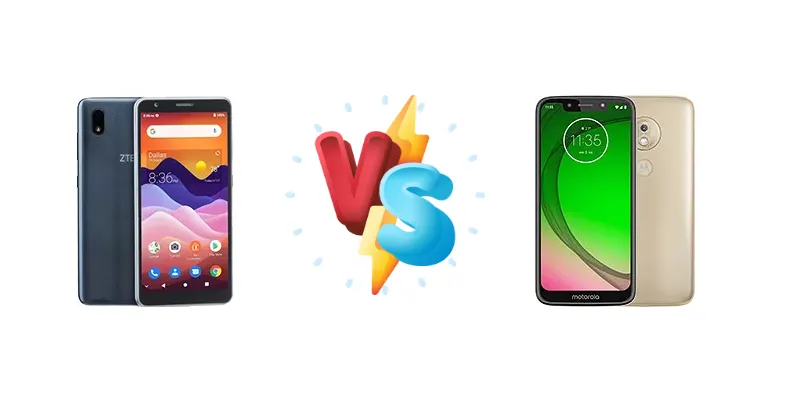
The ZTE Avid 579 and Motorola Moto G7 Play represent two compelling options in the ultra-budget smartphone space. Both aim to deliver essential smartphone functionality at a price point that won't break the bank, but they achieve this with significantly different hardware approaches. This comparison dissects those differences to help you determine which device best suits your needs.
🏆 Quick Verdict
For most users, the Motorola Moto G7 Play is the superior choice. Its Qualcomm Snapdragon 632 chipset provides a noticeably smoother and more responsive experience than the ZTE Avid 579’s MediaTek Helio A20, making it better suited for multitasking and app usage. While battery life is comparable, the G7 Play’s processing power offers a more enjoyable daily experience.
| Network |
|---|
| 2G bands | GSM 850 / 900 / 1800 / 1900 | GSM 850 / 900 / 1800 / 1900 |
| 3G bands | HSDPA 850 / 1700(AWS) / 1900 | HSDPA 850 / 900 / 1700(AWS) / 1900 / 2100 |
| 4G bands | 2, 4, 5, 12, 41, 66, 71 | 1, 2, 3, 4, 5, 7, 8, 20, 28, 38, 40, 41 - Europe |
| Speed | HSPA, LTE | HSPA 42.2/5.76 Mbps, LTE (2CA) Cat7 300/50 Mbps |
| Technology | GSM / HSPA / LTE | GSM / HSPA / LTE |
| | - | 1, 2, 3, 4, 5, 7, 8, 12, 13, 14, 17, 20, 25, 26, 29, 30, 38, 39, 40, 41, 41, 66, 71 - USA |
| Launch |
|---|
| Announced | 2020, June 24. Released 2020, June 24 | 2019, February. Released 2019, March |
| Status | Discontinued | Discontinued |
| Body |
|---|
| Build | - | Glass front (Gorilla Glass 3), plastic back, plastic frame |
| Dimensions | 147 x 71 x 9.6 mm (5.79 x 2.80 x 0.38 in) | 147.3 x 71.5 x 8 mm (5.80 x 2.81 x 0.31 in) |
| SIM | Nano-SIM | · Nano-SIM· Nano-SIM + Nano-SIM |
| Weight | 160 g (5.64 oz) | 149 g (5.26 oz) |
| | - | Splash resistant (market dependent) |
| Display |
|---|
| Protection | - | Corning Gorilla Glass 3 (market dependent) |
| Resolution | 720 x 1440 pixels, 18:9 ratio (~295 ppi density) | 720 x 1512 pixels, 19:9 ratio (~294 ppi density) |
| Size | 5.45 inches, 5.45, 76.7 cm2 (~73.4% screen-to-body ratio) | 5.7 inches, 81.4 cm2 (~77.3% screen-to-body ratio) |
| Type | TFT LCD | IPS LCD |
| Platform |
|---|
| CPU | Quad-core 1.8 GHz Cortex-A53 | Octa-core (4x1.8 GHz Kryo 250 Gold & 4x1.8 GHz Kryo 250 Silver) |
| Chipset | Mediatek MT6761D Helio A20 (12 nm) | Qualcomm SDM632 Snapdragon 632 (14 nm) |
| GPU | PowerVR GE8320 | Adreno 506 |
| OS | Android 10 | Android 9.0 (Pie), upgradable to Android 10 |
| Memory |
|---|
| Card slot | microSDXC | microSDXC (dedicated slot) |
| Internal | 32GB 2GB RAM | 32GB 2GB RAM, 32GB 3GB RAM |
| | - | eMMC 5.1 |
| Main Camera |
|---|
| Features | LED flash | LED flash, panorama, HDR |
| Single | 8 MP | 13 MP, f/2.0, 1/3.1", 1.12µm, PDAF |
| Video | - | 4K@30fps, 1080p@30fps |
| Selfie camera |
|---|
| Features | - | LED flash |
| Single | 2 MP | 8 MP, f/2.2, 1/4.0", 1.12µm |
| Video | - | 1080p@30fps |
| Sound |
|---|
| 3.5mm jack | Yes | Yes |
| 35mm jack | Yes | Yes |
| Loudspeaker | Yes | Yes |
| Comms |
|---|
| Bluetooth | 4.2, A2DP | 4.2, A2DP, LE |
| NFC | No | No |
| Positioning | GPS | GPS, GLONASS |
| Radio | FM Radio | FM radio |
| USB | microUSB | USB Type-C 2.0, OTG |
| WLAN | Wi-Fi 802.11 b/g/n | Wi-Fi 802.11 b/g/n |
| Features |
|---|
| Sensors | Accelerometer, proximity | Fingerprint (rear-mounted), accelerometer, gyro, proximity, compass |
| Battery |
|---|
| Charging | - | 10W wired |
| Type | Li-Ion 2660 mAh, removable | Li-Ion 3000 mAh, non-removable |
| Misc |
|---|
| Colors | Black | Deep indigo, Fine Gold, Starry Black |
| Models | - | XT1952-4, XT1952-5 |
| Price | About 20 EUR | About 160 EUR |
| SAR | - | 0.74 W/kg (head) 1.40 W/kg (body) |
| SAR EU | - | 0.84 W/kg (head) 0.85 W/kg (body) |
| Tests |
|---|
| Audio quality | - |
Noise -90.0dB / Crosstalk -92.9dB |
| Battery life | - | Endurance rating 103h |
| Camera | - |
Photo / Video |
| Display | - |
Contrast ratio: 1468:1 (nominal), 3.180 (sunlight) |
| Loudspeaker | - |
Voice 66dB / Noise 74dB / Ring 81dB |
| Performance | - |
AnTuTu: 97230 (v7)
GeekBench: 4154 (v4.4)
GFXBench: 7.7fps (ES 3.1 onscreen) |
ZTE Avid 579
- Potentially lower price point
- Functional for basic tasks
- Comparable battery endurance
- Significantly weaker processor
- Limited multitasking capabilities
- Unspecified display quality
Motorola Moto G7 Play
- More powerful Snapdragon 632 chipset
- Smoother user experience
- Better multitasking performance
- May be slightly more expensive
- 10W charging is relatively slow
- Camera quality likely average
Display Comparison
Both the ZTE Avid 579 and Motorola Moto G7 Play share a contrast ratio of 1468:1 (nominal) and 3.180 (sunlight), suggesting similar outdoor visibility. However, the context data lacks specifics on screen resolution or panel type for the Avid 579. The G7 Play’s display, while not exceptional, benefits from Qualcomm’s image processing capabilities, potentially offering slightly more accurate color reproduction. Without further data on the Avid 579’s panel, it’s difficult to assess its color accuracy or viewing angles.
Camera Comparison
Both devices are listed as having 'Photo / Video' capabilities, but lack specific details regarding sensor size, aperture, or features. Given the budget nature of both phones, image quality is unlikely to be a standout feature. It’s reasonable to assume the Moto G7 Play benefits from Qualcomm’s image signal processor (ISP), potentially offering better dynamic range and noise reduction compared to the Avid 579’s MediaTek ISP. However, without detailed camera specs, a definitive assessment is impossible. The presence of a 2MP macro camera on either device is likely a marketing gimmick with limited practical value.
Performance
The Motorola Moto G7 Play’s Qualcomm Snapdragon 632 (14nm) significantly outperforms the ZTE Avid 579’s MediaTek Helio A20 (12nm). The Snapdragon 632 utilizes an octa-core architecture (4x1.8 GHz Kryo 250 Gold & 4x1.8 GHz Kryo 250 Silver) compared to the Avid 579’s quad-core 1.8 GHz Cortex-A53. This translates to a more fluid multitasking experience and faster app loading times on the G7 Play. The 14nm process node of the Snapdragon 632, while older, is optimized for efficiency, and the octa-core design provides a substantial advantage in parallel processing tasks. Users who frequently switch between apps or engage in light gaming will find the G7 Play far more capable.
Battery Life
Both the ZTE Avid 579 and Motorola Moto G7 Play achieve an endurance rating of 103 hours, indicating comparable battery life under similar usage conditions. The G7 Play supports 10W wired charging, while the Avid 579’s charging speed is unspecified. While both offer adequate battery life for a full day of moderate use, the G7 Play’s more efficient chipset may contribute to slightly longer real-world battery performance, especially during demanding tasks. The lack of fast charging on either device means topping up the battery will take a considerable amount of time.
Buying Guide
Buy the ZTE Avid 579 if your primary need is a basic, functional smartphone for minimal tasks like calls, texts, and light web browsing, and you prioritize absolute lowest cost. Buy the Motorola Moto G7 Play if you value a more responsive user experience, smoother app performance, and a chipset capable of handling more demanding tasks, even within the budget category.
Frequently Asked Questions
❓ Is the MediaTek Helio A20 in the ZTE Avid 579 sufficient for running popular social media apps like Facebook and Instagram?
While the Helio A20 can technically run these apps, expect a less fluid experience compared to the Moto G7 Play. Scrolling may be less smooth, and app loading times will be noticeably slower. The Helio A20 is designed for very basic tasks, and social media apps can be surprisingly demanding.
❓ Does the Motorola Moto G7 Play support software updates beyond Android 9 Pie (its original OS)?
Software update support for the Moto G7 Play has been limited. It received one major Android update to Android 10, but further updates are unlikely. This is a common limitation with budget smartphones, so long-term software support shouldn't be a primary consideration.
❓ How does the Snapdragon 632 handle light gaming on the Motorola Moto G7 Play?
The Snapdragon 632 can handle light gaming, such as casual puzzle games or older titles, at playable frame rates. However, demanding 3D games will likely require reduced graphics settings and may still experience occasional stuttering. It's not a gaming phone, but it's significantly more capable than the Avid 579 for gaming.