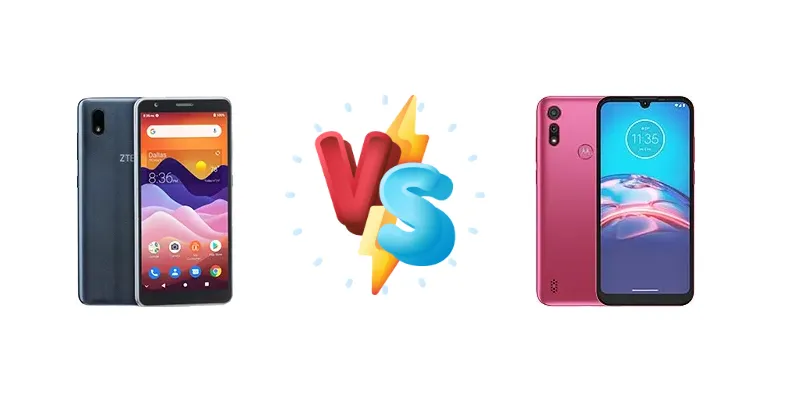
The ZTE Avid 579 and Motorola Moto E6i represent the extreme end of the smartphone price spectrum. Both aim to deliver essential functionality at a minimal cost, but they take drastically different approaches to achieving this. The Avid 579 prioritizes a newer, albeit less powerful, process node, while the Moto E6i opts for a higher core count. This comparison dissects these choices to determine which phone offers the best value for users on a tight budget.
🏆 Quick Verdict
For the average user prioritizing basic tasks like calling, texting, and light social media, the Motorola Moto E6i is the better choice. Its octa-core processor, despite being built on an older 28nm process, provides a noticeable performance advantage over the ZTE Avid 579’s quad-core setup, making everyday use smoother.
| Network |
|---|
| 2G bands | GSM 850 / 900 / 1800 / 1900 | GSM 850 / 900 / 1800 / 1900 |
| 3G bands | HSDPA 850 / 1700(AWS) / 1900 | HSDPA 850 / 900 / 1700(AWS) / 1900 / 2100 |
| 4G bands | 2, 4, 5, 12, 41, 66, 71 | 1, 2, 3, 4, 5, 7, 8, 19, 28, 66 |
| Speed | HSPA, LTE | HSPA, LTE |
| Technology | GSM / HSPA / LTE | GSM / HSPA / LTE |
| Launch |
|---|
| Announced | 2020, June 24. Released 2020, June 24 | 2021, February 11 |
| Status | Discontinued | Available. Released 2021, February 11 |
| Body |
|---|
| Build | - | Glass front, plastic back, plastic frame |
| Dimensions | 147 x 71 x 9.6 mm (5.79 x 2.80 x 0.38 in) | 155.6 x 73 x 8.5 mm (6.13 x 2.87 x 0.33 in) |
| SIM | Nano-SIM | Nano-SIM + Nano-SIM |
| Weight | 160 g (5.64 oz) | 160 g (5.64 oz) |
| Display |
|---|
| Resolution | 720 x 1440 pixels, 18:9 ratio (~295 ppi density) | 720 x 1560 pixels, 19.5:9 ratio (~282 ppi density) |
| Size | 5.45 inches, 5.45, 76.7 cm2 (~73.4% screen-to-body ratio) | 6.1 inches, 91.3 cm2 (~80.4% screen-to-body ratio) |
| Type | TFT LCD | IPS LCD |
| Platform |
|---|
| CPU | Quad-core 1.8 GHz Cortex-A53 | Octa-core (4x1.6 GHz Cortex-A55 & 4x1.2 GHz Cortex-A55) |
| Chipset | Mediatek MT6761D Helio A20 (12 nm) | Unisoc SC9863A (28 nm) |
| GPU | PowerVR GE8320 | IMG8322 |
| OS | Android 10 | Android 10 (Go edition) |
| Memory |
|---|
| Card slot | microSDXC | microSDXC (uses shared SIM slot) |
| Internal | 32GB 2GB RAM | 32GB 2GB RAM |
| | - | eMMC 5.1 |
| Main Camera |
|---|
| Dual | - | 13 MP, f/2.2, 26mm (wide), 1/3.1", 1.12µm, PDAF
Auxiliary lens |
| Features | LED flash | LED flash, HDR, panorama |
| Single | 8 MP | - |
| Video | - | 1080p@30fps |
| Selfie camera |
|---|
| Single | 2 MP | 5 MP, f/2.2, 27mm (wide), 1.12µm |
| Video | - | 1080p@30fps |
| Sound |
|---|
| 3.5mm jack | Yes | Yes |
| 35mm jack | Yes | Yes |
| Loudspeaker | Yes | Yes |
| Comms |
|---|
| Bluetooth | 4.2, A2DP | 4.2, A2DP, LE |
| NFC | No | No |
| Positioning | GPS | GPS, GLONASS |
| Radio | FM Radio | Unspecified |
| USB | microUSB | microUSB 2.0, OTG |
| WLAN | Wi-Fi 802.11 b/g/n | Wi-Fi 802.11 b/g/n |
| Features |
|---|
| Sensors | Accelerometer, proximity | Fingerprint (rear-mounted), accelerometer, proximity |
| Battery |
|---|
| Charging | - | 10W wired |
| Type | Li-Ion 2660 mAh, removable | Li-Ion 3000 mAh |
| Misc |
|---|
| Colors | Black | Titanium Gray, Pink |
| Models | - | XT2053-5 |
| Price | About 20 EUR | About 170 EUR |
ZTE Avid 579
- More modern 12nm process potentially offering better efficiency.
- Potentially better future software support due to newer chipset.
- Simpler architecture may lead to fewer software conflicts.
- Quad-core CPU limits multitasking and app responsiveness.
- Older Cortex-A53 cores are less performant.
- No specified charging speed.
Motorola Moto E6i
- Octa-core CPU provides smoother performance for everyday tasks.
- More modern Cortex-A55 cores offer improved efficiency per core.
- 10W wired charging provides a defined charging speed.
- Less efficient 28nm process may lead to higher power consumption.
- Unisoc chipset may have limited software support compared to Mediatek.
- Potentially more complex architecture could lead to software issues.
Display Comparison
Neither device boasts a standout display. Details regarding panel type, resolution, and brightness are unavailable, but given the price bracket, both likely utilize LCD panels with 720p+ resolutions. The focus here isn't on visual fidelity. However, the lack of display specifications highlights a common trade-off in this segment: compromises are made to keep costs down.
Camera Comparison
Camera performance is expected to be basic on both devices. Without specific sensor details, it’s safe to assume both feature low-resolution primary sensors paired with auxiliary lenses of questionable utility. Image quality will likely be acceptable in good lighting conditions but suffer in low light. The focus should not be on photographic capabilities when considering these phones.
Performance
The core difference lies in the chipsets. The ZTE Avid 579’s Mediatek MT6761D Helio A20 (12nm) features a quad-core Cortex-A53 CPU. While the 12nm process is more efficient, the A53 cores are older and less performant individually. Conversely, the Motorola Moto E6i’s Unisoc SC9863A (28nm) utilizes an octa-core configuration – four Cortex-A55 cores clocked at 1.6GHz and four at 1.2GHz. The Cortex-A55 is a more modern architecture than the A53, and the higher core count provides a significant advantage in multi-tasking and app responsiveness. The 28nm process is less efficient, potentially leading to slightly higher power consumption, but the performance gains are likely more noticeable in daily use.
Battery Life
Battery capacity details are missing for both devices. However, the Unisoc SC9863A in the Moto E6i supports 10W wired charging, a feature absent in the Avid 579’s specifications. While 10W isn’t fast charging by modern standards, it provides a defined charging speed. The less efficient 28nm process of the Unisoc chip may necessitate a larger battery to achieve comparable battery life to the Avid 579, but the E6i’s charging capability offers a tangible benefit.
Buying Guide
Buy the ZTE Avid 579 if you absolutely need the most modern chipset architecture available at this price point and anticipate minimal demanding usage. It's a good option for those who prioritize potential future software compatibility. Buy the Motorola Moto E6i if you prefer a more responsive experience for everyday tasks, even if it means sacrificing the latest process technology. The E6i is ideal for users who want a phone that 'just works' without frustrating lag.
Frequently Asked Questions
❓ Will the Motorola Moto E6i struggle with multiple apps open simultaneously?
While the Moto E6i isn't a powerhouse, its octa-core processor and 2GB of RAM (typical for this segment) are sufficient for handling a few apps concurrently. Expect some slowdown with very demanding applications or a large number of apps open, but it will outperform the ZTE Avid 579 in this scenario.
❓ Is the Unisoc SC9863A chipset known for overheating issues?
The Unisoc SC9863A is a low-power chipset designed for basic smartphone tasks. Overheating is unlikely to be a significant concern under normal usage conditions. However, prolonged gaming or intensive tasks may cause some warmth, but not to a degree that would cause performance throttling or discomfort.
❓ Can either of these phones handle popular mobile games like PUBG Mobile or Call of Duty Mobile?
Both phones will struggle to provide a smooth gaming experience with popular titles like PUBG Mobile or Call of Duty Mobile. While they may be able to run the games at the lowest settings, expect significant frame rate drops and lag. These phones are not designed for gaming.