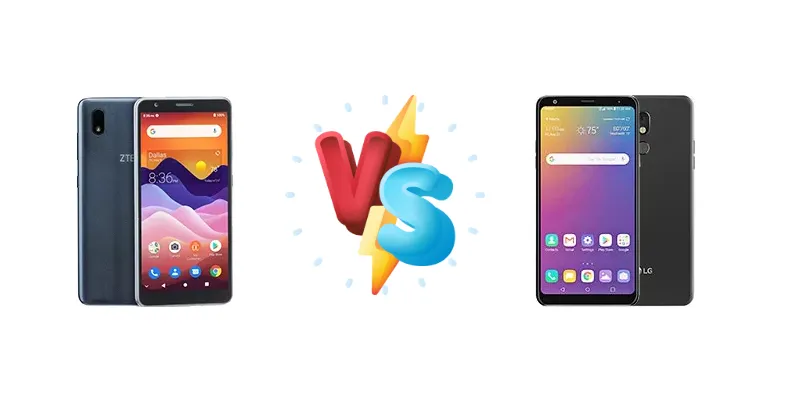
The ZTE Avid 579 and LG Stylo 5 represent two compelling options in the ultra-budget smartphone space. While both aim to deliver essential functionality at a low price point, they take different approaches to achieving this. The Avid 579 relies on MediaTek’s Helio A20, while the Stylo 5 opts for Qualcomm’s Snapdragon 450. This comparison will dissect the key differences to determine which device offers the best value for your money.
🏆 Quick Verdict
For the average user prioritizing multitasking and a more responsive experience, the LG Stylo 5 is the better choice. Its octa-core Snapdragon 450 provides a noticeable performance advantage over the Avid 579’s quad-core Helio A20, and the 20W charging is a significant convenience. However, the Avid 579 remains a viable option for extremely basic usage.
| Network |
|---|
| 2G bands | GSM 850 / 900 / 1800 / 1900 | GSM 850 / 900 / 1800 / 1900 |
| 3G bands | HSDPA 850 / 1700(AWS) / 1900 | HSDPA 850 / 1700(AWS) / 1900 |
| 4G bands | 2, 4, 5, 12, 41, 66, 71 | 2, 4, 5, 12, 14, 29, 30, 66 |
| Speed | HSPA, LTE | HSPA, LTE |
| Technology | GSM / HSPA / LTE | GSM / HSPA / LTE |
| Launch |
|---|
| Announced | 2020, June 24. Released 2020, June 24 | 2019, June. Released 2019, June |
| Status | Discontinued | Discontinued |
| Body |
|---|
| Build | - | Glass front (Gorilla Glass 5), aluminum back, aluminum frame |
| Dimensions | 147 x 71 x 9.6 mm (5.79 x 2.80 x 0.38 in) | 160 x 77.7 x 8.4 mm (6.30 x 3.06 x 0.33 in) |
| SIM | Nano-SIM | Nano-SIM |
| Weight | 160 g (5.64 oz) | 179 g (6.31 oz) |
| | - | Stylus |
| Display |
|---|
| Protection | - | Corning Gorilla Glass 5 |
| Resolution | 720 x 1440 pixels, 18:9 ratio (~295 ppi density) | 1080 x 2160 pixels, 18:9 ratio (~390 ppi density) |
| Size | 5.45 inches, 5.45, 76.7 cm2 (~73.4% screen-to-body ratio) | 6.2 inches, 99.2 cm2 (~79.8% screen-to-body ratio) |
| Type | TFT LCD | IPS LCD |
| Platform |
|---|
| CPU | Quad-core 1.8 GHz Cortex-A53 | Octa-core 1.8 GHz Cortex-A53 |
| Chipset | Mediatek MT6761D Helio A20 (12 nm) | Qualcomm SDM450 Snapdragon 450 (14 nm) |
| GPU | PowerVR GE8320 | Adreno 506 |
| OS | Android 10 | Android 9.0 (Pie) |
| Memory |
|---|
| Card slot | microSDXC | microSDXC (dedicated slot) |
| Internal | 32GB 2GB RAM | 32GB 3GB RAM |
| | - | eMMC 5.1 |
| Main Camera |
|---|
| Features | LED flash | LED flash, panorama, HDR |
| Single | 8 MP | 13 MP, PDAF |
| Video | - | 1080p@30fps |
| Selfie camera |
|---|
| Dual | - | 16 MP, f/2.0, 26mm (wide), 1/3.06", 1.0µm
8 MP |
| Single | 2 MP | 5 MP |
| Video | - | 1080p@30fps |
| Sound |
|---|
| 3.5mm jack | Yes | Yes |
| 35mm jack | Yes | Yes |
| Loudspeaker | Yes | Yes |
| Comms |
|---|
| Bluetooth | 4.2, A2DP | 4.2, A2DP, LE |
| NFC | No | No |
| Positioning | GPS | GPS |
| Radio | FM Radio | No |
| USB | microUSB | USB Type-C 2.0 |
| WLAN | Wi-Fi 802.11 b/g/n | Wi-Fi 802.11 a/b/g/n/ac, dual-band, Wi-Fi Direct |
| Features |
|---|
| Sensors | Accelerometer, proximity | Fingerprint (rear-mounted), accelerometer, proximity |
| Battery |
|---|
| Charging | - | 20W wired |
| Type | Li-Ion 2660 mAh, removable | Li-Ion 3500 mAh, non-removable |
| Misc |
|---|
| Colors | Black | Blonde Rose, Platinum Gray |
| Models | - | LM-Q720 |
| Price | About 20 EUR | About 200 EUR |
| Tests |
|---|
| Audio quality | - |
Noise-93.5dB / Crosstalk -92.0dB |
| Battery life | - |
Endurance rating 79h
|
| Camera | - |
Photo / Video |
| Display | - |
Contrast ratio: 1485 (nominal), 3.218 (sunlight) |
| Loudspeaker | - |
Voice 62dB / Noise 69dB / Ring 70dB
|
| Performance | - |
GeekBench: 4695 (v4.4)
GFXBench: 6fps (ES 3.1 onscreen) |
ZTE Avid 579
- Potentially longer battery life due to less powerful chipset.
- Likely more affordable price point.
- Simple and straightforward user experience.
- Significantly slower performance compared to the Stylo 5.
- Limited multitasking capabilities.
- Likely lower-quality display.
LG Stylo 5
- Faster and more responsive performance with the Snapdragon 450.
- 20W fast charging for quicker top-ups.
- Better display contrast for improved visibility.
- May have slightly shorter battery life than the Avid 579.
- Potentially higher price point.
- More complex software experience.
Display Comparison
The LG Stylo 5 boasts a contrast ratio of 1485 (nominal) and 3.218 (sunlight), suggesting better visibility in outdoor conditions compared to the ZTE Avid 579, which lacks detailed display specifications. While both likely utilize IPS LCD panels common in this price bracket, the Stylo 5’s higher contrast ratio indicates a more vibrant and readable image, particularly under direct sunlight. The absence of detailed display specs for the Avid 579 suggests a more basic panel, potentially impacting color accuracy and viewing angles.
Camera Comparison
Both phones likely feature basic camera setups geared towards casual photography. Without detailed sensor information, it’s difficult to make a definitive judgment. However, the LG Stylo 5’s inclusion of photo and video capabilities suggests a more feature-rich camera experience, even if the image quality remains modest. The Avid 579’s camera specs are not provided, implying a simpler, potentially lower-resolution camera system. It’s safe to assume neither phone will excel in low-light conditions.
Performance
The core difference lies in the chipsets. The LG Stylo 5’s Qualcomm Snapdragon 450, with its octa-core Cortex-A53 configuration, offers a significant advantage over the ZTE Avid 579’s MediaTek Helio A20, which features only four cores. While both CPUs are clocked at 1.8 GHz, the increased core count of the Snapdragon 450 translates to better multitasking and smoother performance in demanding applications. The Snapdragon 450’s 14nm process, while older, is also more efficient than the Helio A20’s 12nm process, potentially leading to slightly better thermal management under sustained load. This means the Stylo 5 is less likely to experience performance throttling during extended use.
Battery Life
The LG Stylo 5’s endurance rating of 79 hours is a strong indicator of excellent battery life. While the ZTE Avid 579’s battery capacity is unknown, the less powerful Helio A20 chipset likely contributes to good longevity. However, the Stylo 5’s 20W wired charging is a game-changer, allowing for significantly faster top-ups compared to the Avid 579, which likely supports slower charging speeds. This means less downtime and more time using the phone.
Buying Guide
Buy the ZTE Avid 579 if you need a phone for absolutely essential tasks – calls, texts, and very light app usage – and prioritize maximizing battery life above all else. Buy the LG Stylo 5 if you prefer a smoother, more capable experience for social media, streaming, and occasional gaming, and value faster charging speeds.
Frequently Asked Questions
❓ Is the Snapdragon 450 in the LG Stylo 5 powerful enough for basic gaming?
The Snapdragon 450 can handle less demanding mobile games at lower settings. While it won't deliver a high-end gaming experience, it's capable of running titles like Candy Crush or older, less graphically intensive games without significant lag. The ZTE Avid 579’s Helio A20 would struggle with even these basic games.
❓ How much faster is the charging on the LG Stylo 5 compared to the ZTE Avid 579?
The LG Stylo 5’s 20W charging is substantially faster than the likely 5W-10W charging supported by the ZTE Avid 579. This translates to a significantly reduced charging time – potentially going from 0% to 50% in around 30-45 minutes on the Stylo 5, compared to potentially over 2 hours on the Avid 579.
❓ Will the LG Stylo 5 overheat during prolonged use?
The Snapdragon 450 is a relatively efficient chipset. While it can get warm during extended gaming or video streaming, it’s unlikely to overheat to the point of causing performance issues or discomfort. The 14nm process helps manage thermal output effectively.