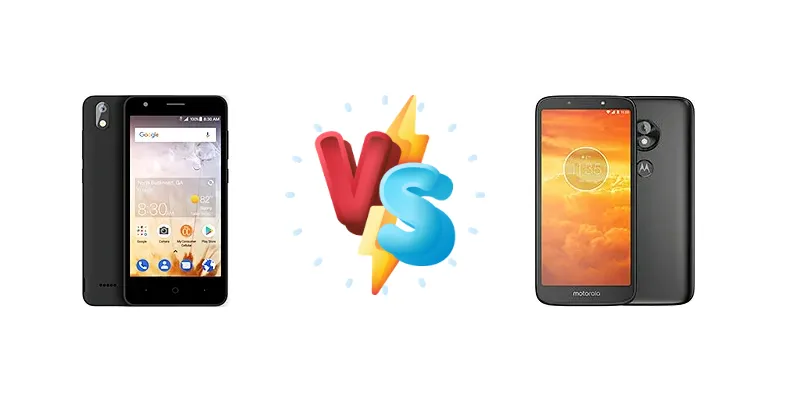
The ZTE Avid 559 and Motorola Moto E5 Play Go represent the extreme end of the smartphone price spectrum. Both devices target first-time smartphone buyers or those needing a reliable secondary device. However, beneath the similar price points lie key differences in their core processing power, stemming from the Qualcomm Snapdragon 210 in the Avid 559 and the Snapdragon 425 in the Moto E5 Play Go. This comparison dissects those differences to determine which phone offers the best value.
🏆 Quick Verdict
For the average user prioritizing responsiveness and a smoother experience, the Motorola Moto E5 Play Go is the better choice. Its Snapdragon 425, with its Cortex-A53 cores clocked at 1.4 GHz, provides a noticeable performance uplift over the ZTE Avid 559’s Snapdragon 210 and Cortex-A7 cores, making everyday tasks feel less sluggish.
| Network |
|---|
| 2G bands | GSM 850 / 1900 | GSM 850 / 900 / 1800 / 1900 |
| 3G bands | HSDPA 850 / 1700(AWS) / 1900 | HSDPA 850 / 900 / 1700(AWS) / 1900 / 2100 |
| 4G bands | 2, 4, 5, 12, 66, 71 | 2, 4, 5, 13 |
| Speed | HSPA, LTE | HSPA, LTE |
| Technology | GSM / HSPA / LTE | GSM / CDMA / HSPA / LTE |
| | - | CDMA 800 / 1900 |
| Launch |
|---|
| Announced | 2019, March. Released 2019, March | 2018, July. Released 2018, August |
| Status | Discontinued | Discontinued |
| Body |
|---|
| Dimensions | 147 x 71.9 x 9.4 mm (5.79 x 2.83 x 0.37 in) | 7.6 mm thickness |
| SIM | Nano-SIM | Nano-SIM |
| Weight | 145 g (5.11 oz) | 150.3 g (5.29 oz) |
| Display |
|---|
| Resolution | 480 x 854 pixels, 16:9 ratio (~196 ppi density) | 480 x 960 pixels, 18:9 ratio (~206 ppi density) |
| Size | 5.0 inches, 5.00, 68.9 cm2 (~65.2% screen-to-body ratio) | 5.2 inches, 69.8 cm2 |
| Type | TFT LCD | IPS LCD |
| Platform |
|---|
| CPU | Quad-core 1.1 GHz Cortex-A7 | Quad-core 1.4 GHz Cortex-A53 |
| Chipset | Qualcomm MSM8909 Snapdragon 210 (28 nm) | Qualcomm MSM8917 Snapdragon 425 (28 nm) |
| GPU | Adreno 304 | Adreno 308 |
| OS | Android 8.1 (Oreo) | Android 8.0 Oreo (Go edition) |
| Memory |
|---|
| Card slot | microSDXC | microSDXC (dedicated slot) |
| Internal | 16GB 2GB RAM | 16GB 1GB RAM |
| | eMMC 5.1 | eMMC 5.1 |
| Main Camera |
|---|
| Features | - | LED flash, panorama, HDR |
| Single | 5 MP | 8 MP, f/2.0, 1.12 µm, AF |
| Video | 720p@30fps | 1080p@30fps |
| Selfie camera |
|---|
| Features | - | LED flash |
| Single | 2 MP | 5 MP |
| Sound |
|---|
| 3.5mm jack | Yes | Yes |
| 35mm jack | Yes | Yes |
| Loudspeaker | Yes | Yes |
| Comms |
|---|
| Bluetooth | 4.2, A2DP | 4.2, A2DP |
| NFC | No | No |
| Positioning | GPS | GPS, GLONASS |
| Radio | FM Radio | FM radio |
| USB | USB Type-C 2.0 | microUSB 2.0 |
| WLAN | Wi-Fi 802.11 b/g/n | Wi-Fi 802.11 b/g/n |
| Features |
|---|
| Sensors | Accelerometer, proximity | Accelerometer |
| Battery |
|---|
| Type | Li-Ion 2200 mAh | Li-Ion 2800 mAh battery |
| Misc |
|---|
| Colors | Black | Black, Dark lake, Flash gray |
| Models | - | XT1921, MOTXT19218PP |
| Price | About 40 EUR | About 70 EUR |
ZTE Avid 559
- Lowest possible price point
- Functional for basic communication
- Simple and straightforward interface
- Sluggish performance with even moderate use
- Outdated processor architecture
- Limited multitasking capabilities
Motorola Moto E5 Play Go
- Noticeably smoother performance
- More efficient processor
- Better multitasking capabilities
- Still a budget device with limitations
- Camera quality is basic
- May be slightly more expensive than the Avid 559
Display Comparison
Neither device is expected to boast a high-quality display. Given the target market, both likely utilize LCD panels with modest resolutions. However, display quality isn't the differentiating factor here. The focus is on the processing power needed to drive the UI and apps *on* the display.
Camera Comparison
Both phones likely feature basic camera setups geared towards casual snapshots. Without specific sensor details, it’s safe to assume image quality will be similar in good lighting conditions. However, the Snapdragon 425’s slightly more capable ISP (Image Signal Processor) in the Moto E5 Play Go may offer marginally better image processing, particularly in low-light scenarios. Expect both to struggle with dynamic range and detail in challenging conditions.
Performance
The core difference lies in the chipsets. The Motorola Moto E5 Play Go’s Snapdragon 425, built on the same 28nm process as the Avid 559’s Snapdragon 210, features quad-core Cortex-A53 processors clocked at 1.4 GHz. This is a significant upgrade over the Avid 559’s quad-core Cortex-A7 processors running at 1.1 GHz. The Cortex-A53 architecture is substantially more efficient and powerful than the older Cortex-A7. This translates to faster app loading times, smoother multitasking, and a more responsive overall user experience on the Moto E5 Play Go. While both are 28nm, the architectural improvements of the A53 outweigh the process node similarity.
Battery Life
Battery life will largely depend on usage patterns. While specific battery capacities aren't provided, the Snapdragon 425’s improved efficiency should translate to slightly longer battery life on the Moto E5 Play Go, even with a similar battery size. The more efficient CPU requires less power to perform the same tasks, extending runtime between charges. Charging speeds are also likely to be similar, given the budget nature of both devices.
Buying Guide
Buy the ZTE Avid 559 if you absolutely need the lowest possible price and your smartphone usage is limited to basic calling, texting, and very light app use. It’s a functional device for minimal needs. Buy the Motorola Moto E5 Play Go if you value a more responsive user experience, even for basic tasks, and anticipate using apps like social media or light web browsing. The extra processing power offers a significant quality-of-life improvement.
Frequently Asked Questions
❓ Will the Motorola Moto E5 Play Go handle popular social media apps like Facebook and Instagram without significant lag?
Yes, the Snapdragon 425 in the Moto E5 Play Go provides enough processing power to run Facebook and Instagram relatively smoothly. While it won't offer a flagship-level experience, it will be significantly more responsive than the ZTE Avid 559, which may struggle with these apps.
❓ Is the ZTE Avid 559 suitable for a senior citizen who primarily needs a phone for calls and texts?
The ZTE Avid 559 is a viable option for a senior citizen with very basic needs. Its simplicity and low price point make it appealing. However, be aware that the slow processor may cause frustration when navigating menus or making adjustments to settings.
❓ Can either of these phones run modern mobile games?
Neither phone is well-suited for modern mobile gaming. The Snapdragon 210 and 425 are entry-level chipsets and will struggle with graphically demanding games. Simple, older games may be playable at low settings, but don't expect a good gaming experience.