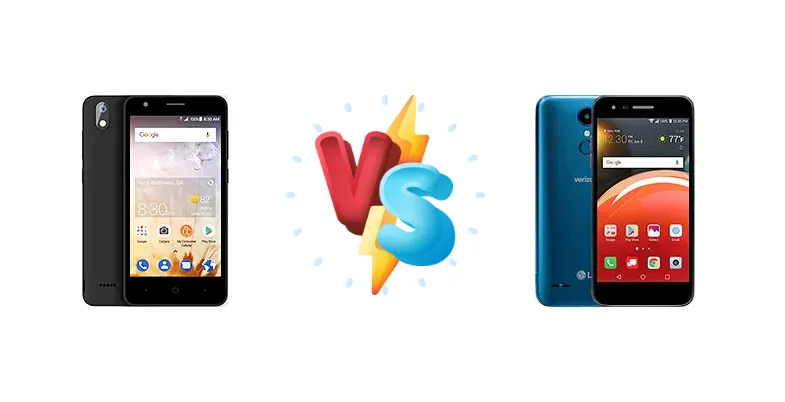
The ZTE Avid 559 and LG Zone 4 represent the lower end of the smartphone spectrum, often found as affordable options through carriers or unlocked. Both devices utilize Qualcomm Snapdragon processors, but significant differences in their chipsets dictate real-world performance and usability. This comparison dissects those differences, helping you determine which device best suits your needs.
🏆 Quick Verdict
For the average user prioritizing responsiveness and a smoother experience, the LG Zone 4 is the better choice. Its Snapdragon 425, with its Cortex-A53 cores clocked at 1.4 GHz, provides a noticeable performance uplift over the Avid 559’s Snapdragon 210. However, the Avid 559 may appeal to those seeking the absolute lowest price point.
| Network |
|---|
| 2G bands | GSM 850 / 1900 | GSM 850 / 900 / 1800 / 1900 |
| 3G bands | HSDPA 850 / 1700(AWS) / 1900 | HSDPA 2100 |
| 4G bands | 2, 4, 5, 12, 66, 71 | 2, 4, 5, 13 |
| Speed | HSPA, LTE | HSPA, LTE |
| Technology | GSM / HSPA / LTE | GSM / CDMA / HSPA / EVDO / LTE |
| | - | CDMA2000 1xEV-DO |
| Launch |
|---|
| Announced | 2019, March. Released 2019, March | 2018, March. Released 2018, March |
| Status | Discontinued | Discontinued |
| Body |
|---|
| Build | - | Glass front, plastic back, plastic frame |
| Dimensions | 147 x 71.9 x 9.4 mm (5.79 x 2.83 x 0.37 in) | 144.8 x 71.9 x 7.9 mm (5.70 x 2.83 x 0.31 in) |
| SIM | Nano-SIM | Nano-SIM |
| Weight | 145 g (5.11 oz) | 140.3 g (4.94 oz) |
| Display |
|---|
| Resolution | 480 x 854 pixels, 16:9 ratio (~196 ppi density) | 720 x 1280 pixels, 16:9 ratio (~294 ppi density) |
| Size | 5.0 inches, 5.00, 68.9 cm2 (~65.2% screen-to-body ratio) | 5.0 inches, 68.9 cm2 (~66.2% screen-to-body ratio) |
| Type | TFT LCD | IPS LCD |
| Platform |
|---|
| CPU | Quad-core 1.1 GHz Cortex-A7 | Quad-core 1.4 GHz Cortex-A53 |
| Chipset | Qualcomm MSM8909 Snapdragon 210 (28 nm) | Qualcomm MSM8917 Snapdragon 425 (28 nm) |
| GPU | Adreno 304 | Adreno 308 |
| OS | Android 8.1 (Oreo) | Android 7.1.2 (Nougat) |
| Memory |
|---|
| Card slot | microSDXC | microSDXC (dedicated slot) |
| Internal | 16GB 2GB RAM | 16GB 2GB RAM |
| | eMMC 5.1 | eMMC 5.1 |
| Main Camera |
|---|
| Features | - | LED flash, HDR |
| Single | 5 MP | 8 MP, AF |
| Video | 720p@30fps | 1080p@30fps |
| Selfie camera |
|---|
| Single | 2 MP | 5 MP |
| Sound |
|---|
| 3.5mm jack | Yes | Yes |
| 35mm jack | Yes | Yes |
| Loudspeaker | Yes | Yes |
| Comms |
|---|
| Bluetooth | 4.2, A2DP | 4.2, A2DP, LE |
| NFC | No | No |
| Positioning | GPS | GPS |
| Radio | FM Radio | No |
| USB | USB Type-C 2.0 | microUSB 2.0 |
| WLAN | Wi-Fi 802.11 b/g/n | Wi-Fi 802.11 b/g/n, Wi-Fi Direct |
| Features |
|---|
| Sensors | Accelerometer, proximity | Fingerprint (rear-mounted), accelerometer, proximity |
| Battery |
|---|
| Stand-by | - | Up to 400 h (3G) |
| Talk time | - | Up to 30 h (3G) |
| Type | Li-Ion 2200 mAh | Li-Ion 2500 mAh, removable |
| Misc |
|---|
| Colors | Black | Moroccan Blue |
| Price | About 40 EUR | About 100 EUR |
ZTE Avid 559
- Likely the most affordable option
- Functional for basic communication
- Simple and straightforward user experience
- Slow performance with the Snapdragon 210
- Struggles with multitasking
- Limited app compatibility
LG Zone 4
- Noticeably faster performance with Snapdragon 425
- More responsive user interface
- Better multitasking capabilities
- Slightly higher price point
- Still limited in terms of overall performance
- May not support all modern apps
Display Comparison
Neither ZTE nor LG provided detailed display specifications. Given the market segment, both likely utilize LCD panels with 720p resolutions. The real difference lies in the processing power driving them. A faster processor, like the one in the Zone 4, will translate to smoother scrolling and animations, even on a similar display. Expect both to have limited brightness and color accuracy.
Camera Comparison
Without detailed camera specs, it’s safe to assume both phones feature basic camera setups. Given the price point, image quality will be heavily reliant on software processing. The Snapdragon 425 in the Zone 4 has a slightly more capable ISP (Image Signal Processor) than the 210, potentially leading to better dynamic range and noise reduction. However, don't expect flagship-level photography from either device. Any claims of advanced features should be viewed skeptically.
Performance
The core distinction between these phones is the chipset. The LG Zone 4’s Snapdragon 425, built on the same 28nm process as the Avid 559’s Snapdragon 210, features quad-core Cortex-A53 CPUs clocked at 1.4 GHz. This is a significant upgrade over the Avid 559’s quad-core Cortex-A7 CPUs running at 1.1 GHz. The A53 architecture offers improved instruction set efficiency, resulting in faster application loading times and better multitasking. While both are 28nm, the A53’s design is more efficient, meaning the Zone 4 will likely experience less thermal throttling under sustained load. The Avid 559 will struggle with even moderately demanding apps.
Battery Life
Battery capacity is not specified for either device. However, the Snapdragon 425’s improved efficiency in the LG Zone 4 could translate to slightly better battery life despite potentially having a similar capacity to the Avid 559. The 425’s ability to complete tasks faster also means less time spent with the processor actively consuming power. Charging speeds are also likely to be similar, with both devices likely supporting standard 5W charging.
Buying Guide
Buy the ZTE Avid 559 if you need a functional smartphone for basic tasks like calls, texts, and light web browsing, and your budget is extremely limited. Buy the LG Zone 4 if you prefer a more responsive user experience, can tolerate slightly higher cost, and anticipate using apps beyond the most basic functionalities. The Zone 4 is better suited for users who occasionally browse social media or use simple productivity apps.
Frequently Asked Questions
❓ Will the LG Zone 4 handle basic social media apps like Facebook and Instagram without significant lag?
Yes, the Snapdragon 425 in the LG Zone 4 provides enough processing power to run basic social media apps like Facebook and Instagram reasonably well. While it won't offer a fluid experience like a higher-end device, it should be usable for casual browsing and posting. The ZTE Avid 559 will struggle significantly with these apps.
❓ Is the difference in CPU clock speed (1.1 GHz vs 1.4 GHz) really that noticeable in everyday use?
Yes, the 300 MHz difference, combined with the architectural improvements of the Cortex-A53 cores in the LG Zone 4, is quite noticeable. The A53 cores are more efficient and can process instructions faster, leading to quicker app loading times, smoother scrolling, and a more responsive overall experience. The Avid 559’s Cortex-A7 cores are older and less efficient.
❓ Can either of these phones play modern mobile games?
Neither phone is well-suited for modern, graphically demanding mobile games. The Snapdragon 210 in the Avid 559 will struggle with even older titles. The Snapdragon 425 in the Zone 4 might handle some less demanding games at low settings, but expect significant frame rate drops and lag. These phones are best suited for simple, 2D games.