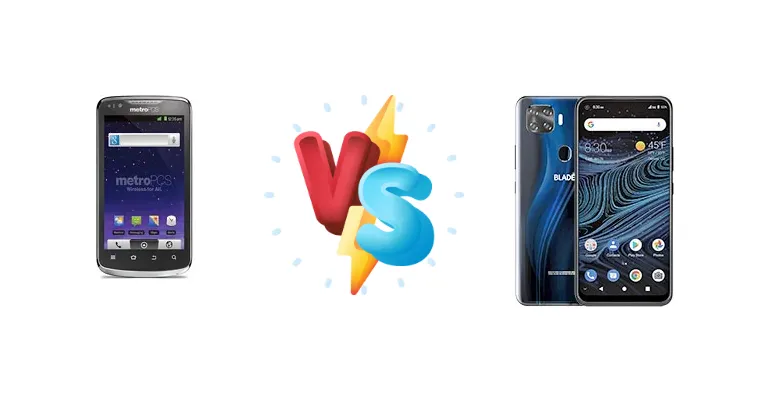
The ZTE Anthem 4G represents a reliable, established 4G experience, while the ZTE Blade X1 5G aims to bring next-generation connectivity and processing power to a budget-friendly price point. This comparison dissects the core differences between these two ZTE devices, focusing on how their hardware translates into real-world performance and value.
🏆 Quick Verdict
For most users, the ZTE Blade X1 5G is the superior choice. Its Snapdragon 765G chipset delivers significantly improved performance and future-proofs connectivity with 5G support. While the Anthem 4G offers a simpler experience, the X1 5G’s performance gains justify the likely price difference.
| Network |
|---|
| 2G bands | CDMA 800 / 1700 / 1900 / 2100 | GSM 850 / 900 / 1800 / 1900 |
| 3G bands | CDMA2000 1xEV-DO | HSDPA 850 / 900 / 1700(AWS) / 1900 / 2100 |
| 4G bands | 2, 4 | 2, 4, 5, 12, 13, 66 |
| 5G bands | - | 2, 5, 66 Sub6 |
| Speed | EV-DO Rev.A 3.1 Mbps, LTE | HSPA, LTE, 5G |
| Technology | CDMA / EVDO / LTE | GSM / HSPA / LTE / 5G |
| Launch |
|---|
| Announced | 2012, September. Released 2012, September | 2021, January 26 |
| Status | Discontinued | Available. Released 2021, January 26 |
| Body |
|---|
| Build | - | Glass front, plastic back, plastic frame |
| Dimensions | 130.1 x 68.1 x 13.7 mm (5.12 x 2.68 x 0.54 in) | 164 x 76 x 9.2 mm (6.46 x 2.99 x 0.36 in) |
| SIM | Mini-SIM | Nano-SIM |
| Weight | 189.9 g (6.67 oz) | 190 g (6.70 oz) |
| Display |
|---|
| Resolution | 480 x 800 pixels, 5:3 ratio (~217 ppi density) | 1080 x 2340 pixels, 19.5:9 ratio (~396 ppi density) |
| Size | 4.3 inches, 52.6 cm2 (~59.4% screen-to-body ratio) | 6.5 inches, 103.7 cm2 (~83.2% screen-to-body ratio) |
| Type | TFT, 256K colors | IPS LCD |
| Platform |
|---|
| CPU | Dual-core 1.2 GHz | Octa-core (1x2.4 GHz Kryo 475 Prime & 1x2.2 GHz Kryo 475 Gold & 6x1.8 GHz Kryo 475 Silver) |
| Chipset | Qualcomm Snapdragon | Qualcomm SM7250 Snapdragon 765G 5G (7 nm) |
| GPU | - | Adreno 620 |
| OS | Android 2.3 (Gingerbread) | Android 10 |
| Memory |
|---|
| Card slot | microSDHC (dedicated slot) | microSDXC |
| Internal | 4GB (2.3GB user available), 512MB RAM | 128GB 6GB RAM |
| Main Camera |
|---|
| Features | LED flash | LED flash, panorama, HDR |
| Quad | - | 48 MP, f/1.8, (wide), 1/2.0", 0.8µm, PDAF
8 MP, f/2.2, 120˚ (ultrawide)
2 MP (macro)
Auxiliary lens |
| Single | 5 MP, AF | - |
| Video | 1080p@30fps | 4K@30fps, 1080p@30fps |
| Selfie camera |
|---|
| Features | - | HDR |
| Single | VGA | 16 MP, f/2.0, (wide) |
| Video | - | 1080p@30fps |
| Sound |
|---|
| 3.5mm jack | Yes | Yes |
| 35mm jack | Yes | Yes |
| Loudspeaker | Yes | Yes |
| Comms |
|---|
| Bluetooth | Yes | 5.0, A2DP, LE |
| NFC | No | Yes |
| Positioning | GPS | GPS |
| Radio | No | No |
| USB | microUSB 2.0 | USB Type-C 2.0 |
| WLAN | Wi-Fi 802.11 b/g/n, hotspot | Wi-Fi 802.11 a/b/g/n/ac, dual-band |
| Features |
|---|
| Sensors | Accelerometer, proximity | Fingerprint (rear-mounted), accelerometer, gyro, proximity |
| | HDMI port
MP4/H.264 player
MP3/WAV/eAAC+ player
Photo viewer/editor | - |
| Battery |
|---|
| Charging | - | 18W wired |
| Stand-by | Up to 244 h | - |
| Talk time | Up to 4 h | - |
| Type | Li-Ion 1780 mAh, removable | Li-Ion 4000 mAh |
| Misc |
|---|
| Colors | Black | Dark Blue |
| Price | - | About 320 EUR |
ZTE Anthem 4G
- Simpler user experience
- Potentially lower price point
- Reliable 4G connectivity
- Outdated processor
- Limited performance for demanding tasks
- Likely slower charging
ZTE Blade X1 5G
- Significantly faster processor
- 5G connectivity for future-proofing
- 18W fast charging
- Potentially higher price
- More complex software experience
- 5G availability dependent on location
Display Comparison
The context data lacks display specifics for both devices. However, given the Anthem 4G’s age, it likely features a standard LCD panel with a 60Hz refresh rate. The Blade X1 5G, being a newer device, may incorporate a higher-quality panel, potentially with improved color accuracy and brightness. The absence of details like resolution and peak brightness makes a direct comparison difficult, but the X1 5G likely benefits from advancements in display technology during its production cycle.
Camera Comparison
Without specific camera sensor details, a detailed comparison is limited. However, the Blade X1 5G, as a more recent model, likely benefits from improved image processing algorithms and potentially larger sensor sizes. The Anthem 4G likely features a basic camera setup suitable for casual snapshots. The 765G’s image signal processor (ISP) offers more advanced features like improved low-light performance and faster autofocus, giving the X1 5G an edge in image quality. We can assume the X1 5G will offer a more versatile camera experience.
Performance
The performance gap between these devices is substantial. The ZTE Anthem 4G’s dual-core 1.2 GHz Snapdragon processor is significantly outmatched by the ZTE Blade X1 5G’s octa-core Snapdragon 765G (7nm). The 765G’s Kryo 475 architecture, with its Prime, Gold, and Silver cores clocked at 2.4 GHz, 2.2 GHz, and 1.8 GHz respectively, provides a far more responsive and capable experience for multitasking, gaming, and demanding applications. The 7nm process node of the 765G also contributes to improved power efficiency compared to the older Snapdragon in the Anthem 4G. This translates to better sustained performance and less thermal throttling under load.
Battery Life
The context data doesn’t provide battery capacities for either device. However, the Blade X1 5G’s 18W wired charging is a significant advantage over what the Anthem 4G likely offers. Faster charging reduces downtime and allows for quicker top-ups. While a larger battery capacity in the Anthem 4G could offset the slower charging, the 7nm efficiency of the 765G in the X1 5G suggests it can deliver comparable or even better battery life despite potentially having a smaller battery.
Buying Guide
Buy the ZTE Anthem 4G if you prioritize absolute simplicity and have no immediate need for 5G connectivity, or if you find it at a significantly discounted price. It’s a solid option for basic communication and light tasks. Buy the ZTE Blade X1 5G if you want a phone capable of handling more demanding apps, enjoy faster download speeds with 5G, and appreciate the benefits of a more modern processor for future software updates and longevity.
Frequently Asked Questions
❓ Will the ZTE Blade X1 5G actually get 5G speeds where I live?
5G availability varies greatly by location. Check your carrier's coverage map to confirm 5G service in your area before purchasing. Even with 5G coverage, speeds can be affected by network congestion and signal strength.
❓ Is the Snapdragon 765G in the Blade X1 5G powerful enough for modern mobile games?
Yes, the Snapdragon 765G is capable of running most modern mobile games at medium to high settings. While it won't match the performance of flagship Snapdragon 8-series chips, it provides a significant upgrade over the Anthem 4G’s processor and offers a smooth gaming experience for the majority of titles.
❓ Does the ZTE Blade X1 5G support VoLTE and VoWiFi for improved call quality?
The Snapdragon 765G inherently supports VoLTE (Voice over LTE) and VoWiFi (Voice over Wi-Fi). However, carrier support is essential. Confirm with your mobile carrier that they support VoLTE and VoWiFi on the ZTE Blade X1 5G to ensure optimal call quality.