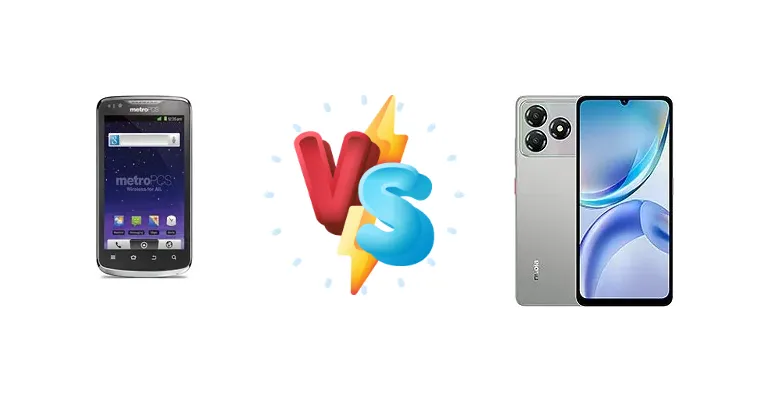
The ZTE Anthem 4G and Blade A36 represent ZTE's approach to the budget smartphone market, but cater to different priorities. The Anthem 4G, leveraging a Qualcomm Snapdragon chipset, aims for a balance of performance and affordability. In contrast, the Blade A36 prioritizes longevity with its Unisoc T7200 and impressive battery endurance, making it a compelling choice for users who value sustained usage over raw power.
🏆 Quick Verdict
For the average user prioritizing all-day battery life and consistent performance for everyday tasks, the ZTE Blade A36 is the clear winner. Its Unisoc T7200 chipset and exceptional 54:13h endurance significantly outweigh the Anthem 4G’s older Snapdragon platform, despite the latter’s potential for slightly faster burst performance.
| Network |
|---|
| 2G bands | CDMA 800 / 1700 / 1900 / 2100 | GSM 850 / 900 / 1800 / 1900 |
| 3G bands | CDMA2000 1xEV-DO | HSDPA 850 / 900 / 1900 / 2100 |
| 4G bands | 2, 4 | 1, 3, 5, 7, 8, 20, 28, 38, 40, 41 |
| Speed | EV-DO Rev.A 3.1 Mbps, LTE | HSPA, LTE |
| Technology | CDMA / EVDO / LTE | GSM / HSPA / LTE |
| Launch |
|---|
| Announced | 2012, September. Released 2012, September | 2025, June 18 |
| Status | Discontinued | Available. Released 2025, June |
| Body |
|---|
| Build | - | Glass front, plastic frame, plastic back |
| Dimensions | 130.1 x 68.1 x 13.7 mm (5.12 x 2.68 x 0.54 in) | 167.6 x 77.4 x 8.3 mm (6.60 x 3.05 x 0.33 in) |
| SIM | Mini-SIM | Nano-SIM + Nano-SIM |
| Weight | 189.9 g (6.67 oz) | - |
| Display |
|---|
| Protection | - | Mohs level 4 |
| Resolution | 480 x 800 pixels, 5:3 ratio (~217 ppi density) | 720 x 1600 pixels, 20:9 ratio (~260 ppi density) |
| Size | 4.3 inches, 52.6 cm2 (~59.4% screen-to-body ratio) | 6.75 inches, 110.0 cm2 (~84.8% screen-to-body ratio) |
| Type | TFT, 256K colors | IPS LCD, 90Hz |
| Platform |
|---|
| CPU | Dual-core 1.2 GHz | Octa-core (2x1.6 GHz Cortex-A75 & 6x1.6 GHz Cortex-A55) |
| Chipset | Qualcomm Snapdragon | Unisoc T7200 (12 nm) |
| GPU | - | Mali-G57 MP1 |
| OS | Android 2.3 (Gingerbread) | Android 15 |
| Memory |
|---|
| Card slot | microSDHC (dedicated slot) | microSDXC (dedicated slot) |
| Internal | 4GB (2.3GB user available), 512MB RAM | 64GB 4GB RAM |
| Main Camera |
|---|
| Features | LED flash | LED flash |
| Single | 5 MP, AF | 13 MP, AF
Auxiliary lens |
| Video | 1080p@30fps | 1080p@30fps |
| Selfie camera |
|---|
| Single | VGA | 5 MP |
| Video | - | Yes |
| Sound |
|---|
| 3.5mm jack | Yes | - |
| 35mm jack | Yes | Yes |
| Loudspeaker | Yes | Yes |
| Comms |
|---|
| Bluetooth | Yes | 5.2, A2DP, LE |
| NFC | No | No |
| Positioning | GPS | GPS, GALILEO, GLONASS |
| Radio | No | FM radio |
| USB | microUSB 2.0 | USB Type-C 2.0 |
| WLAN | Wi-Fi 802.11 b/g/n, hotspot | Wi-Fi 802.11 a/b/g/n/ac |
| Features |
|---|
| Sensors | Accelerometer, proximity | Accelerometer, proximity, compass |
| | HDMI port
MP4/H.264 player
MP3/WAV/eAAC+ player
Photo viewer/editor | - |
| Battery |
|---|
| Charging | - | 10W wired |
| Stand-by | Up to 244 h | - |
| Talk time | Up to 4 h | - |
| Type | Li-Ion 1780 mAh, removable | 5000 mAh |
| Misc |
|---|
| Colors | Black | Black, Green, Silver |
| Models | - | Z2472 |
| Price | - | About 60 EUR |
| EU LABEL |
|---|
| Battery | - | 54:13h endurance, 800 cycles |
| Energy | - | Class A |
| Free fall | - | Class D (80 falls) |
| Repairability | - | Class B |
ZTE Anthem 4G
- Potentially slightly faster burst performance for simple tasks.
- Qualcomm Snapdragon chipset is a known quantity.
- May be more readily available in certain markets.
- Outdated dual-core processor.
- Likely shorter battery life.
- Will struggle with multitasking and demanding apps.
ZTE Blade A36
- Exceptional battery life (54:13h endurance).
- Modern octa-core Unisoc T7200 processor.
- 800 charge cycles indicate long-term battery health.
- Slow 10W charging.
- Unisoc chipset may have limited software support.
- Camera performance likely basic.
Display Comparison
Display specifications are absent from the provided data, making a direct comparison impossible. However, given the market segment, both devices likely feature LCD panels. The Blade A36’s focus on endurance suggests a potentially lower-brightness panel to conserve power, while the Anthem 4G might prioritize slightly more vibrant colors. Without knowing resolution or refresh rate, it’s safe to assume both displays are adequate for basic consumption but won’t impress enthusiasts.
Camera Comparison
Camera details are lacking for both devices. Given their price point, expect basic camera setups. The absence of any sensor information suggests neither phone will excel in low-light photography. The Blade A36’s more modern chipset *could* offer slightly better image processing capabilities, but this is speculative. Users should not expect flagship-level camera performance from either device.
Performance
The core difference lies in the CPU. The ZTE Blade A36’s Unisoc T7200, an octa-core processor with a mix of Cortex-A75 and A55 cores, represents a significant architectural leap over the ZTE Anthem 4G’s dual-core 1.2 GHz Snapdragon. The T7200’s 12nm process node also contributes to improved efficiency. While the Snapdragon is a known quantity, the T7200’s eight cores will handle multitasking and more demanding applications far more effectively. The Anthem 4G will struggle with modern app bloat and complex tasks, while the Blade A36 offers a smoother, more responsive experience.
Battery Life
The ZTE Blade A36 dominates in battery performance. Its 54:13h endurance and 800 charge cycles are exceptional for a budget phone. This translates to multiple days of use for light users and a full day even with heavy usage. The Anthem 4G’s battery capacity is unknown, but given its older chipset and likely less efficient display, it will almost certainly fall short of the Blade A36’s longevity. The Blade A36’s 10W charging is slow, but the extended battery life mitigates this drawback.
Buying Guide
Buy the ZTE Anthem 4G if you need a phone for light tasks and occasional gaming, and are comfortable with potentially shorter battery life. Its Snapdragon chipset *might* offer a slight edge in responsiveness for simple apps. Buy the ZTE Blade A36 if you prioritize battery life above all else, and need a phone that can reliably last through a full day of moderate to heavy use. This is the phone for users who dislike frequent charging.
Frequently Asked Questions
❓ Is the Unisoc T7200 in the Blade A36 powerful enough for social media and web browsing?
Yes, the Unisoc T7200 is more than capable of handling social media, web browsing, and most everyday tasks. Its octa-core architecture provides ample processing power for smooth multitasking and responsive app loading, unlike the Anthem 4G’s older dual-core processor.
❓ How does the 10W charging on the Blade A36 affect the user experience, given its large battery?
While 10W charging is slow, the Blade A36’s exceptional battery life mitigates this issue. You won’t need to charge it as frequently as the Anthem 4G, and overnight charging is perfectly viable. The focus is on longevity, not speed.
❓ Will the ZTE Blade A36 receive software updates and security patches?
Software update support for ZTE’s budget devices can be inconsistent. While the Blade A36 runs on a relatively recent chipset, long-term software support is not guaranteed. Users should temper expectations regarding major Android version updates.