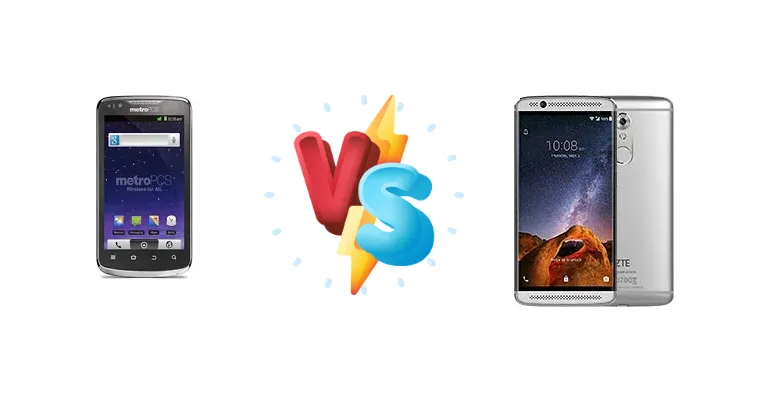
The ZTE Anthem 4G and Axon 7 mini represent ZTE's attempts to deliver affordable smartphones. While both target budget-conscious consumers, they differ significantly in their internal hardware. The Anthem 4G, with its older dual-core processor, contrasts sharply with the Axon 7 mini’s octa-core Snapdragon 617. This comparison will dissect these differences to determine which device offers the best value.
🏆 Quick Verdict
For the average user prioritizing multitasking and responsiveness, the ZTE Axon 7 mini is the clear winner. Its octa-core processor provides a significantly smoother experience than the Anthem 4G’s dual-core chip. While the Anthem 4G may suffice for basic tasks, the Axon 7 mini offers a more future-proof and enjoyable user experience.
| Network |
|---|
| 2G bands | CDMA 800 / 1700 / 1900 / 2100 | GSM 850 / 900 / 1800 / 1900 - SIM 1 & SIM 2 |
| 3G bands | CDMA2000 1xEV-DO | HSDPA 850 / 900 / 1700(AWS) / 1900 / 2100 |
| 4G bands | 2, 4 | 1, 2, 3, 4, 5, 7, 8, 12, 17, 20, 38, 40, 41 |
| Speed | EV-DO Rev.A 3.1 Mbps, LTE | HSPA 42.2/5.76 Mbps, LTE (2CA) Cat6 300/50 Mbps |
| Technology | CDMA / EVDO / LTE | GSM / CDMA / HSPA / LTE |
| | - | 1, 2, 3, 4, 5, 7, 8, 12, 17, 20, 41 - USA |
| Launch |
|---|
| Announced | 2012, September. Released 2012, September | 2016, September. Released 2016, October |
| Status | Discontinued | Discontinued |
| Body |
|---|
| Dimensions | 130.1 x 68.1 x 13.7 mm (5.12 x 2.68 x 0.54 in) | 147.5 x 71 x 7.8 mm (5.81 x 2.80 x 0.31 in) |
| SIM | Mini-SIM | Nano-SIM + Nano-SIM |
| Weight | 189.9 g (6.67 oz) | 153 g (5.40 oz) |
| Display |
|---|
| Protection | - | Corning Gorilla Glass 4 |
| Resolution | 480 x 800 pixels, 5:3 ratio (~217 ppi density) | 1080 x 1920 pixels, 16:9 ratio (~423 ppi density) |
| Size | 4.3 inches, 52.6 cm2 (~59.4% screen-to-body ratio) | 5.2 inches, 74.9 cm2 (~71.5% screen-to-body ratio) |
| Type | TFT, 256K colors | AMOLED |
| Platform |
|---|
| CPU | Dual-core 1.2 GHz | Octa-core (4x1.5 GHz Cortex-A53 & 4x1.2 GHz Cortex-A53) |
| Chipset | Qualcomm Snapdragon | Qualcomm MSM8952 Snapdragon 617 (28 nm) |
| GPU | - | Adreno 405 |
| OS | Android 2.3 (Gingerbread) | Android 6.1 (Marshmallow), upgradable to 7.1.1 (Nougat), MiFavor 4 |
| Memory |
|---|
| Card slot | microSDHC (dedicated slot) | microSDXC (uses shared SIM slot) |
| Internal | 4GB (2.3GB user available), 512MB RAM | 32GB 3GB RAM |
| | - | eMMC 5.1 |
| Main Camera |
|---|
| Features | LED flash | Dual-LED flash, panorama, HDR |
| Single | 5 MP, AF | 16 MP, f/1.9, PDAF |
| Video | 1080p@30fps | 1080p@30fps, 720p@120fps |
| Selfie camera |
|---|
| Single | VGA | 8 MP, f/2.2 |
| Video | - | 1080p@30fps |
| Sound |
|---|
| 3.5mm jack | Yes | Yes |
| 35mm jack | Yes | Yes |
| Loudspeaker | Yes | Yes, with stereo speakers |
| | - | 32-bit/192kHz audio |
| Comms |
|---|
| Bluetooth | Yes | 4.1, A2DP, LE |
| NFC | No | Yes |
| Positioning | GPS | GPS, GLONASS, BDS |
| Radio | No | No |
| USB | microUSB 2.0 | USB Type-C 2.0 |
| WLAN | Wi-Fi 802.11 b/g/n, hotspot | Wi-Fi 802.11 b/g/n, Wi-Fi Direct |
| Features |
|---|
| Sensors | Accelerometer, proximity | Fingerprint (rear-mounted), accelerometer, gyro, proximity, compass |
| | HDMI port
MP4/H.264 player
MP3/WAV/eAAC+ player
Photo viewer/editor | - |
| Battery |
|---|
| Charging | - | 18W wired, QC2, 46% in 30 min |
| Stand-by | Up to 244 h | Up to 270 h (3G) |
| Talk time | Up to 4 h | Up to 15 h (3G) |
| Type | Li-Ion 1780 mAh, removable | Li-Ion 2705 mAh, non-removable |
| Misc |
|---|
| Colors | Black | Ion Gold, Platinum Gray |
| Models | - | B2017G |
| Price | - | About 220 EUR |
ZTE Anthem 4G
- Potentially lower price point
- Functional for basic tasks
- Simple user interface (assumed)
- Outdated dual-core processor
- Poor multitasking performance
- Slow charging (assumed)
ZTE Axon 7 mini
- Octa-core Snapdragon 617 processor
- 18W Quick Charge 2.0 support
- Smoother user experience
- May be slightly more expensive
- Snapdragon 617 can still struggle with demanding games
- Limited RAM (assumed)
Display Comparison
Context data lacks display specifics for both devices. Given their market positioning, it's reasonable to assume both utilize IPS LCD panels. However, the Axon 7 mini, being a slightly later model, likely benefits from improved color calibration and potentially higher brightness. The absence of information regarding resolution or refresh rate makes a definitive comparison impossible, but the Axon 7 mini’s later release suggests a more refined visual experience.
Camera Comparison
Without detailed camera specifications, a direct comparison is limited. However, it’s safe to assume both devices feature modest camera setups geared towards casual photography. The Axon 7 mini, being a slightly more premium offering, likely incorporates a more capable image sensor and potentially better image processing algorithms. The presence of Quick Charge 2.0 on the Axon 7 mini suggests a focus on user experience, which could extend to camera performance through faster image capture and processing speeds.
Performance
The core difference lies in the processors. The ZTE Anthem 4G’s dual-core 1.2 GHz Snapdragon is significantly outmatched by the Axon 7 mini’s octa-core Snapdragon 617 (4x1.5 GHz Cortex-A53 & 4x1.2 GHz Cortex-A53). The 617’s architecture, utilizing a combination of faster and slower cores, allows for more efficient task handling. The Anthem 4G will struggle with multitasking and demanding applications, while the Axon 7 mini offers a smoother, more responsive experience. The 28nm process node of the Snapdragon 617, while not cutting-edge, is more efficient than what was likely used in the Anthem 4G, potentially leading to better thermal management under sustained load.
Battery Life
Battery capacity is not specified for either device. However, the Axon 7 mini’s 18W wired charging with Quick Charge 2.0 support is a significant advantage. The ability to gain 46% charge in 30 minutes is a substantial convenience. The Anthem 4G likely relies on slower charging speeds, resulting in longer downtime. While a larger battery capacity on the Anthem 4G could offset the slower charging, the Axon 7 mini’s quick charging capability provides a more practical benefit for daily use.
Buying Guide
Buy the ZTE Anthem 4G if you need a very basic smartphone for calls, texts, and light web browsing, and your budget is extremely limited. It's a functional device for minimal smartphone usage. Buy the ZTE Axon 7 mini if you prefer a more responsive experience for social media, streaming, and light gaming. The Axon 7 mini’s octa-core processor and faster charging capabilities make it a better all-around choice for most users.
Frequently Asked Questions
❓ Will the Snapdragon 617 in the Axon 7 mini overheat during extended gaming sessions?
The Snapdragon 617 is not a high-end gaming chip, and prolonged gaming will likely lead to some thermal throttling. However, its 28nm process node and the Axon 7 mini’s likely thermal design should prevent overheating to the point of complete performance shutdown. Expect reduced frame rates after extended play.
❓ Is the difference in performance between the Anthem 4G and Axon 7 mini noticeable for everyday tasks like browsing and social media?
Yes, the difference is quite noticeable. The Anthem 4G’s dual-core processor will exhibit lag and slowdowns when switching between apps or loading complex web pages. The Axon 7 mini’s octa-core processor provides a much smoother and more responsive experience for these everyday tasks.
❓ Does the Axon 7 mini's Quick Charge 2.0 require a special charger?
While the Axon 7 mini supports Quick Charge 2.0, it will still charge with a standard 5W charger, albeit much slower. To take full advantage of the 18W charging speed, you'll need a Quick Charge 2.0 compatible charger and cable.