
ZTE A41 Ultra vs Honor Magic4 Pro: A Deep Dive into Performance and Power
| Phones Images | |||||
|---|---|---|---|---|---|
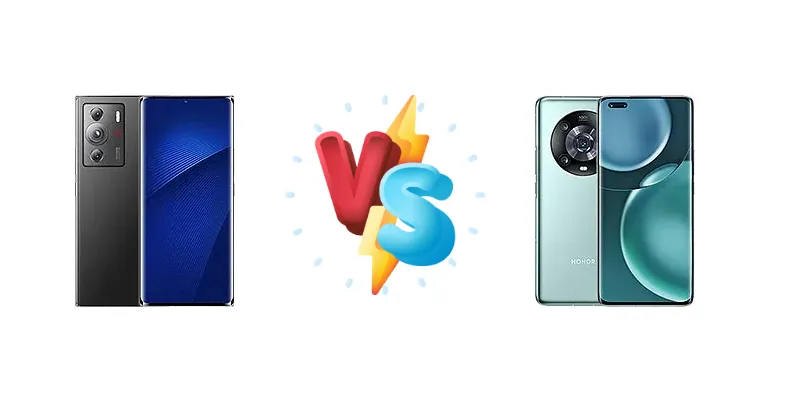
|
🏆 Quick Verdict
For users prioritizing ultimate charging convenience and a slightly longer endurance rating, the Honor Magic4 Pro is the clear winner. Its 100W wired and wireless charging capabilities drastically reduce downtime. However, the ZTE A41 Ultra remains a strong contender, offering a similar performance profile at a potentially lower price point.
| PHONES | ||
|---|---|---|
| Phone Names | ZTE A41 Ultra | Honor Magic4 Pro |
| Network | ||
|---|---|---|
| 2G bands | GSM 850 / 900 / 1800 / 1900 | GSM 850 / 900 / 1800 / 1900 |
| 3G bands | HSDPA 850 / 900 / 2100 | HSDPA 800 / 850 / 900 / 1700(AWS) / 1900 / 2100 |
| 4G bands | LTE | 1, 2, 3, 4, 5, 7, 8, 12, 17, 18, 19, 20, 26, 28, 34, 38, 39, 40, 41 - China |
| 5G bands | SA/NSA | 1, 3, 5, 8, 28, 38, 41, 77, 78, 79 SA/NSA - China |
| Speed | HSPA, LTE, 5G | HSPA, LTE, 5G |
| Technology | GSM / CDMA / HSPA / LTE / 5G | GSM / CDMA / HSPA / EVDO / LTE / 5G |
| - | CDMA2000 1xEV-DO | |
| Launch | ||
|---|---|---|
| Announced | 2022 | 2022, February 28 |
| Status | Available. Released 2022 | Available. Released 2022, April 09 |
| Body | ||
|---|---|---|
| Build | Glass front, glass back, aluminum frame | Glass front, aluminum frame, glass back |
| Dimensions | 161.9 x 72.9 x 8.5 mm (6.37 x 2.87 x 0.33 in) | 163.6 x 74.7 x 9.1 mm or 9.2 mm |
| SIM | Nano-SIM + Nano-SIM | · Nano-SIM + eSIM· Nano-SIM + Nano-SIM |
| Weight | 199 g (7.02 oz) | 209 g / 215 g (7.37 oz) |
| - | IP68 dust/water resistant (up to 1.5m for 30 min) | |
| Display | ||
|---|---|---|
| Protection | - | Aluminosilicate glass |
| Resolution | 1080 x 2400 pixels, 20:9 ratio (~395 ppi density) | 1312 x 2848 pixels, 19.5:9 ratio (~460 ppi density) |
| Size | 6.67 inches, 107.4 cm2 (~91.0% screen-to-body ratio) | 6.81 inches, 113.7 cm2 (~93.0% screen-to-body ratio) |
| Type | AMOLED, 1B colors, 144Hz | LTPO OLED, 1B colors, 120Hz, HDR10+, 1000 nits (peak) |
| Platform | ||
|---|---|---|
| CPU | Octa-core (1x3.00 GHz Cortex-X2 & 3x2.50 GHz Cortex-A710 & 4x1.80 GHz Cortex-A510) | Octa-core (1x3.00 GHz Cortex-X2 & 3x2.50 GHz Cortex-A710 & 4x1.80 GHz Cortex-A510) |
| Chipset | Qualcomm SM8450 Snapdragon 8 Gen 1 (4 nm) | Qualcomm SM8450 Snapdragon 8 Gen 1 (4 nm) |
| GPU | Adreno 730 | Adreno 730 |
| OS | Android 12, MyOS 12 | Android 12, Magic UI 6 |
| Memory | ||
|---|---|---|
| Card slot | No | No |
| Internal | 256GB 8GB RAM, 256GB 12GB RAM, 512GB 12GB RAM | 256GB 8GB RAM, 256GB 12GB RAM, 512GB 12GB RAM |
| Main Camera | ||
|---|---|---|
| Features | LED flash, HDR, panorama | Laser AF, color spectrum sensor, LED flash, HDR, panorama |
| Single | - | 12 MP, f/2.4, 100˚ (ultrawide), 1.22µm TOF 3D, (depth/biometrics sensor) |
| Triple | 64 MP, f/1.7, 35mm (standard), 1/1.7", PDAF, OIS 8 MP, f/3.4, 125mm (periscope telephoto), 1/4.0", PDAF, OIS, 5x optical zoom 50 MP, f/2.2, 14mm, 116˚ (ultrawide) | 50 MP, f/1.8, 23mm (wide), 1/1.56", 1.0µm, multi-directional PDAF 50 MP, f/2.2, 122˚ (ultrawide), 1/2.5", AF 64 MP, f/3.5, 90mm (periscope telephoto), 1/2.0", 0.7µm, PDAF, OIS, 3.5x optical zoom TOF 3D (depth) |
| Video | Yes | 4K@30/60fps, 1080p@30/60fps, gyro-EIS, HDR10, 10-bit video |
| Selfie camera | ||
|---|---|---|
| Features | - | HDR |
| Single | 44 MP, (wide) | 12 MP, f/2.4, 100˚ (ultrawide), 1.22µm TOF 3D, (depth/biometrics sensor) |
| Video | Yes | 4K@30fps, 1080p@30fps |
| Sound | ||
|---|---|---|
| 3.5mm jack | - | No |
| 35mm jack | Unspecified | No |
| Loudspeaker | Yes | Yes, with stereo speakers |
| - | 24-bit audio stereo recording | |
| Comms | ||
|---|---|---|
| Bluetooth | 5.2, A2DP, LE, aptX HD, aptX Adaptive | 5.2, A2DP, LE, aptX HD |
| Infrared port | - | Yes |
| NFC | Yes | Yes |
| Positioning | GPS (L1+L5), GLONASS, GALILEO, BDS, QZSS | GPS (L1+L5), GLONASS (L1), BDS (B1I+B1c+B2a), GALILEO (E1+E5a) |
| Radio | No | No |
| USB | USB Type-C 3.1, OTG | USB Type-C 3.1, OTG |
| WLAN | Wi-Fi 802.11 a/b/g/n/ac/6e, dual-band, Wi-Fi Direct | Wi-Fi 802.11 a/b/g/n/ac/6, dual-band, Wi-Fi Direct |
| Features | ||
|---|---|---|
| Sensors | Fingerprint (under display, optical), accelerometer, gyro, proximity, compass | Fingerprint (under display, ultrasonic), Face ID, accelerometer, gyro, proximity, compass |
| Battery | ||
|---|---|---|
| Charging | 66W wired, PD3.0, QC4 | 100W wired, 100% in 30 min 100W wireless, 50% in 15 min Reverse wireless 5W reverse wired |
| Type | 5000 mAh | Li-Po 4600 mAh |
| Misc | ||
|---|---|---|
| Colors | Black | Black, White, Cyan, Gold, Orange |
| Models | - | LGE-NX9, LGE-N49B, LGE-N19B, LGE-AN10, GBD-NX9 |
| Price | - | € 469.41 / £ 397.48 |
| Tests | ||
|---|---|---|
| Battery life | - | Endurance rating 82h |
| Camera | - | Photo / Video |
| Display | - | Contrast ratio: Infinite (nominal) |
| Loudspeaker | - | -23.6 LUFS (Very good) |
| Performance | - | AnTuTu: 980755 (v9) GeekBench: 3512 (v5.1) GFXBench: 59fps (ES 3.1 onscreen) |
ZTE A41 Ultra
- Potentially lower price point
- Snapdragon 8 Gen 1 performance
- 66W fast charging
- Slower charging compared to Honor
- Limited battery information
Honor Magic4 Pro
- 100W wired and wireless charging
- 82-hour endurance rating
- Reverse wireless and wired charging
- Potentially higher price
- Snapdragon 8 Gen 1 performance (potential for throttling)
Display Comparison
The Honor Magic4 Pro boasts a measured peak brightness of 957 nits, suggesting a more visible display in direct sunlight compared to the ZTE A41 Ultra (brightness data unavailable). While both likely utilize high-refresh-rate OLED panels, the Honor’s infinite contrast ratio (nominal) indicates a potentially superior viewing experience with deeper blacks. Without specific panel technology details for the ZTE, it’s difficult to assess potential differences in color accuracy or viewing angles, but the Magic4 Pro’s brightness advantage is a clear differentiator.
Camera Comparison
Both phones feature 'Photo / Video' capabilities, but lack specific sensor details. Without knowing megapixel counts, sensor sizes, or aperture values, a direct comparison is limited. The presence of OIS (Optical Image Stabilization) is assumed on both, given their flagship status. Image processing styles will likely differ – Honor often leans towards vibrant, saturated colors, while ZTE may aim for a more natural look. The absence of detailed camera specs makes it impossible to declare a clear winner based on the provided data.
Performance
Both devices are powered by the Qualcomm SM8450 Snapdragon 8 Gen 1 (4 nm) chipset, featuring the same CPU configuration: 1x3.00 GHz Cortex-X2, 3x2.50 GHz Cortex-A710, and 4x1.80 GHz Cortex-A510 cores. This means raw processing power will be largely identical. However, thermal management – not explicitly stated – will be crucial. The 4nm process node aims for efficiency, but sustained workloads could still induce throttling. The Honor Magic4 Pro’s larger chassis *may* offer slightly better thermal dissipation, but real-world testing is needed to confirm. RAM speed (LPDDR5x) is also unspecified for both, but is a key factor in sustained performance.
Battery Life
The Honor Magic4 Pro’s charging capabilities are its standout feature: 100W wired charging, achieving a full charge in just 30 minutes, and 100W wireless charging, reaching 50% in 15 minutes. It also includes reverse wireless and 5W reverse wired charging for topping up accessories. The ZTE A41 Ultra offers a more modest 66W wired charging with PD3.0 and QC4 support. Both devices share an endurance rating of 82 hours, suggesting similar overall battery life despite the charging speed disparity. The Honor’s faster charging effectively mitigates any potential battery life differences, offering greater convenience for power users.
Buying Guide
Buy the ZTE A41 Ultra if you need a high-performance Snapdragon 8 Gen 1 device and are comfortable with a more conventional charging experience. It's ideal for users who prioritize value and don't require the absolute fastest charging speeds. Buy the Honor Magic4 Pro if you prioritize minimizing downtime with its groundbreaking 100W wired and wireless charging, and appreciate the convenience of reverse wireless charging, even if it comes at a potentially higher cost.