
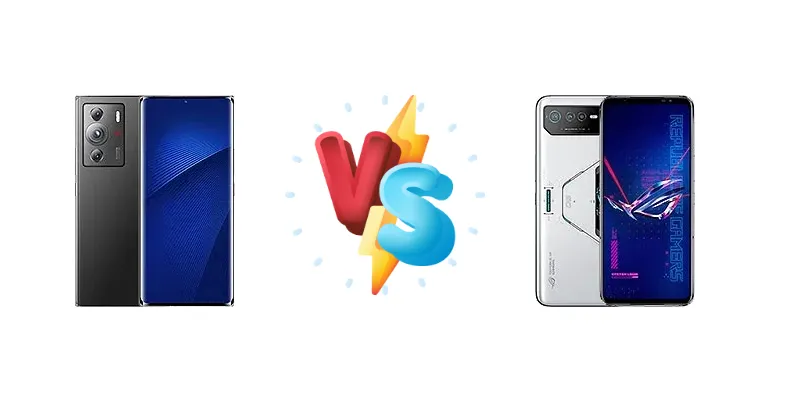
ZTE A41 Ultra vs. Asus ROG Phone 6 Pro: A Deep Dive into Gaming and Performance
| Phones Images | |||||
|---|---|---|---|---|---|
|
🏆 Quick Verdict
For the average user prioritizing a well-rounded experience, the Asus ROG Phone 6 Pro emerges as the stronger contender. Its Snapdragon 8+ Gen 1 chipset offers superior thermal management and sustained performance, coupled with a comparable battery life and faster 65W charging. While the ZTE A41 Ultra is a capable device, the ROG Phone 6 Pro’s gaming-centric features and optimized performance give it the edge.
| PHONES | ||
|---|---|---|
| Phone Names | ZTE A41 Ultra | Asus ROG Phone 6 Pro |
| Network | ||
|---|---|---|
| 2G bands | GSM 850 / 900 / 1800 / 1900 | GSM 850 / 900 / 1800 / 1900 |
| 3G bands | HSDPA 850 / 900 / 2100 | HSDPA 800 / 850 / 900 / 1700(AWS) / 1900 / 2100 |
| 4G bands | LTE | 1, 2, 3, 4, 5, 7, 8, 12, 13, 17, 18, 19, 20, 25, 26, 28, 29, 30, 32, 34, 38, 39, 40, 41, 42, 43, 48, 66, 71 - Version A |
| 5G bands | SA/NSA | 1, 2, 3, 5, 7, 8, 12, 13, 18, 20, 25, 26, 28, 38, 40, 41, 48, 66, 71, 77, 78, 79 SA/NSA/Sub6 - Version A |
| Speed | HSPA, LTE, 5G | HSPA 42.2/5.76 Mbps, LTE (6CA) Cat20 2024/210 Mbps, 5G |
| Technology | GSM / CDMA / HSPA / LTE / 5G | GSM / CDMA / HSPA / LTE / 5G |
| - | 1, 3, 5, 8, 28, 41, 77, 78, 79 - Version B | |
| Launch | ||
|---|---|---|
| Announced | 2022 | 2022, July 05 |
| Status | Available. Released 2022 | Available. Released 2022, July 13 |
| Body | ||
|---|---|---|
| Build | Glass front, glass back, aluminum frame | Glass front (Gorilla Glass Victus), glass back (Gorilla Glass 3), aluminum frame |
| Dimensions | 161.9 x 72.9 x 8.5 mm (6.37 x 2.87 x 0.33 in) | 173 x 77 x 10.3 mm (6.81 x 3.03 x 0.41 in) |
| SIM | Nano-SIM + Nano-SIM | Nano-SIM + Nano-SIM |
| Weight | 199 g (7.02 oz) | 239 g (8.43 oz) |
| - | IPX4 water resistant 2" OLED display (on the back) Pressure sensitive zones (Gaming triggers) | |
| Display | ||
|---|---|---|
| Protection | - | Corning Gorilla Glass Victus |
| Resolution | 1080 x 2400 pixels, 20:9 ratio (~395 ppi density) | 1080 x 2448 pixels (~395 ppi density) |
| Size | 6.67 inches, 107.4 cm2 (~91.0% screen-to-body ratio) | 6.78 inches, 109.5 cm2 (~82.2% screen-to-body ratio) |
| Type | AMOLED, 1B colors, 144Hz | AMOLED, 1B colors, 165Hz, HDR10+, 800 nits (typ), 1200 nits (peak) |
| Platform | ||
|---|---|---|
| CPU | Octa-core (1x3.00 GHz Cortex-X2 & 3x2.50 GHz Cortex-A710 & 4x1.80 GHz Cortex-A510) | Octa-core (1x3.19 GHz Cortex-X2 & 3x2.75 GHz Cortex-A710 & 4x1.80 GHz Cortex-A510) |
| Chipset | Qualcomm SM8450 Snapdragon 8 Gen 1 (4 nm) | Qualcomm SM8475 Snapdragon 8+ Gen 1 (4 nm) |
| GPU | Adreno 730 | Adreno 730 |
| OS | Android 12, MyOS 12 | Android 12, upgradable to Android 13 |
| Memory | ||
|---|---|---|
| Card slot | No | No |
| Internal | 256GB 8GB RAM, 256GB 12GB RAM, 512GB 12GB RAM | 512GB 18GB RAM |
| - | UFS 3.1 NTFS support for external storage | |
| Main Camera | ||
|---|---|---|
| Features | LED flash, HDR, panorama | LED flash, HDR, panorama |
| Triple | 64 MP, f/1.7, 35mm (standard), 1/1.7", PDAF, OIS 8 MP, f/3.4, 125mm (periscope telephoto), 1/4.0", PDAF, OIS, 5x optical zoom 50 MP, f/2.2, 14mm, 116˚ (ultrawide) | 50 MP, f/1.9, (wide), 1/1.56", 1.0µm, PDAF 13 MP, f/2.2, (ultrawide) 5 MP (macro) |
| Video | Yes | 8K@24fps, 4K@30/60/120fps, 1080p@30/60/120/240fps, 720p@480fps; gyro-EIS |
| Selfie camera | ||
|---|---|---|
| Features | - | Panorama, HDR |
| Single | 44 MP, (wide) | 12 MP, 28mm (wide) |
| Video | Yes | 1080p@30fps |
| Sound | ||
|---|---|---|
| 3.5mm jack | - | Yes |
| 35mm jack | Unspecified | Yes |
| Loudspeaker | Yes | Yes, with stereo speakers (2 amplifiers) |
| - | 32-bit/384kHz audio | |
| Comms | ||
|---|---|---|
| Bluetooth | 5.2, A2DP, LE, aptX HD, aptX Adaptive | 5.2, A2DP, LE, aptX HD, aptX Adaptive, aptX Lossless |
| NFC | Yes | Yes |
| Positioning | GPS (L1+L5), GLONASS, GALILEO, BDS, QZSS | GPS (L1+L5), GLONASS (L1), BDS (B1I+B1c+B2a), GALILEO (E1+E5a), QZSS (L1+L5), NavIC (L5) |
| Radio | No | No |
| USB | USB Type-C 3.1, OTG | USB Type-C 3.1 (side), USB Type-C 2.0 (bottom), OTG, accessory connector |
| WLAN | Wi-Fi 802.11 a/b/g/n/ac/6e, dual-band, Wi-Fi Direct | Wi-Fi 802.11 a/b/g/n/ac/6e, tri-band, Wi-Fi Direct |
| Features | ||
|---|---|---|
| Sensors | Fingerprint (under display, optical), accelerometer, gyro, proximity, compass | Fingerprint (under display, optical), accelerometer, gyro, proximity, compass |
| Battery | ||
|---|---|---|
| Charging | 66W wired, PD3.0, QC4 | 65W wired, PD3.0, QC5, 100% in 42 min 10W reverse wired |
| Type | 5000 mAh | Li-Po 6000 mAh |
| Misc | ||
|---|---|---|
| Colors | Black | Storm White |
| Models | - | AI2201_D |
| Price | - | About 800 EUR |
| Tests | ||
|---|---|---|
| Battery life | - | Endurance rating 119h |
| Camera | - | Photo / Video |
| Display | - | Contrast ratio: Infinite (nominal) |
| Loudspeaker | - | -24.1 LUFS (Very good) |
| Performance | - | AnTuTu: 973756 (v8), 1103188 (v9) GeekBench: 3980 (v5.1) GFXBench: 79fps (ES 3.1 onscreen) |
ZTE A41 Ultra
- Fast 66W wired charging
- Balanced flagship features
- Potentially more understated design
- Snapdragon 8 Gen 1 prone to throttling
- Less optimized for gaming
- Limited camera details available
Asus ROG Phone 6 Pro
- Snapdragon 8+ Gen 1 offers superior performance
- Faster 65W charging with QC5
- Gaming-centric features (AirTriggers)
- Gaming aesthetic may not appeal to everyone
- Potentially higher price point
- Large form factor
Display Comparison
Both devices offer large displays, but the Asus ROG Phone 6 Pro boasts a measured peak brightness of 829 nits, suggesting a more visible screen outdoors compared to the ZTE A41 Ultra (brightness data unavailable). While both likely utilize high refresh rate panels, the ROG Phone 6 Pro’s infinite contrast ratio (nominal) indicates a superior OLED panel capable of deeper blacks and more vibrant colors. The absence of LTPO information for either device means we can’t assess dynamic refresh rate capabilities, but the ROG Phone 6 Pro’s display is likely optimized for gaming with faster response times.
Camera Comparison
Both phones feature photo and video capabilities, but detailed camera specifications are limited. Without sensor size or aperture data, a direct comparison is difficult. However, given Asus’s history with ROG phones, the camera is likely tuned for vibrant, shareable images rather than professional-grade accuracy. The ZTE A41 Ultra may offer a more balanced camera experience, but without specific details, it’s impossible to definitively say. The inclusion of a 2MP macro camera on either device is likely a marketing feature with limited real-world utility.
Performance
The Asus ROG Phone 6 Pro’s Snapdragon 8+ Gen 1 (4nm) represents a significant upgrade over the ZTE A41 Ultra’s Snapdragon 8 Gen 1 (4nm). The 8+ Gen 1 features a higher peak CPU clock speed (3.19 GHz vs 3.00 GHz) and more efficient architecture, resulting in improved sustained performance and reduced thermal throttling. Both utilize the same core configuration (1x Cortex-X2, 3x Cortex-A710, 4x Cortex-A510), but the ROG Phone 6 Pro’s chipset will consistently deliver higher frame rates in demanding games. The ROG Phone 6 Pro also benefits from optimized cooling solutions, further enhancing its performance capabilities.
Battery Life
Both the ZTE A41 Ultra and Asus ROG Phone 6 Pro achieve an endurance rating of 119 hours, suggesting comparable battery life under similar usage conditions. However, the ROG Phone 6 Pro’s 65W charging with QC5 support and a reported 42-minute 0-100% charge time is significantly faster than the ZTE A41 Ultra’s 66W charging with PD3.0 and QC4. The ROG Phone 6 Pro also offers 10W reverse wired charging, a feature absent on the A41 Ultra, adding to its versatility.
Buying Guide
Buy the ZTE A41 Ultra if you need a powerful, all-around flagship with fast 66W charging and prefer a more understated design. It’s ideal for users who enjoy gaming but don’t require the specialized features of a dedicated gaming phone. Buy the Asus ROG Phone 6 Pro if you prioritize maximum gaming performance, sustained frame rates, and features like AirTriggers. This phone is built for enthusiasts who demand the best possible mobile gaming experience and are willing to pay a premium for it.