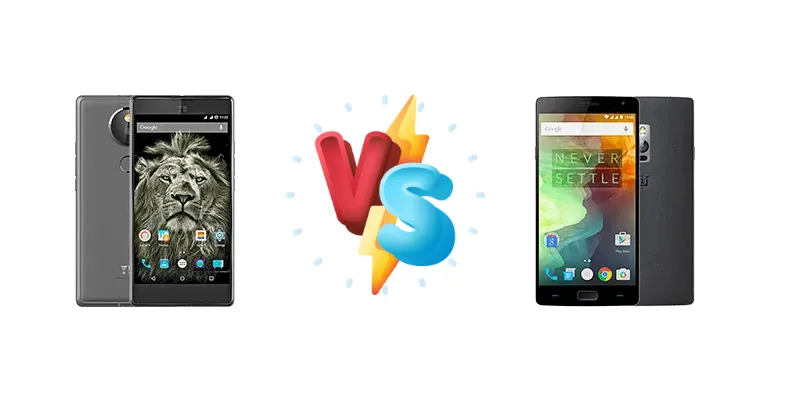
The YU Yutopia and OnePlus 2 were both ambitious attempts to deliver flagship specs at a more accessible price point. Released around the same time, they promised powerful performance and premium features. But which phone ultimately delivered a better experience? Let's find out.
🏆 Quick Verdict
Both phones share the Snapdragon 810 chipset, but the OnePlus 2 edges out the Yutopia thanks to its slightly better software support and display contrast. While both offer solid performance, the OnePlus 2's overall package feels more refined, making it the slightly preferable choice.
| Network |
|---|
| 2G bands | GSM 900 / 1800 / 1900 - SIM 1 & SIM 2 | GSM 850 / 900 / 1800 / 1900 - SIM 1 & SIM 2 |
| 3G bands | HSDPA 900 / 2100 | HSDPA 850 / 900 / 1900 / 2100 |
| 4G bands | 3, 5, 7, 20, 40 | 1, 3, 5, 7, 8, 20, 38, 40, 41 |
| Speed | HSPA 42.2/5.76 Mbps, LTE Cat4 150/50 Mbps | HSPA 42.2/5.76 Mbps, LTE Cat4 150/50 Mbps |
| Technology | GSM / HSPA / LTE | GSM / HSPA / LTE |
| Launch |
|---|
| Announced | 2015, December. Released 2015, December | 2015, July. Released 2015, August |
| Status | Discontinued | Discontinued |
| Body |
|---|
| Build | - | Glass front (Gorilla Glass 3), plastic back, aluminum frame |
| Dimensions | 146.6 x 72.7 x 7.2 mm (5.77 x 2.86 x 0.28 in) | 151.8 x 74.9 x 9.9 mm (5.98 x 2.95 x 0.39 in) |
| SIM | Nano-SIM + Micro-SIM | Nano-SIM + Nano-SIM |
| Weight | 159 g (5.61 oz) | 175 g (6.17 oz) |
| Display |
|---|
| Protection | Corning Concore Glass | Corning Gorilla Glass 3 |
| Resolution | 1440 x 2560 pixels, 16:9 ratio (~565 ppi density) | 1080 x 1920 pixels, 16:9 ratio (~401 ppi density) |
| Size | 5.2 inches, 74.5 cm2 (~69.9% screen-to-body ratio) | 5.5 inches, 83.4 cm2 (~73.3% screen-to-body ratio) |
| Type | IPS LCD | IPS LCD |
| Platform |
|---|
| CPU | Octa-core (4x2.0 GHz Cortex A57 & 4x1.5 GHz Cortex-A53) | Octa-core (4x1.56 GHz Cortex-A53 & 4x1.82 GHz Cortex-A57) |
| Chipset | Qualcomm MSM8994 Snapdragon 810 (20 nm) | Qualcomm MSM8994 Snapdragon 810 (20 nm) |
| GPU | Adreno 430 | Adreno 430 |
| OS | Android 5.1.1 (Lollipop), Cyanogen 12.1 | Android 5.1 (Lollipop), upgradable to 6.0.1 (Marshmallow), Oxygen 3.5.6 UI |
| Memory |
|---|
| Card slot | microSDXC (uses shared SIM slot) | No |
| Internal | 32GB 4GB RAM | 16GB 3GB RAM, 64GB 4GB RAM |
| | eMMC 5.0 | eMMC 5.0 |
| Main Camera |
|---|
| Features | Dual-LED dual-tone flash, HDR, panorama | Laser AF, Dual-LED flash, panorama, HDR |
| Single | 21 MP, f/2.2, 27mm (wide), 1/2.4", 1.12µm, PDAF, OIS | 13 MP, f/2.0, 1/2.6", 1.3µm, OIS |
| Video | 4K@30fps, 720p@120fps | 4K@30fps, 4K(DCI)@24fps, 1080p@60fps, 720p@120fps, HDR, stereo sound rec. |
| Selfie camera |
|---|
| Single | 8 MP, f/2.2, 1/3.2", 1.4µm | 5 MP, f/2.4 |
| Video | - | 720p@30fps |
| Sound |
|---|
| 3.5mm jack | Yes | Yes |
| 35mm jack | Yes | Yes |
| Loudspeaker | Yes, with stereo speakers | Yes |
| Comms |
|---|
| Bluetooth | 4.1, A2DP, LE | 4.1, A2DP |
| NFC | No | No |
| Positioning | GPS, GLONASS | GPS, GLONASS |
| Radio | FM radio | No |
| USB | microUSB 2.0, OTG | USB Type-C 2.0 |
| WLAN | Wi-Fi 802.11 a/b/g/n/ac, Wi-Fi Direct, hotspot | Wi-Fi 802.11 a/b/g/n/ac, Wi-Fi Direct, DLNA, hotspot |
| Features |
|---|
| Sensors | Fingerprint (rear-mounted), accelerometer, gyro, proximity, barometer, compass | Fingerprint (front-mounted), accelerometer, gyro, proximity, compass |
| Battery |
|---|
| Charging | 18W wired, QC2 | - |
| Stand-by | Up to 300 h (3G) | - |
| Talk time | Up to 8 h (3G) | - |
| Type | Li-Po 3000 mAh, non-removable | Li-Po 3300 mAh, non-removable |
| Misc |
|---|
| Colors | Silver | Sandstone Black |
| Models | YU5050 | ONE A2003, ONE A2005, ONE A2001 |
| Price | About 420 EUR | About 300 EUR |
| SAR EU | - | 0.43 W/kg (head) 0.20 W/kg (body) |
| Tests |
|---|
| Audio quality | - |
Noise -94.2dB / Crosstalk -94.3dB |
| Battery life | - | Endurance rating 61h |
| Camera | - |
Photo / Video |
| Display | - |
Contrast ratio: 1187 (nominal), 2.165 (sunlight) |
| Loudspeaker | - |
Voice 75dB / Noise 73dB / Ring 80dB |
| Performance | - |
Basemark OS II 2.0: 1622Basemark X: 21937 |
YU Yutopia
- Powerful Snapdragon 810 chipset
- Excellent battery life
- Competitive price at launch
- Large 5.5-inch display
- Software updates were inconsistent
- Thermal throttling issues
- Less refined design
- Camera performance could be improved
OnePlus 2
- Slightly better display contrast
- More consistent software experience (initially)
- Premium design (for the time)
- Excellent battery life
- Snapdragon 810 thermal throttling
- Camera performance was average
- OxygenOS updates slowed down over time
- Fingerprint sensor issues
Display Comparison
Both phones featured 5.5-inch displays, but the OnePlus 2 boasted a significantly higher contrast ratio, particularly in sunlight (2.165 vs nominal 1187). While both were LCD panels, the OnePlus 2's display offered better visibility and color reproduction. The Yutopia's display was adequate but lacked the vibrancy of the OnePlus 2.
Camera Comparison
Camera performance was a mixed bag on both devices. Both featured decent camera hardware, but image quality varied depending on lighting conditions. The OnePlus 2 generally produced slightly more consistent results, with better color accuracy and dynamic range. Low-light performance was a weakness for both phones.
Performance
Both devices utilized the Snapdragon 810 chipset, but with slightly different CPU configurations. The Yutopia had a 4x2.0 GHz Cortex A57 & 4x1.5 GHz Cortex-A53 setup, while the OnePlus 2 used 4x1.56 GHz Cortex-A53 & 4x1.82 GHz Cortex-A57. Real-world performance was generally comparable, though both phones were known to experience thermal throttling under sustained load. Software optimization played a larger role in the overall experience.
Battery Life
Both phones achieved an impressive endurance rating of 61 hours, indicating excellent battery life. This was a significant strength for both devices, allowing for extended usage without frequent charging.
Buying Guide
The YU Yutopia is a good option for those seeking raw power on a budget and don't mind a potentially less polished software experience. The OnePlus 2 is better suited for users who value a slightly better display, a more consistent software experience, and a device that felt a bit more premium overall.
Frequently Asked Questions
❓ Which phone had better software support?
Initially, the OnePlus 2 had better software support with OxygenOS. However, updates slowed down significantly over time. The YU Yutopia's software support was inconsistent from the start.
❓ Did both phones suffer from thermal throttling?
Yes, both the YU Yutopia and OnePlus 2 were known to experience thermal throttling under sustained load due to the Snapdragon 810 chipset.