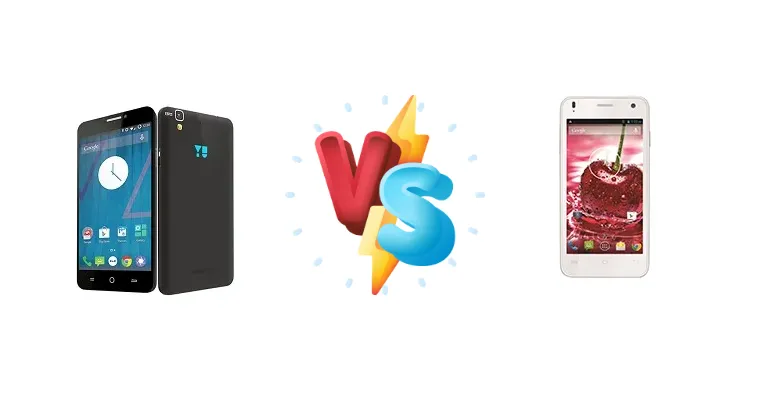
The YU Yureka and Lava Iris X1 were both contenders in the budget smartphone market, offering affordable options for users. But which one truly delivered the best value? This comprehensive comparison dives deep into their specs, performance, and features to help you decide.
🏆 Quick Verdict
The YU Yureka clearly wins this comparison. Its Snapdragon 615 chipset provides significantly better performance than the Lava Iris X1's Broadcom chip. While both are budget phones, the Yureka offers a smoother experience and more future-proofing.
| Network |
|---|
| 2G bands | GSM 900 / 1800 / 1900 - SIM 1 & SIM 2 | GSM 900 / 1800 - SIM 1 & SIM 2 |
| 3G bands | HSDPA 900 / 2100 | HSDPA 2100 |
| 4G bands | 3, 40 | - |
| Speed | HSPA 42.2/11.5 Mbps, LTE Cat4 150/50 Mbps | HSPA |
| Technology | GSM / HSPA / LTE | GSM / HSPA |
| Launch |
|---|
| Announced | 2015, January. Released 2015, January | 2014, May. Released 2014, May |
| Status | Discontinued | Discontinued |
| Body |
|---|
| Dimensions | 154.8 x 78 x 6 - 8.8 mm | 134 x 66 x 8.9 mm (5.28 x 2.60 x 0.35 in) |
| SIM | Dual SIM (Micro-SIM, dual stand-by) | Dual SIM |
| Weight | 155 g (5.47 oz) | 138 g (4.87 oz) |
| Display |
|---|
| Protection | Corning Gorilla Glass 3 | - |
| Resolution | 720 x 1280 pixels, 16:9 ratio (~267 ppi density) | 480 x 854 pixels, 16:9 ratio (~218 ppi density) |
| Size | 5.5 inches, 83.4 cm2 (~69.1% screen-to-body ratio) | 4.5 inches, 55.8 cm2 (~63.1% screen-to-body ratio) |
| Type | IPS LCD | IPS LCD |
| | Cyanogen 12.1 | - |
| Platform |
|---|
| CPU | Octa-core (4x1.7 GHz Cortex-A53 & 4x1.0 GHz Cortex-A53) | Quad-core 1.2 GHz |
| Chipset | Qualcomm MSM8939 Snapdragon 615 (28 nm) | Broadcom BCM23550 |
| GPU | Adreno 405 | Broadcom VideoCore IV |
| OS | Android 4.4.4 (KitKat), upgradable to 5.1 (Lollipop) | Android 4.4.2 (KitKat) |
| Memory |
|---|
| Card slot | microSDHC (dedicated slot) | microSDHC |
| Internal | 16GB 2GB RAM | 8GB 1GB RAM |
| | eMMC 4.5 | - |
| Main Camera |
|---|
| Features | LED flash, panorama | LED flash |
| Single | 13 MP, f/2.2, 1/3.1", 1.12µm, AF | 8 MP, AF |
| Video | 1080p@30fps | 1080p@30fps |
| Selfie camera |
|---|
| Single | 5 MP | 2 MP |
| Sound |
|---|
| 3.5mm jack | Yes | Yes |
| 35mm jack | Yes | Yes |
| Loudspeaker | Yes | Yes |
| Comms |
|---|
| Bluetooth | 4.0, A2DP | 4.0, LE |
| NFC | No | No |
| Positioning | GPS | GPS |
| Radio | FM radio | FM radio, recording |
| USB | microUSB 2.0 | microUSB 2.0 |
| WLAN | Wi-Fi 802.11 b/g/n, hotspot | Wi-Fi 802.11 b/g/n, hotspot |
| Features |
|---|
| Sensors | Accelerometer, gyro, proximity | Accelerometer, proximity |
| Battery |
|---|
| Stand-by | Up to 210 h | - |
| Talk time | Up to 8 h | Up to 9 h 45 min |
| Type | Li-Po 2500 mAh, removable | Li-Ion 2100 mAh, removable |
| Misc |
|---|
| Colors | Moonstone Grey | Black, White |
| Models | AO5510 | - |
| Price | About 130 EUR | About 100 EUR |
YU Yureka
- Superior Performance (Snapdragon 615)
- Better Multitasking
- More Future-Proof
- Generally Better Camera
- Potentially Older Software Updates
- Design might feel dated
Lava Iris X1
- Lower Price Point
- Basic Functionality
- Weak Performance (Broadcom Chip)
- Limited Multitasking
- Poor Gaming Performance
- Inferior Camera Quality
- Less Efficient
Display Comparison
The YU Yureka typically featured a 5.5-inch 720p display, offering decent viewing angles and color reproduction for its price range. The Lava Iris X1 likely had a similar sized display, but potentially with lower brightness and color accuracy. The Yureka's slightly better panel generally provided a more enjoyable viewing experience.
Camera Comparison
The Yureka generally had a 13MP rear camera and a 5MP front camera, offering acceptable image quality in good lighting conditions. The Lava Iris X1 likely had a similar resolution, but image processing and sensor quality were likely inferior, resulting in less detailed and potentially noisier photos. Low-light performance would be noticeably worse on the Iris X1.
Performance
This is where the Yureka shines. The Snapdragon 615 octa-core processor is considerably more powerful than the Lava Iris X1's quad-core Broadcom chip. Expect smoother multitasking, faster app loading times, and better gaming performance on the Yureka. The Iris X1 would likely struggle with demanding apps and games.
Battery Life
Both phones likely featured around 2500mAh batteries. Battery life would depend heavily on usage, but the Yureka's more efficient chipset might give it a slight edge in overall endurance.
Buying Guide
The YU Yureka is ideal for users who prioritize performance and a smoother Android experience, even on a budget. The Lava Iris X1 might appeal to those seeking the absolute lowest price point and basic functionality, but be prepared for compromises.
Frequently Asked Questions
❓ Is the YU Yureka still worth buying?
While older, the Yureka's performance still holds up reasonably well for basic tasks. However, consider newer budget options with more modern software and features.
❓ What are the main differences between the YU Yureka and Lava Iris X1?
The primary difference is the chipset. The YU Yureka's Snapdragon 615 offers significantly better performance than the Lava Iris X1's Broadcom chip, impacting everything from app loading to gaming.