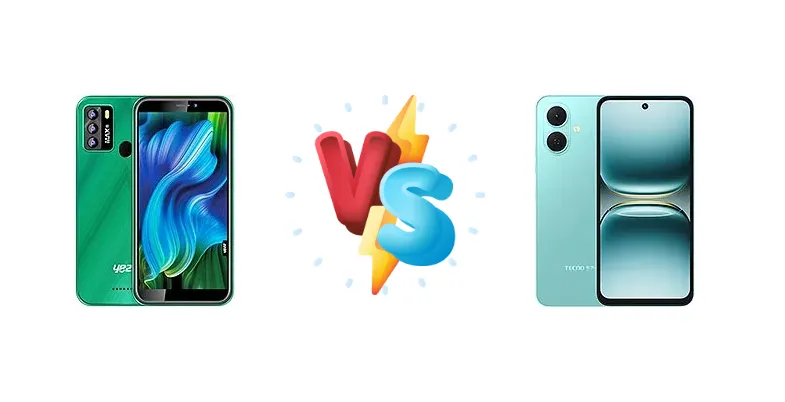
The Yezz Max 3 and Tecno Spark Go 2 represent the extreme lower end of the smartphone market, targeting users with minimal budgets. However, even within this segment, significant differences exist. The Tecno Spark Go 2, with its newer chipset, aims to deliver a more responsive experience, while the Yezz Max 3 focuses on basic functionality. This comparison dissects these differences to determine which device offers the best value.
🏆 Quick Verdict
For the average user, the Tecno Spark Go 2 is the clear winner. Its Unisoc T7250 chipset, featuring an octa-core CPU, provides a substantially faster and more fluid experience than the Yezz Max 3’s quad-core Unisoc SC9832E. While both phones are entry-level, the Tecno’s performance advantage justifies the likely price difference.
| Network |
|---|
| 2G bands | GSM 850 / 900 / 1800 / 1900 | GSM 850 / 900 / 1800 / 1900 |
| 3G bands | HSDPA 850 / 900 / 1900 / 2100 | HSDPA 900 / 2100 |
| 4G bands | 2, 3, 4, 7, 12, 17, 28 | LTE |
| Speed | HSPA, LTE | HSPA, LTE |
| Technology | GSM / HSPA / LTE | GSM / HSPA / LTE |
| Launch |
|---|
| Announced | 2022, September | 2025, June 24 |
| Status | Available. Released 2023, January | Available. Released 2025, June |
| Body |
|---|
| Build | - | Glass front, plastic back, plastic frame |
| Dimensions | 149.3 x 77.2 x 9.7 mm (5.88 x 3.04 x 0.38 in) | 165.6 x 77 x 8.3 mm (6.52 x 3.03 x 0.33 in) |
| SIM | Nano-SIM + Nano-SIM | Nano-SIM + Nano-SIM |
| Weight | - | - |
| Display |
|---|
| Resolution | 720 x 1440 pixels, 18:9 ratio (~295 ppi density) | 720 x 1600 pixels, 20:9 ratio (~263 ppi density) |
| Size | 5.45 inches, 76.7 cm2 (~66.5% screen-to-body ratio) | 6.67 inches, 107.4 cm2 (~84.2% screen-to-body ratio) |
| Type | IPS LCD | IPS LCD, 120Hz |
| Platform |
|---|
| CPU | Quad-core 1.3 GHz | Octa-core (2x1.8 GHz Cortex-A75 & 6x1.6 GHz Cortex-A55) |
| Chipset | Unisoc SC9832E (28 nm) | Unisoc T7250 (12 nm) |
| GPU | Mali-T820 MP1 | Mali-G57 MP1 |
| OS | Android 12 | Android 15, HIOS 15 |
| Memory |
|---|
| Card slot | microSDXC | microSDXC |
| Internal | 32GB 2GB RAM | 64GB 3GB RAM, 64GB 4GB RAM, 128GB 3GB RAM, 128GB 4GB RAM, 256GB 4GB RAM |
| | eMMC 5.1 | - |
| Main Camera |
|---|
| Features | LED flash | Dual-LED flash, HDR |
| Single | - | 13 MP, f/1.8, 27mm (wide), PDAF |
| Triple | 13 MP, AF
0.3 MP
0.3 MP | - |
| Video | 1080p@30fps | 1080p@30fps |
| Selfie camera |
|---|
| Features | - | Dual-LED flash |
| Single | 8 MP | 8 MP |
| Video | Yes | Yes |
| Sound |
|---|
| 3.5mm jack | Yes | - |
| 35mm jack | Yes | Yes |
| Loudspeaker | Yes | Yes, with dual speakers |
| Comms |
|---|
| Bluetooth | 4.2, A2DP, LE | Yes |
| Infrared port | - | Yes |
| NFC | No | No |
| Positioning | GPS | GPS |
| Radio | Stereo FM radio, recording | FM radio |
| USB | microUSB 2.0 | USB Type-C, OTG |
| WLAN | Wi-Fi 802.11 b/g/n | Yes |
| Features |
|---|
| Sensors | Fingerprint (rear-mounted) | Fingerprint (side-mounted); unspecified sensors |
| Battery |
|---|
| Charging | - | 15W wired |
| Type | Li-Ion 2600 mAh, removable | 5000 mAh |
| Misc |
|---|
| Colors | Denim Blue, Aurora Green, Glacier Blue, Space Gray, Coral Red | Ink Black, Titanium Grey, Veil White, Turquoise Green |
| Models | - | KM4 |
| Price | About 70 EUR | About 80 EUR |
Yezz Max 3
- Likely the lowest possible price point.
- Functional for basic communication.
- May be more readily available in certain regions.
- Significantly slower performance.
- Outdated chipset architecture.
- Likely limited software support.
Tecno Spark Go 2
- Faster and more responsive performance.
- Octa-core CPU for better multitasking.
- 15W wired charging for quicker top-ups.
- More modern chipset with better power efficiency.
- Likely slightly higher price.
- Camera performance will still be limited.
- May not be available in all markets.
Display Comparison
Neither device boasts a standout display. Given the context of these phones, display specs are likely basic. We can assume both utilize LCD panels, and resolution is likely 720p or lower. The lack of information prevents a detailed comparison of brightness or color accuracy. However, the Tecno’s slightly higher price point *might* indicate a marginally better panel, but this is speculative. Bezels are likely substantial on both devices.
Camera Comparison
Camera performance is likely to be similar – basic. Both phones likely feature a primary camera and potentially a secondary depth sensor. Without specific sensor size or aperture information, it’s safe to assume image quality will be limited, especially in low-light conditions. Any 2MP macro camera included on either device is unlikely to provide usable results. Image processing will be minimal on both, relying heavily on software optimization, which is unlikely to be a strength in this price bracket.
Performance
The performance disparity is the most significant difference. The Tecno Spark Go 2’s Unisoc T7250, built on a 12nm process, is a substantial upgrade over the Yezz Max 3’s Unisoc SC9832E (28nm). The T7250’s octa-core configuration – with two Cortex-A75 cores clocked at 1.8GHz and six Cortex-A55 cores at 1.6GHz – provides a much more capable CPU for handling everyday tasks. The A75 cores offer a significant performance boost over the older architecture found in the Yezz Max 3. The 12nm process also contributes to better power efficiency, potentially leading to longer battery life under load. The Yezz Max 3’s quad-core 1.3GHz CPU will struggle with even moderate multitasking.
Battery Life
Battery capacity is not specified for either device, but given their market segment, we can assume capacities are around 3000-4000mAh. The Tecno Spark Go 2’s 15W wired charging is a notable advantage. While not fast charging by modern standards, it will significantly reduce charging times compared to the Yezz Max 3, which likely supports only 5W or 10W charging. This means the Tecno will spend less time tethered to a power outlet.
Buying Guide
Buy the Yezz Max 3 if you absolutely need the lowest possible price and only require a phone for basic tasks like calls, texts, and light web browsing. It’s a suitable backup device or a first smartphone for someone with extremely limited needs. Buy the Tecno Spark Go 2 if you prioritize a smoother user experience, occasional multitasking, and the ability to run more demanding apps – even if those apps are still relatively lightweight. The 15W charging is also a significant benefit for those who value convenience.
Frequently Asked Questions
❓ Will the Tecno Spark Go 2 be able to run popular social media apps like Facebook and Instagram smoothly?
Yes, the Tecno Spark Go 2’s Unisoc T7250 chipset is sufficiently powerful to run social media apps like Facebook and Instagram without significant lag. The octa-core CPU and improved architecture will provide a much smoother experience compared to the Yezz Max 3, especially when multitasking between apps.
❓ Is the Yezz Max 3 a good option as a temporary or backup phone?
The Yezz Max 3 can serve as a basic backup phone for emergency calls and texts. However, its limited processing power means it’s not ideal for anything beyond the most essential tasks. If you anticipate needing to use the backup phone for more than just basic communication, the Tecno Spark Go 2 is a far better investment.
❓ Does the Tecno Spark Go 2 support software updates?
Software update support for the Tecno Spark Go 2 is likely limited, but it will likely receive at least some security patches. Tecno, like many budget brands, doesn't typically offer extensive long-term software support. However, it's likely to receive more updates than the Yezz Max 3, which may receive none.