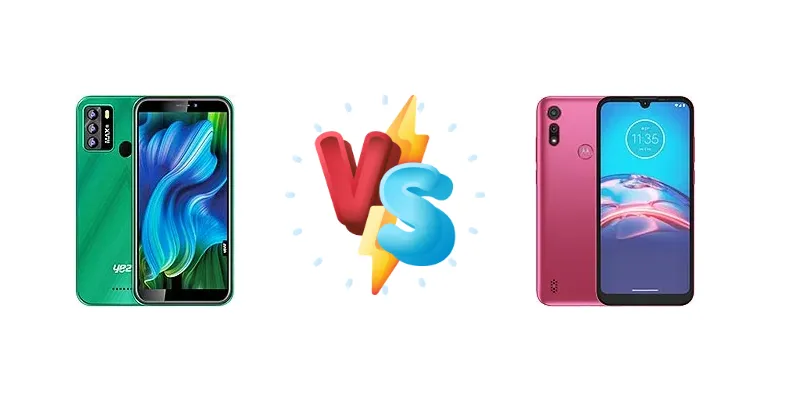
The Yezz Max 3 and Motorola Moto E6i represent the ultra-budget end of the smartphone spectrum. Both aim to deliver essential functionality at the lowest possible price point, but they take different approaches to achieving this. The key differentiator lies in their chipsets, impacting everything from app loading times to multitasking capabilities.
🏆 Quick Verdict
For the average user, the Motorola Moto E6i is the superior choice. Its Unisoc SC9863A chipset, featuring an octa-core CPU, provides a significantly smoother and more responsive experience than the Yezz Max 3’s quad-core Unisoc SC9832E. While both phones are limited, the Moto E6i offers a better balance of performance and usability.
| Network |
|---|
| 2G bands | GSM 850 / 900 / 1800 / 1900 | GSM 850 / 900 / 1800 / 1900 |
| 3G bands | HSDPA 850 / 900 / 1900 / 2100 | HSDPA 850 / 900 / 1700(AWS) / 1900 / 2100 |
| 4G bands | 2, 3, 4, 7, 12, 17, 28 | 1, 2, 3, 4, 5, 7, 8, 19, 28, 66 |
| Speed | HSPA, LTE | HSPA, LTE |
| Technology | GSM / HSPA / LTE | GSM / HSPA / LTE |
| Launch |
|---|
| Announced | 2022, September | 2021, February 11 |
| Status | Available. Released 2023, January | Available. Released 2021, February 11 |
| Body |
|---|
| Build | - | Glass front, plastic back, plastic frame |
| Dimensions | 149.3 x 77.2 x 9.7 mm (5.88 x 3.04 x 0.38 in) | 155.6 x 73 x 8.5 mm (6.13 x 2.87 x 0.33 in) |
| SIM | Nano-SIM + Nano-SIM | Nano-SIM + Nano-SIM |
| Weight | - | 160 g (5.64 oz) |
| Display |
|---|
| Resolution | 720 x 1440 pixels, 18:9 ratio (~295 ppi density) | 720 x 1560 pixels, 19.5:9 ratio (~282 ppi density) |
| Size | 5.45 inches, 76.7 cm2 (~66.5% screen-to-body ratio) | 6.1 inches, 91.3 cm2 (~80.4% screen-to-body ratio) |
| Type | IPS LCD | IPS LCD |
| Platform |
|---|
| CPU | Quad-core 1.3 GHz | Octa-core (4x1.6 GHz Cortex-A55 & 4x1.2 GHz Cortex-A55) |
| Chipset | Unisoc SC9832E (28 nm) | Unisoc SC9863A (28 nm) |
| GPU | Mali-T820 MP1 | IMG8322 |
| OS | Android 12 | Android 10 (Go edition) |
| Memory |
|---|
| Card slot | microSDXC | microSDXC (uses shared SIM slot) |
| Internal | 32GB 2GB RAM | 32GB 2GB RAM |
| | eMMC 5.1 | eMMC 5.1 |
| Main Camera |
|---|
| Dual | - | 13 MP, f/2.2, 26mm (wide), 1/3.1", 1.12µm, PDAF
Auxiliary lens |
| Features | LED flash | LED flash, HDR, panorama |
| Triple | 13 MP, AF
0.3 MP
0.3 MP | - |
| Video | 1080p@30fps | 1080p@30fps |
| Selfie camera |
|---|
| Single | 8 MP | 5 MP, f/2.2, 27mm (wide), 1.12µm |
| Video | Yes | 1080p@30fps |
| Sound |
|---|
| 3.5mm jack | Yes | Yes |
| 35mm jack | Yes | Yes |
| Loudspeaker | Yes | Yes |
| Comms |
|---|
| Bluetooth | 4.2, A2DP, LE | 4.2, A2DP, LE |
| NFC | No | No |
| Positioning | GPS | GPS, GLONASS |
| Radio | Stereo FM radio, recording | Unspecified |
| USB | microUSB 2.0 | microUSB 2.0, OTG |
| WLAN | Wi-Fi 802.11 b/g/n | Wi-Fi 802.11 b/g/n |
| Features |
|---|
| Sensors | Fingerprint (rear-mounted) | Fingerprint (rear-mounted), accelerometer, proximity |
| Battery |
|---|
| Charging | - | 10W wired |
| Type | Li-Ion 2600 mAh, removable | Li-Ion 3000 mAh |
| Misc |
|---|
| Colors | Denim Blue, Aurora Green, Glacier Blue, Space Gray, Coral Red | Titanium Gray, Pink |
| Models | - | XT2053-5 |
| Price | About 70 EUR | About 170 EUR |
Yezz Max 3
- Potentially lower price point
- Basic smartphone functionality
- May include expandable storage (market dependent)
- Significantly slower performance
- Less responsive user interface
- Likely inferior camera performance
Motorola Moto E6i
- Faster and more responsive performance
- Octa-core processor for smoother multitasking
- 10W wired charging
- May be slightly more expensive
- Still limited by budget components
- Camera quality likely remains basic
Display Comparison
Neither Yezz nor Motorola provide display specifications beyond size. Given the price point, both likely utilize LCD panels with 720p+ resolutions. The absence of detailed specs suggests neither phone prioritizes display quality. Expect similar viewing experiences, with limited brightness and color accuracy. Bezels are likely substantial on both devices to minimize manufacturing costs.
Camera Comparison
Without detailed camera specifications, a direct comparison is difficult. However, given the market segment, both phones likely feature basic camera setups. It's safe to assume both will include a primary camera and potentially a secondary depth sensor. Image quality will be heavily reliant on software processing, and neither phone is expected to excel in low-light conditions. The Yezz Max 3's camera is likely to be significantly slower to process images due to the weaker chipset.
Performance
The Motorola Moto E6i’s Unisoc SC9863A is the clear winner here. Its octa-core configuration (4x1.6 GHz Cortex-A55 & 4x1.2 GHz Cortex-A55) offers a substantial performance advantage over the Yezz Max 3’s quad-core 1.3 GHz Unisoc SC9832E. The Cortex-A55 cores in the Moto E6i, while still entry-level, are more efficient and capable than those found in the older SC9832E. This translates to faster app launch times, smoother multitasking, and a more responsive overall user experience. Both chipsets are fabricated on a 28nm process, indicating similar power efficiency concerns.
Battery Life
Battery capacity is not specified for either device. However, given the budget nature of both phones, expect capacities around 3000-4000 mAh. The Moto E6i’s inclusion of 10W wired charging is a slight advantage, allowing for faster top-ups compared to the Yezz Max 3, which likely relies on slower charging speeds. The more efficient chipset in the Moto E6i will also contribute to better battery life during typical usage.
Buying Guide
Buy the Yezz Max 3 if your primary need is a basic, functional phone for calls, texts, and very light app usage, and you are prioritizing the absolute lowest possible cost. Buy the Motorola Moto E6i if you want a more responsive experience for everyday tasks like browsing, social media, and occasional gaming, even if it means spending a little more. The Moto E6i is the better option for anyone who values a fluid user interface.
Frequently Asked Questions
❓ Will the Motorola Moto E6i be able to handle popular social media apps like Facebook and Instagram without significant lag?
Yes, the Moto E6i’s octa-core processor and more efficient architecture are well-suited for running social media apps. While it won’t offer a flagship-level experience, you should expect a reasonably smooth experience when browsing feeds, posting updates, and viewing photos and videos. The Yezz Max 3 may struggle with these tasks, exhibiting noticeable lag.
❓ Is the Unisoc SC9863A chipset in the Moto E6i capable of playing basic mobile games?
The Unisoc SC9863A can handle basic mobile games, such as puzzle games and simple arcade titles, without significant issues. However, it will likely struggle with more demanding games that require high processing power and graphics capabilities. Expect lower frame rates and potentially reduced graphical settings. The Yezz Max 3 will likely perform even worse in gaming scenarios.
❓ Does the Motorola Moto E6i support software updates beyond the initial Android version?
Motorola’s update policy for the Moto E series is typically limited. While the Moto E6i likely launched with Android 10 or 11 (Go Edition), expect only one major Android update, if any, and limited security patches. Long-term software support is not a strength of this device.