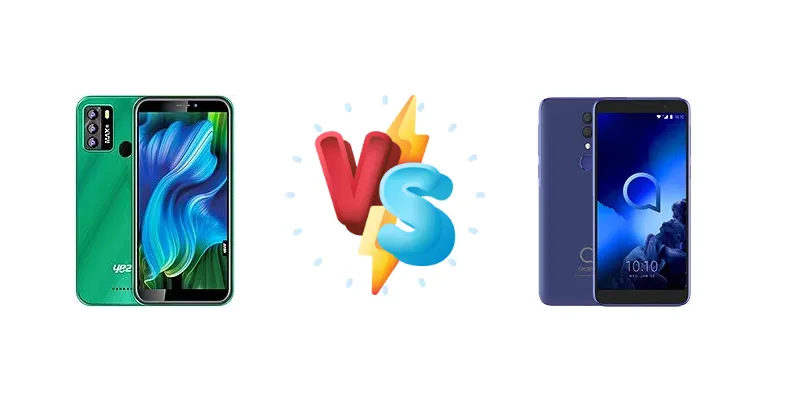
The Yezz Max 3 and Alcatel 1x (2019) represent the extreme end of the smartphone price spectrum. Both devices aim to deliver basic smartphone functionality at an incredibly low cost. This comparison dissects their core components to determine which offers the best experience for users prioritizing affordability above all else.
🏆 Quick Verdict
For the average user seeking a functional, if basic, smartphone experience, the Alcatel 1x (2019) edges out the Yezz Max 3. Its slightly faster 1.5 GHz CPU, built on the same 28nm process, provides a marginally smoother user experience, particularly when navigating the Android Go operating system.
| Network |
|---|
| 2G bands | GSM 850 / 900 / 1800 / 1900 | GSM 850 / 900 / 1800 / 1900 |
| 3G bands | HSDPA 850 / 900 / 1900 / 2100 | HSDPA 850 / 900 / 1700(AWS) / 1900 / 2100 - 5059A |
| 4G bands | 2, 3, 4, 7, 12, 17, 28 | 1, 3, 5, 7, 8, 28, 38, 40 - 5008T |
| Speed | HSPA, LTE | HSPA 42.2/5.76 Mbps, LTE Cat4 150/50 Mbps |
| Technology | GSM / HSPA / LTE | GSM / HSPA / LTE |
| | - | 1, 3, 7, 8, 20, 28 - 5008Y |
| Launch |
|---|
| Announced | 2022, September | 2019, January. Released 2019, Q1 |
| Status | Available. Released 2023, January | Discontinued |
| Body |
|---|
| Dimensions | 149.3 x 77.2 x 9.7 mm (5.88 x 3.04 x 0.38 in) | 146.4 x 68.8 x 8.3 mm (5.76 x 2.71 x 0.33 in) |
| SIM | Nano-SIM + Nano-SIM | · Nano-SIM· Nano-SIM + Nano-SIM |
| Weight | - | 130 g (4.59 oz) |
| Display |
|---|
| Resolution | 720 x 1440 pixels, 18:9 ratio (~295 ppi density) | 720 x 1440 pixels, 18:9 ratio (~293 ppi density) |
| Size | 5.45 inches, 76.7 cm2 (~66.5% screen-to-body ratio) | 5.5 inches, 78.1 cm2 (~77.5% screen-to-body ratio) |
| Type | IPS LCD | IPS LCD |
| Platform |
|---|
| CPU | Quad-core 1.3 GHz | Quad-core 1.5 GHz Cortex-A53 |
| Chipset | Unisoc SC9832E (28 nm) | Mediatek MT6739 (28 nm) |
| GPU | Mali-T820 MP1 | PowerVR GE8100 |
| OS | Android 12 | Android 8.1 (Oreo) |
| Memory |
|---|
| Card slot | microSDXC | microSDXC |
| Internal | 32GB 2GB RAM | 16GB 2GB RAM |
| | eMMC 5.1 | eMMC 5.1 |
| Main Camera |
|---|
| Dual | - | 13 MP
2 MP |
| Features | LED flash | LED flash, HDR |
| Triple | 13 MP, AF
0.3 MP
0.3 MP | - |
| Video | 1080p@30fps | 1080p@30fps |
| Selfie camera |
|---|
| Features | - | LED flash |
| Single | 8 MP | 5 MP |
| Video | Yes | 720p |
| Sound |
|---|
| 3.5mm jack | Yes | Yes |
| 35mm jack | Yes | Yes |
| Loudspeaker | Yes | Yes |
| Comms |
|---|
| Bluetooth | 4.2, A2DP, LE | 4.2, A2DP, LE |
| NFC | No | No |
| Positioning | GPS | GPS |
| Radio | Stereo FM radio, recording | FM radio |
| USB | microUSB 2.0 | microUSB 2.0 |
| WLAN | Wi-Fi 802.11 b/g/n | Wi-Fi 802.11 b/g/n, Wi-Fi Direct |
| Features |
|---|
| Sensors | Fingerprint (rear-mounted) | Fingerprint (rear-mounted, 5008T only), accelerometer, proximity |
| Battery |
|---|
| Type | Li-Ion 2600 mAh, removable | Li-Ion 3000 mAh, removable |
| Misc |
|---|
| Colors | Denim Blue, Aurora Green, Glacier Blue, Space Gray, Coral Red | Pebble Blue, Pebble Black |
| Models | - | 5008T, 5008Y, 5008U, 5008R, 5008D_EEA, 5008Y_EEA, 5008D |
| Price | About 70 EUR | About 120 EUR |
Yezz Max 3
- Potentially lower price point (depending on retailer)
- Functional for basic tasks
- Android Go optimized for low-end hardware
- Slower CPU clock speed (1.3 GHz)
- Unisoc chipset generally less optimized than Mediatek
- Likely limited software updates
alcatel 1x (2019)
- Faster CPU clock speed (1.5 GHz)
- Mediatek chipset offers slightly better performance
- Android Go optimized for low-end hardware
- May be slightly more expensive
- Camera performance likely similar to Yezz Max 3
- Limited RAM and storage
Display Comparison
Neither device boasts a standout display. Given the shared target market, both likely utilize similar low-cost LCD panels with resolutions around 480x854. Without specific brightness or color gamut data, it's safe to assume both offer adequate, but not impressive, viewing experiences. The focus here is functionality, not fidelity.
Camera Comparison
Camera performance on both devices will be limited. Expect basic image capture suitable for casual snapshots in good lighting conditions. Without sensor size or aperture information, it's difficult to make a definitive statement. However, the inclusion of a 2MP macro camera on either device is largely a marketing gimmick, offering minimal practical benefit due to the low resolution and lack of optical image stabilization. Image processing will likely be minimal, resulting in images lacking detail and dynamic range.
Performance
The core difference lies in the chipsets. The Alcatel 1x (2019) utilizes the Mediatek MT6739 with a quad-core Cortex-A53 CPU clocked at 1.5 GHz. The Yezz Max 3 employs the Unisoc SC9832E, also quad-core, but clocked slightly lower at 1.3 GHz. While both are based on a 28nm process, the Cortex-A53 architecture in the MT6739 generally offers better single-core performance, translating to snappier app launches and smoother scrolling. This difference, though small, is noticeable in everyday use. Both will struggle with demanding games or multitasking.
Battery Life
Battery life will heavily depend on usage patterns. Neither device is likely to feature fast charging capabilities. The actual mAh capacity of both devices is not provided, but given their price point, expect capacities around 2000-3000 mAh. The slightly more efficient CPU in the Alcatel 1x (2019) *may* translate to marginally longer battery life, but the difference will likely be minimal and overshadowed by user habits.
Buying Guide
Buy the Yezz Max 3 if you need a device primarily for static tasks like messaging and occasional web browsing, and are willing to accept potentially slower performance. Buy the Alcatel 1x (2019) if you prefer a slightly more responsive experience, even for basic tasks, and value the marginally improved CPU clock speed for a similar price point. Both are best suited for first-time smartphone users or as emergency backup devices.
Frequently Asked Questions
❓ Will the Alcatel 1x (2019) run popular apps like WhatsApp and Facebook smoothly?
Yes, the Alcatel 1x (2019) should handle basic apps like WhatsApp and Facebook adequately, thanks to the Android Go edition operating system which is optimized for lower-end hardware. However, expect some lag when switching between apps or loading complex content.
❓ Is the Unisoc SC9832E chipset in the Yezz Max 3 known for overheating?
The Unisoc SC9832E is a low-power chipset and is unlikely to overheat under normal usage conditions. However, prolonged gaming or intensive tasks may cause some thermal throttling, resulting in reduced performance.
❓ Can either of these phones be used for mobile gaming?
While technically capable of running some less demanding mobile games, neither the Yezz Max 3 nor the Alcatel 1x (2019) are suitable for serious gaming. Expect low frame rates and significant lag in most titles. They are best suited for casual gaming only.