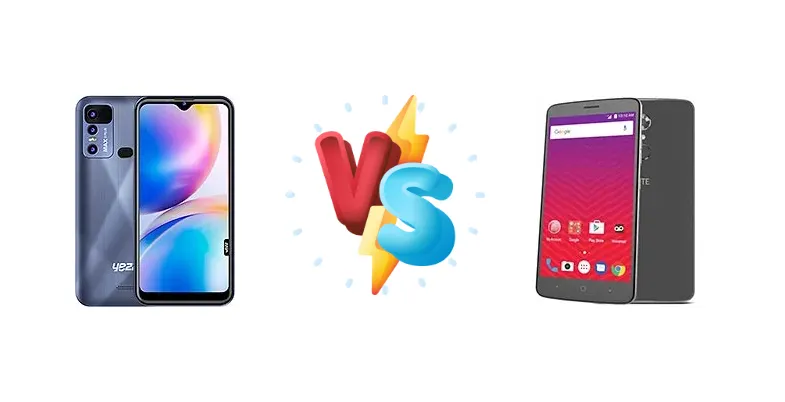
The Yezz Max 3 Plus and ZTE Max XL represent a segment of the market where value is paramount. Both phones aim to deliver a functional smartphone experience without breaking the bank, but they take different approaches to achieving this. The Yezz relies on a Unisoc chipset, while the ZTE opts for a Qualcomm Snapdragon. This comparison will dissect the key differences to help you determine which device best suits your needs.
🏆 Quick Verdict
For the average user prioritizing responsiveness and multitasking, the ZTE Max XL is the better choice. Its octa-core Snapdragon 435 offers a significant performance advantage over the Yezz Max 3 Plus’s quad-core Unisoc SC9832E, making everyday tasks smoother and more efficient. While both are budget devices, the ZTE provides a more future-proof experience.
| Network |
|---|
| 2G bands | GSM 850 / 900 / 1800 / 1900 | GSM 850 / 900 / 1800 / 1900 |
| 3G bands | HSDPA 850 / 900 / 1900 / 2100 | HSDPA 850 / 1700(AWS) / 1900 |
| 4G bands | 2, 3, 4, 7, 12, 17, 28 | LTE |
| Speed | HSPA, LTE | HSPA, LTE (2CA) |
| Technology | GSM / HSPA / LTE | GSM / HSPA / LTE |
| Launch |
|---|
| Announced | 2022, October | 2017, April. Released 2017, April |
| Status | Available. Released 2023, January | Discontinued |
| Body |
|---|
| Dimensions | 159.8 x 77.2 x 9.5 mm (6.29 x 3.04 x 0.37 in) | 165.1 x 83.8 x 9.4 mm (6.5 x 3.30 x 0.37 in) |
| SIM | Nano-SIM + Nano-SIM | Nano-SIM |
| Weight | - | 180 g (6.35 oz) |
| Display |
|---|
| Protection | INX Glass | Corning Gorilla Glass (unspecified version) |
| Resolution | 480 x 1010 pixels, 19:9 ratio (~183 ppi density) | 1080 x 1920 pixels, 16:9 ratio (~367 ppi density) |
| Size | 6.1 inches, 93.1 cm2 (~75.4% screen-to-body ratio) | 6.0 inches, 99.2 cm2 (~71.7% screen-to-body ratio) |
| Type | IPS LCD | IPS LCD |
| Platform |
|---|
| CPU | Quad-core 1.4 GHz | Octa-core 1.4 GHz Cortex-A53 |
| Chipset | Unisoc SC9832E (28 nm) | Qualcomm MSM8940 Snapdragon 435 (28 nm) |
| GPU | Mali-T820 MP1 | Adreno 505 |
| OS | Android 12 | Android 7.1.1 (Nougat) |
| Memory |
|---|
| Card slot | microSDXC | microSDXC (dedicated slot) |
| Internal | 32GB 2GB RAM | 16GB 2GB RAM, 32GB 2GB RAM |
| | eMMC 5.1 | eMMC 5.1 |
| Main Camera |
|---|
| Features | LED flash | LED flash, HDR, panorama |
| Single | - | 13 MP, AF |
| Triple | 13 MP, AF
0.3 MP
0.3 MP | - |
| Video | 1080p@30fps | 1080p@30fps |
| Selfie camera |
|---|
| Single | 8 MP | 5 MP |
| Video | Yes | - |
| Sound |
|---|
| 3.5mm jack | Yes | Yes |
| 35mm jack | Yes | Yes |
| Loudspeaker | Yes | Yes |
| Comms |
|---|
| Bluetooth | 4.2, A2DP, LE | 4.2, A2DP, LE |
| NFC | No | No |
| Positioning | GPS | GPS |
| Radio | Stereo FM radio, recording | FM radio |
| USB | microUSB 2.0 | USB Type-C |
| WLAN | Wi-Fi 802.11 b/g/n | Wi-Fi 802.11 a/b/g/n, Wi-Fi Direct |
| Features |
|---|
| Sensors | Fingerprint (rear-mounted) | Fingerprint (rear-mounted), accelerometer, proximity, compass |
| Battery |
|---|
| Charging | - | 18W wired, QC2 |
| Type | Li-Ion 3700 mAh, removable | Li-Ion 3990 mAh, non-removable |
| Misc |
|---|
| Colors | Midnight Black, Glacier Blue, Cosmic Blue, Carbon Grey | Black |
| Models | - | N9560, Z983 |
| Price | About 90 EUR | About 120 EUR |
Yezz Max 3 Plus
- Potentially lower price point
- Simpler user experience
- May have longer standby time due to less powerful processor
- Significantly slower performance
- Less responsive multitasking
- Inferior camera image processing
ZTE Max XL
- Faster and more responsive performance
- Quick Charge 2.0 support for faster charging
- Better camera image processing capabilities
- Potentially higher price
- May have slightly shorter battery life under heavy load
- More complex software features
Display Comparison
Neither device boasts a standout display. Given the shared 28nm fabrication process, display quality is unlikely to be a major differentiator. We can assume both utilize IPS LCD panels common in this price bracket. Without specific resolution or brightness data, it's difficult to declare a winner, but the ZTE's potential for better image processing due to the more powerful chipset *could* translate to slightly improved color accuracy and contrast.
Camera Comparison
Without detailed camera specifications beyond the chipsets, a direct comparison is challenging. However, the Snapdragon 435 typically supports more advanced image signal processors (ISPs) than those found in Unisoc chipsets of this generation. This means the ZTE Max XL is likely to produce images with better dynamic range, noise reduction, and color accuracy, even with similar sensor sizes. The Yezz Max 3 Plus will likely suffice for basic snapshots, but the ZTE offers a more capable camera experience.
Performance
The core difference lies in the processors. The ZTE Max XL’s Qualcomm MSM8940 Snapdragon 435, with its octa-core Cortex-A53 configuration, significantly outperforms the Yezz Max 3 Plus’s Unisoc SC9832E quad-core processor. While both are clocked at 1.4 GHz, the sheer number of cores on the Snapdragon allows for superior multitasking and handling of more demanding applications. The Snapdragon 435 also benefits from Qualcomm’s optimized architecture, leading to better efficiency and sustained performance. This translates to faster app loading times and a smoother overall user experience on the ZTE.
Battery Life
Battery life will depend heavily on usage patterns and battery capacity (which is not provided). However, the ZTE Max XL’s inclusion of 18W wired charging with Quick Charge 2.0 support is a significant advantage. This allows for much faster charging times compared to the Yezz Max 3 Plus, which likely relies on standard 5W charging. Even if the Yezz Max 3 Plus has a slightly larger battery, the ZTE’s faster charging will minimize downtime and provide a more convenient user experience.
Buying Guide
Buy the Yezz Max 3 Plus if you need a basic smartphone for essential tasks like calls, texts, and light web browsing, and are extremely price-sensitive. Its simplicity and lower cost are its main draws. Buy the ZTE Max XL if you prefer a more responsive experience for social media, streaming, and occasional gaming, and appreciate the convenience of Quick Charge 2.0 for faster battery top-ups. The ZTE offers a better balance of features and performance for a slightly higher investment.
Frequently Asked Questions
❓ Will the ZTE Max XL handle popular social media apps like Facebook and Instagram smoothly?
Yes, the Snapdragon 435’s octa-core processor and optimized architecture are well-suited for running social media applications without significant lag. The Yezz Max 3 Plus may experience occasional slowdowns when multitasking between apps and social media.
❓ Is the Quick Charge 2.0 feature on the ZTE Max XL compatible with all USB-C chargers?
While Quick Charge 2.0 is widely supported, you'll achieve the fastest charging speeds with a charger specifically designed for Quick Charge 2.0. Standard USB-C chargers will still work, but at a slower charging rate.
❓ Can the Yezz Max 3 Plus handle basic mobile games like Candy Crush or Angry Birds?
The Yezz Max 3 Plus can handle simple 2D games like Candy Crush or Angry Birds, but more demanding 3D games will likely experience significant frame rate drops and lag. The Unisoc SC9832E is not designed for intensive gaming.
❓ Does either phone support software updates beyond the initial Android version?
Given the budget nature of both devices, long-term software update support is unlikely. Expect limited updates, primarily security patches, if any. Neither manufacturer has a strong track record for extended software support on these models.