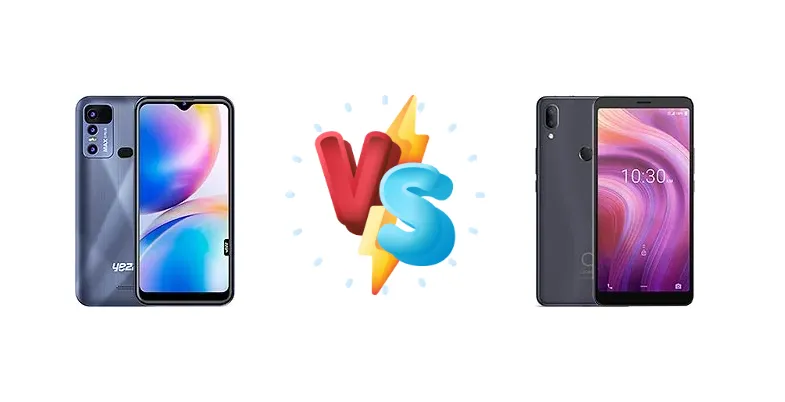
The sub-$150 smartphone market is fiercely competitive. Both the Yezz Max 3 Plus and the alcatel 3v (2019) aim to deliver essential smartphone functionality at an accessible price. However, significant differences in their core hardware – specifically the chipset – dictate vastly different user experiences. This comparison dissects those differences to help you choose the right device.
🏆 Quick Verdict
For the average user prioritizing responsiveness and multitasking, the alcatel 3v (2019) is the clear winner. Its Mediatek Helio P22 chipset, with its octa-core configuration and 12nm process, provides a noticeably smoother experience than the Yezz Max 3 Plus’s quad-core Unisoc SC9832E. While the Yezz may offer slightly longer battery life due to its less powerful processor, the performance trade-off isn't worth it for most.
| Network |
|---|
| 2G bands | GSM 850 / 900 / 1800 / 1900 | GSM 850 / 900 / 1800 / 1900 |
| 3G bands | HSDPA 850 / 900 / 1900 / 2100 | HSDPA 850 / 900 / 1700(AWS) / 1900 / 2100 |
| 4G bands | 2, 3, 4, 7, 12, 17, 28 | 1, 2, 3, 4, 5, 7, 12, 13, 17, 20, 25, 26, 41, 66, 71 |
| Speed | HSPA, LTE | HSPA 42.2/11.5 Mbps, LTE Cat4 150/50 Mbps |
| Technology | GSM / HSPA / LTE | GSM / HSPA / LTE |
| Launch |
|---|
| Announced | 2022, October | 2019, Q2. Released 2019, Q4 |
| Status | Available. Released 2023, January | Discontinued |
| Body |
|---|
| Build | - | Glass front (DragonTrail Pro glass), plastic back, plastic frame |
| Dimensions | 159.8 x 77.2 x 9.5 mm (6.29 x 3.04 x 0.37 in) | 174.5 x 83.3 x 8.4 mm (6.87 x 3.28 x 0.33 in) |
| SIM | Nano-SIM + Nano-SIM | Nano-SIM |
| Weight | - | 197.9 g (6.98 oz) |
| Display |
|---|
| Protection | INX Glass | DragonTrail Pro |
| Resolution | 480 x 1010 pixels, 19:9 ratio (~183 ppi density) | 720 x 1440 pixels, 18:9 ratio (~240 ppi density) |
| Size | 6.1 inches, 93.1 cm2 (~75.4% screen-to-body ratio) | 6.7 inches, 115.8 cm2 (~79.7% screen-to-body ratio) |
| Type | IPS LCD | IPS LCD |
| Platform |
|---|
| CPU | Quad-core 1.4 GHz | Octa-core 2.0 GHz Cortex-A53 |
| Chipset | Unisoc SC9832E (28 nm) | Mediatek MT6762 Helio P22 (12 nm) |
| GPU | Mali-T820 MP1 | PowerVR GE8320 |
| OS | Android 12 | Android 9.0 (Pie) |
| Memory |
|---|
| Card slot | microSDXC | microSDXC (dedicated slot) |
| Internal | 32GB 2GB RAM | 32GB 3GB RAM |
| | eMMC 5.1 | eMMC 5.1 |
| Main Camera |
|---|
| Dual | - | 16 MP, PDAF
Auxiliary lens |
| Features | LED flash | LED flash, HDR, panorama |
| Triple | 13 MP, AF
0.3 MP
0.3 MP | - |
| Video | 1080p@30fps | 1080p@30fps |
| Selfie camera |
|---|
| Single | 8 MP | 8 MP |
| Video | Yes | 720p@30fps |
| Sound |
|---|
| 3.5mm jack | Yes | Yes |
| 35mm jack | Yes | Yes |
| Loudspeaker | Yes | Yes, with stereo speakers |
| Comms |
|---|
| Bluetooth | 4.2, A2DP, LE | 4.2, A2DP, LE |
| NFC | No | No |
| Positioning | GPS | GPS |
| Radio | Stereo FM radio, recording | FM radio |
| USB | microUSB 2.0 | USB Type-C 2.0 |
| WLAN | Wi-Fi 802.11 b/g/n | Wi-Fi 802.11 a/b/g/n, dual-band, Wi-Fi Direct |
| Features |
|---|
| Sensors | Fingerprint (rear-mounted) | Fingerprint (rear-mounted), accelerometer, proximity, compass |
| Battery |
|---|
| Charging | - | 15W wired |
| Type | Li-Ion 3700 mAh, removable | Li-Po 4000 mAh |
| Misc |
|---|
| Colors | Midnight Black, Glacier Blue, Cosmic Blue, Carbon Grey | Elegant Black |
| Models | - | 5032W |
| Price | About 90 EUR | About 170 EUR |
Yezz Max 3 Plus
- Potentially longer battery life due to less powerful processor.
- May be available at a slightly lower price point.
- Simple and straightforward user experience.
- Significantly slower performance compared to the alcatel 3v.
- Laggy and unresponsive user interface.
- Limited multitasking capabilities.
alcatel 3v (2019)
- Faster and more responsive performance thanks to the Helio P22.
- 15W fast charging for quicker battery top-ups.
- Better suited for multitasking and running apps.
- May have slightly shorter battery life than the Yezz Max 3 Plus.
- Camera quality is likely to be limited.
- Build quality may be basic.
Display Comparison
Neither device boasts a standout display. Details regarding panel type (IPS, TFT) and resolution are missing for both, suggesting budget-grade panels. However, the focus should be on performance, as display quality is likely similar. Bezels are expected to be substantial on both, typical of this price point. Color accuracy is unlikely to be a strength on either device.
Camera Comparison
Camera performance is likely to be similar and underwhelming on both devices. Without specific sensor details, it’s safe to assume both rely on low-resolution sensors. The presence of a 2MP macro camera on the alcatel 3v is largely a marketing gimmick; its image quality will be limited. Image processing will be basic on both, with limited dynamic range and detail. Expect acceptable results in good lighting conditions, but poor performance in low light.
Performance
The performance gap is the most significant differentiator. The alcatel 3v (2019) utilizes the Mediatek Helio P22, an octa-core processor built on a 12nm process. This translates to superior efficiency and processing power compared to the Yezz Max 3 Plus’s Unisoc SC9832E, a quad-core chip fabricated on a larger 28nm node. The 2.0 GHz clock speed of the alcatel’s CPU further enhances its ability to handle multitasking and demanding applications. The Unisoc chip will struggle with even moderate workloads, leading to noticeable lag and slowdowns. The alcatel 3v is the better choice for users who want a phone that feels responsive.
Battery Life
While battery capacity isn't specified, the Yezz Max 3 Plus likely benefits from the lower power draw of its less powerful Unisoc chipset. This could translate to slightly longer battery life during typical usage. However, the alcatel 3v (2019) compensates with 15W wired charging, allowing for faster top-ups. This is a significant advantage, as it reduces downtime and ensures you can quickly replenish the battery when needed. The faster charging speed of the alcatel 3v makes it more practical for daily use.
Buying Guide
Buy the Yezz Max 3 Plus if your primary need is a very basic smartphone for calls, texts, and light app usage, and you absolutely prioritize maximizing battery life above all else. Buy the alcatel 3v (2019) if you want a more responsive device capable of handling social media, streaming video, and light gaming without significant lag. The alcatel 3v offers a better overall user experience for a minimal price increase.
Frequently Asked Questions
❓ Will the alcatel 3v (2019) be able to run popular social media apps like TikTok and Instagram smoothly?
Yes, the Mediatek Helio P22 chipset in the alcatel 3v (2019) is capable of running social media apps like TikTok and Instagram without significant lag. While it won't offer a high-end experience, it provides a usable and reasonably smooth experience for these applications, unlike the Yezz Max 3 Plus which will likely struggle.
❓ Is the 15W charging on the alcatel 3v (2019) a significant advantage over the Yezz Max 3 Plus?
Yes, 15W charging is a notable advantage. While the Yezz Max 3 Plus may have a longer overall battery life, the alcatel 3v’s faster charging allows you to quickly replenish the battery when needed, minimizing downtime. This is particularly useful for users who rely heavily on their smartphones throughout the day.
❓ Can I expect to play demanding games like PUBG Mobile on the alcatel 3v (2019)?
While you can *launch* PUBG Mobile on the alcatel 3v (2019), expect to play at the lowest graphics settings and potentially experience frame rate drops. The Helio P22 is not a gaming-focused chipset. The Yezz Max 3 Plus is even less suited for gaming due to its weaker processor.