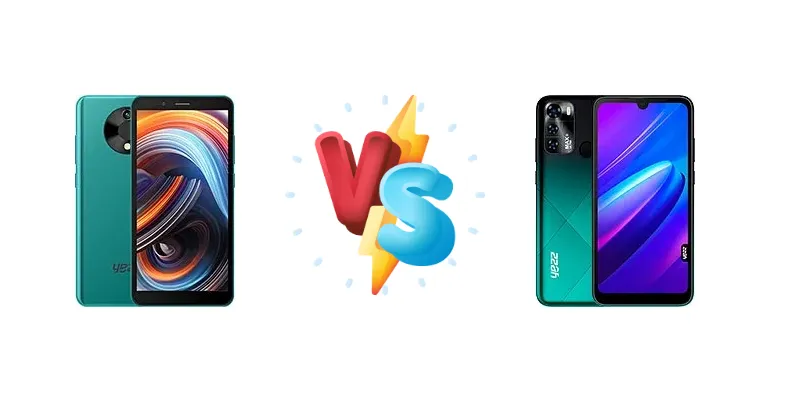
Yezz aims to deliver affordable smartphones, and the Max 2 and Max 3 Ultra represent different approaches within that goal. The Max 2, with its USB Power Delivery, offered a glimpse of faster charging in its time. The Max 3 Ultra attempts to modernize the formula with a newer chipset, but at what cost? This comparison dissects the key differences to help you choose the right Yezz for your needs.
🏆 Quick Verdict
For the average user prioritizing a slightly more modern chipset and willing to sacrifice faster charging, the Yezz Max 3 Ultra is the better choice. However, the Yezz Max 2’s USB Power Delivery support offers a convenience advantage for those already invested in that ecosystem, and its price point may be more attractive.
| Network |
|---|
| 2G bands | GSM 850 / 900 / 1800 / 1900 | GSM 850 / 900 / 1800 / 1900 |
| 3G bands | HSDPA 850 / 900 / 2100 | HSDPA 850 / 900 / 1900 / 2100 |
| 4G bands | 2, 3, 4, 7, 12, 17, 28 | 2, 3, 4, 7, 12, 17, 28 |
| Speed | HSPA 42.2/11.5 Mbps, LTE Cat4 150/50 Mbps | HSPA, LTE |
| Technology | GSM / HSPA / LTE | GSM / HSPA / LTE |
| Launch |
|---|
| Announced | 2021, October. Released 2022, January | 2022, September |
| Status | Discontinued | Available. Released 2023, January |
| Body |
|---|
| Dimensions | 146.5 x 71.5 x 10.2 mm (5.77 x 2.81 x 0.40 in) | 159.7 x 77.3 x 9.9 mm (6.29 x 3.04 x 0.39 in) |
| SIM | Nano-SIM + Micro-SIM | Nano-SIM + Nano-SIM |
| Weight | 170 g (6.00 oz) | 182 g (6.42 oz) |
| Display |
|---|
| Protection | Asahi Glass | INX Glass |
| Resolution | 480 x 960 pixels, 18:9 ratio (~197 ppi density) | 720 x 1520 pixels, 19:9 ratio (~269 ppi density) |
| Size | 5.45 inches, 76.7 cm2 (~73.2% screen-to-body ratio) | 6.26 inches, 97.8 cm2 (~79.2% screen-to-body ratio) |
| Type | IPS LCD | IPS LCD |
| Platform |
|---|
| CPU | Quad-core 1.45 GHz Cortex-A53 | Quad-core 1.4 GHz |
| Chipset | Mediatek MT6737M (28 nm) | Unisoc SC9832E (28 nm) |
| GPU | Mali-T720MP2 | Mali-T820 MP1 |
| OS | Android 11 (Go edition) | Android 12 |
| Memory |
|---|
| Card slot | microSDHC | microSDXC |
| Internal | 32GB 1GB RAM | 32GB 2GB RAM |
| | eMMC 5.1 | eMMC 5.1 |
| Main Camera |
|---|
| Dual | - | 13 MP, AF
0.3 MP |
| Features | LED flash | Dual-LED flash |
| Single | 8 MP, AF | - |
| Video | 1080p@30fps | 1080p@30fps |
| Selfie camera |
|---|
| Single | 5 MP | 8 MP |
| Video | - | Yes |
| Sound |
|---|
| 3.5mm jack | Yes | Yes |
| 35mm jack | Yes | Yes |
| Loudspeaker | Yes | Yes |
| Comms |
|---|
| Bluetooth | 4.0, A2DP, LE | 4.2, A2DP, LE |
| NFC | No | No |
| Positioning | GPS | GPS |
| Radio | Stereo FM radio, recording | Stereo FM radio, recording |
| USB | microUSB 2.0 | USB Type-C 2.0 |
| WLAN | Wi-Fi 802.11 a/b/g/n/ac, dual-band | Wi-Fi 802.11 b/g/n |
| Features |
|---|
| Sensors | No | Fingerprint (rear-mounted) |
| Battery |
|---|
| Charging | USB Power Delivery | 10W wired |
| Type | Li-Ion 2500 mAh, removable | Li-Ion 3700 mAh, removable |
| Misc |
|---|
| Colors | Ocean Green, Space Black, Pacific Blue | Artic Blue, Aqua Green, Turquoise Green |
| Price | About 60 EUR | About 100 EUR |
Yezz Max 2
- USB Power Delivery for faster charging
- Established Mediatek chipset with wider software support
- Potentially lower price point
- Older chipset architecture
- Slightly lower potential graphics performance
Yezz Max 3 Ultra
- Newer Unisoc chipset with potential efficiency gains
- Potentially longer software support within the Unisoc ecosystem
- Modernized chipset architecture
- Slower 10W wired charging
- Less established Unisoc platform
Display Comparison
Neither Yezz provides display specifications beyond size, so a detailed comparison is limited. Both likely utilize IPS LCD panels common in this price bracket. The absence of information regarding resolution, brightness, or color gamut suggests neither device prioritizes display quality as a key selling point. Bezels are likely substantial on both, typical of budget devices.
Camera Comparison
Camera details are sparse for both devices. Without sensor size or aperture information, a meaningful comparison is difficult. It’s safe to assume both feature basic camera setups geared towards casual photography. The inclusion of a 2MP macro lens on either device is largely a marketing tactic, offering limited practical benefit due to the small sensor size and lack of optical image stabilization. Image processing will likely be the differentiating factor, but without sample images, it’s impossible to assess which device produces more pleasing results.
Performance
The Yezz Max 3 Ultra’s Unisoc SC9832E represents a generational shift from the Max 2’s Mediatek MT6737M, but not necessarily a performance leap. Both chipsets employ a quad-core Cortex-A53 architecture, but the Unisoc benefits from architectural refinements. While clock speeds are slightly lower (1.4 GHz vs 1.45 GHz), the Unisoc’s integrated GPU is likely more efficient. However, the 28nm fabrication process remains consistent, limiting potential gains in power efficiency. Users should expect similar performance for everyday tasks, but the Max 3 Ultra may exhibit slightly smoother multitasking and potentially better graphics performance in light gaming.
Battery Life
Battery capacity is not specified for either device, making a direct comparison challenging. However, the charging capabilities are significantly different. The Yezz Max 2 supports USB Power Delivery, allowing for faster charging with compatible chargers. The Yezz Max 3 Ultra is limited to 10W wired charging, a slower standard. This means the Max 2 will likely achieve a 0-100% charge significantly faster, even if the Max 3 Ultra has a slightly larger battery. For users who frequently need to top up their phone quickly, the Max 2’s USB Power Delivery is a major advantage.
Buying Guide
Buy the Yezz Max 2 if you value the convenience of USB Power Delivery for compatibility with existing chargers and prioritize potential future software updates due to the more established Mediatek platform. Buy the Yezz Max 3 Ultra if you prefer a newer chipset, even if it means slower 10W charging, and are looking for a potentially longer-supported device within the Unisoc ecosystem.
Frequently Asked Questions
❓ Will the Yezz Max 3 Ultra's Unisoc chipset receive regular software updates?
Unisoc's software support track record is less established than Mediatek's. While Unisoc is improving, users should temper expectations regarding long-term software updates for the Max 3 Ultra. The Max 2, with its Mediatek chipset, may have a slightly better chance of receiving updates, though this is still not guaranteed for budget devices.
❓ How much faster is the charging on the Yezz Max 2 with USB Power Delivery compared to the Max 3 Ultra?
The Yezz Max 2, utilizing USB Power Delivery, can potentially charge at up to 18W or higher depending on the charger used. The Max 3 Ultra is limited to 10W. This translates to a significantly faster charging time for the Max 2, potentially shaving off an hour or more for a full charge.
❓ Is the difference in CPU clock speed (1.45 GHz vs 1.4 GHz) noticeable in everyday use?
The 0.05 GHz difference in clock speed between the two processors is unlikely to be noticeable in typical smartphone usage. Both processors are quad-core Cortex-A53 designs, and the overall performance will be more influenced by factors like RAM and software optimization than the slight clock speed variation.