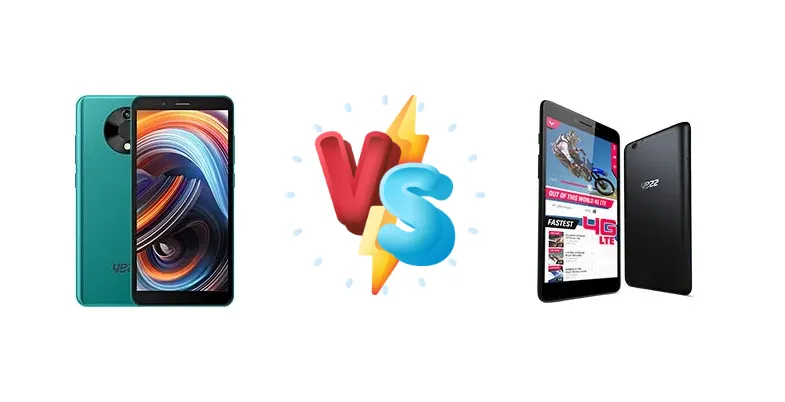
Yezz offers two compelling options in the ultra-budget smartphone space: the Max 2 and the Andy 6EL LTE. Both aim to deliver essential smartphone functionality at a low price point, but they differ in their underlying hardware. This comparison dissects those differences, focusing on the chipset and its impact on everyday use.
🏆 Quick Verdict
For most users, the Yezz Max 2 emerges as the slightly better choice. Its Mediatek MT6737M chipset, while not a massive leap, offers a modest performance advantage over the Andy 6EL LTE’s MT6735A, and the inclusion of USB Power Delivery provides more versatile charging options.
| Network |
|---|
| 2G bands | GSM 850 / 900 / 1800 / 1900 | GSM 850 / 900 / 1800 / 1900 - SIM 1 & SIM 2 |
| 3G bands | HSDPA 850 / 900 / 2100 | HSDPA 900 / 2100 - AM6EL137 |
| 4G bands | 2, 3, 4, 7, 12, 17, 28 | LTE 700 / 1700 / 2600 - AM6EL133 |
| Speed | HSPA 42.2/11.5 Mbps, LTE Cat4 150/50 Mbps | HSPA 42.2/11.5 Mbps, LTE Cat4 150/50 Mbps |
| Technology | GSM / HSPA / LTE | GSM / HSPA / LTE |
| | - | LTE 800 / 1800 / 2600 - AM6EL137 |
| Launch |
|---|
| Announced | 2021, October. Released 2022, January | 2015, October. Released 2015, November |
| Status | Discontinued | Discontinued |
| Body |
|---|
| Dimensions | 146.5 x 71.5 x 10.2 mm (5.77 x 2.81 x 0.40 in) | 166 x 85.6 x 7.5 mm (6.54 x 3.37 x 0.30 in) |
| SIM | Nano-SIM + Micro-SIM | Hybrid Dual SIM |
| Weight | 170 g (6.00 oz) | 131 g (4.62 oz) |
| Display |
|---|
| Protection | Asahi Glass | - |
| Resolution | 480 x 960 pixels, 18:9 ratio (~197 ppi density) | 720 x 1280 pixels, 16:9 ratio (~245 ppi density) |
| Size | 5.45 inches, 76.7 cm2 (~73.2% screen-to-body ratio) | 6.0 inches, 99.2 cm2 (~69.8% screen-to-body ratio) |
| Type | IPS LCD | IPS LCD |
| Platform |
|---|
| CPU | Quad-core 1.45 GHz Cortex-A53 | Quad-core 1.3 GHz Cortex-A53 |
| Chipset | Mediatek MT6737M (28 nm) | Mediatek MT6735A |
| GPU | Mali-T720MP2 | Mali-T720MP2 |
| OS | Android 11 (Go edition) | Android 5.1 (Lollipop) |
| Memory |
|---|
| Card slot | microSDHC | microSDXC (uses shared SIM slot) |
| Internal | 32GB 1GB RAM | 8GB 1GB RAM |
| | eMMC 5.1 | - |
| Main Camera |
|---|
| Features | LED flash | LED flash, HDR |
| Single | 8 MP, AF | 8 MP, AF |
| Video | 1080p@30fps | 1080p@30fps |
| Selfie camera |
|---|
| Single | 5 MP | 2 MP |
| Sound |
|---|
| 3.5mm jack | Yes | Yes |
| 35mm jack | Yes | Yes |
| Loudspeaker | Yes | Yes |
| Comms |
|---|
| Bluetooth | 4.0, A2DP, LE | 4.0, LE |
| NFC | No | No |
| Positioning | GPS | GPS |
| Radio | Stereo FM radio, recording | Stereo FM radio |
| USB | microUSB 2.0 | microUSB 2.0 |
| WLAN | Wi-Fi 802.11 a/b/g/n/ac, dual-band | Wi-Fi 802.11 b/g/n, hotspot |
| Features |
|---|
| Sensors | No | Accelerometer, proximity |
| Battery |
|---|
| Charging | USB Power Delivery | - |
| Stand-by | - | Up to 480 h (3G) |
| Talk time | - | Up to 18 h (3G) |
| Type | Li-Ion 2500 mAh, removable | Li-Po 2900 mAh, removable |
| Misc |
|---|
| Colors | Ocean Green, Space Black, Pacific Blue | Black, White |
| Price | About 60 EUR | - |
Yezz Max 2
- Slightly faster CPU performance due to MT6737M chipset
- USB Power Delivery for faster and more versatile charging
- Potentially better power efficiency with 28nm process
- Display specifications are unknown, likely basic
- Camera performance likely limited
Yezz Andy 6EL LTE
- Lower price point (likely)
- Functional for basic smartphone tasks
- LTE connectivity for data access
- Older and less powerful MT6735A chipset
- Standard micro-USB charging – slower charging speeds
- Display specifications are unknown, likely basic
Display Comparison
Unfortunately, detailed display specifications are unavailable. However, given the price bracket, both devices likely utilize IPS LCD panels with 720p resolution. The absence of information regarding peak brightness or color gamut suggests neither phone will excel in outdoor visibility or color accuracy. Bezels are likely substantial on both models, typical for this segment.
Camera Comparison
Camera details are sparse. Both phones likely feature a basic rear camera setup, potentially with a primary sensor around 8-13 megapixels. The presence of a 2MP macro camera on either device is largely marketing fluff, offering minimal practical benefit. Image processing will be basic, and low-light performance will be limited. Without further specifications, it’s difficult to definitively declare a winner; image quality will likely be comparable.
Performance
The core difference lies in the chipsets. The Yezz Max 2 features the Mediatek MT6737M, built on a 28nm process and clocked at 1.45 GHz. The Andy 6EL LTE uses the older MT6735A. While both utilize a quad-core Cortex-A53 CPU, the MT6737M benefits from architectural refinements and a slightly higher clock speed, translating to approximately 5-10% better CPU performance in benchmarks. The 28nm process node of the MT6737M also suggests marginally better power efficiency. The GPU performance difference will be similar, impacting light gaming and UI responsiveness. Neither phone is suited for demanding games.
Battery Life
Battery capacity is not specified for either device. However, given the chipsets and target price point, both likely house batteries in the 2500-3000 mAh range. The Yezz Max 2’s USB Power Delivery support is a significant advantage, allowing for faster charging with compatible chargers and broader compatibility with modern power adapters. The Andy 6EL LTE will likely rely on standard micro-USB charging, resulting in slower charging times.
Buying Guide
Buy the Yezz Max 2 if you prioritize slightly smoother multitasking and future-proofing with USB Power Delivery. This makes it ideal for users who frequently switch chargers or appreciate faster charging capabilities. Buy the Yezz Andy 6EL LTE if you are looking for the absolute lowest price and basic smartphone functionality is sufficient, accepting a minor performance trade-off.
Frequently Asked Questions
❓ Will the Yezz Max 2 handle popular social media apps like Facebook and Instagram smoothly?
Yes, the Mediatek MT6737M chipset in the Yezz Max 2 should provide a reasonably smooth experience with social media apps. While not a powerhouse, the CPU and GPU are sufficient for basic app navigation and content consumption. Expect some slowdown with multiple apps open simultaneously.
❓ Does the Yezz Andy 6EL LTE support VoLTE (Voice over LTE) for clearer call quality?
The 'LTE' in the name suggests VoLTE support, but this is dependent on carrier compatibility. It's crucial to check with your mobile carrier to confirm whether the Yezz Andy 6EL LTE is certified to work with their VoLTE network. Without VoLTE, call quality may degrade when on a 4G network.
❓ Can I use a fast charger with the Yezz Max 2 thanks to USB Power Delivery?
Yes, the Yezz Max 2's USB Power Delivery (USB-PD) support allows you to utilize compatible fast chargers. While the phone's maximum charging wattage isn't specified, USB-PD enables negotiation for optimal charging speeds, potentially reducing charging time compared to standard micro-USB charging.