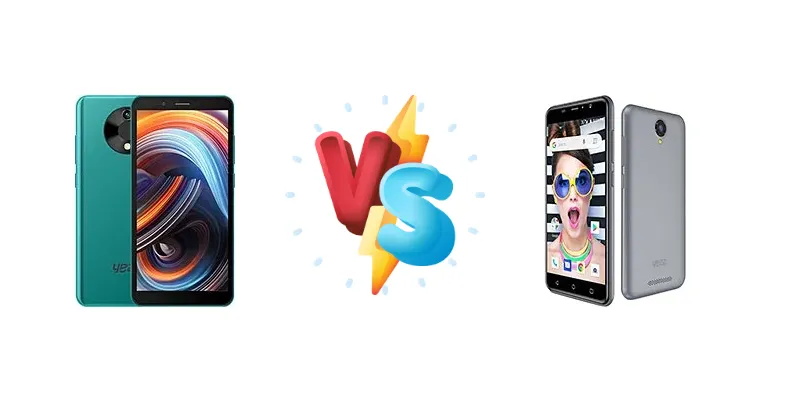
The Yezz Max 2 and Andy 5E5 represent the lower end of the smartphone spectrum, targeting users prioritizing affordability. While both devices offer a basic Android experience, significant differences in their chipsets dictate real-world performance. This comparison dissects those differences to help you choose the best option for your needs.
🏆 Quick Verdict
For the average user needing a functional smartphone for basic tasks like calls, messaging, and light web browsing, the Yezz Max 2 is the better choice. Its Mediatek MT6737M chipset, featuring Cortex-A53 cores, provides a noticeable performance edge over the Andy 5E5’s MT6580M and Cortex-A7, justifying a potential price premium.
| Network |
|---|
| 2G bands | GSM 850 / 900 / 1800 / 1900 | GSM 850 / 900 / 1800 / 1900 |
| 3G bands | HSDPA 850 / 900 / 2100 | HSDPA 850 / 900 / 1900 / 2100 - 5E5052 |
| 4G bands | 2, 3, 4, 7, 12, 17, 28 | - |
| Speed | HSPA 42.2/11.5 Mbps, LTE Cat4 150/50 Mbps | HSPA 21.1/5.76 Mbps |
| Technology | GSM / HSPA / LTE | GSM / HSPA |
| | - | HSDPA 850 / 1900 - 5E5043 |
| Launch |
|---|
| Announced | 2021, October. Released 2022, January | 2018, August. Released 2018, August |
| Status | Discontinued | Discontinued |
| Body |
|---|
| Dimensions | 146.5 x 71.5 x 10.2 mm (5.77 x 2.81 x 0.40 in) | 139.8 x 71.5 x 8.6 mm (5.50 x 2.81 x 0.34 in) |
| SIM | Nano-SIM + Micro-SIM | Nano-SIM + Micro-SIM |
| Weight | 170 g (6.00 oz) | 125 g (4.41 oz) |
| Display |
|---|
| Protection | Asahi Glass | Yes |
| Resolution | 480 x 960 pixels, 18:9 ratio (~197 ppi density) | 480 x 854 pixels, 16:9 ratio (~196 ppi density) |
| Size | 5.45 inches, 76.7 cm2 (~73.2% screen-to-body ratio) | 5.0 inches, 68.9 cm2 (~68.9% screen-to-body ratio) |
| Type | IPS LCD | TN |
| Platform |
|---|
| CPU | Quad-core 1.45 GHz Cortex-A53 | Quad-core 1.3 GHz Cortex-A7 |
| Chipset | Mediatek MT6737M (28 nm) | Mediatek MT6580M (28 nm) |
| GPU | Mali-T720MP2 | Mali-400MP2 |
| OS | Android 11 (Go edition) | Android 8.0 Oreo (Go edition) |
| Memory |
|---|
| Card slot | microSDHC | microSDHC (dedicated slot) |
| Internal | 32GB 1GB RAM | 8GB 1GB RAM |
| | eMMC 5.1 | - |
| Main Camera |
|---|
| Features | LED flash | LED flash |
| Single | 8 MP, AF | 5 MP |
| Video | 1080p@30fps | 1080p@30fps |
| Selfie camera |
|---|
| Single | 5 MP | 2 MP |
| Sound |
|---|
| 3.5mm jack | Yes | Yes |
| 35mm jack | Yes | Yes |
| Loudspeaker | Yes | Yes |
| Comms |
|---|
| Bluetooth | 4.0, A2DP, LE | 4.0, A2DP, LE |
| NFC | No | No |
| Positioning | GPS | GPS |
| Radio | Stereo FM radio, recording | Stereo FM radio |
| USB | microUSB 2.0 | microUSB 2.0 |
| WLAN | Wi-Fi 802.11 a/b/g/n/ac, dual-band | Wi-Fi 802.11 a/b/g/n |
| Features |
|---|
| Sensors | No | Accelerometer |
| Battery |
|---|
| Charging | USB Power Delivery | - |
| Stand-by | - | Up to 180 h (3G) |
| Talk time | - | Up to 6 h (3G) |
| Type | Li-Ion 2500 mAh, removable | Li-Ion 2000 mAh, non-removable |
| Misc |
|---|
| Colors | Ocean Green, Space Black, Pacific Blue | Black, Dark Gray, Gold |
| Price | About 60 EUR | - |
Yezz Max 2
- More powerful CPU (Cortex-A53)
- USB Power Delivery support
- Potentially smoother multitasking
- Likely higher price point
- No specified display details
Yezz Andy 5E5
- Likely lower price point
- Simple and functional for basic tasks
- Acceptable for voice calls and texting
- Older and less efficient CPU (Cortex-A7)
- Slower app loading times
- Limited multitasking capabilities
Display Comparison
Neither Yezz provides display specifications. Given their market segment, both likely utilize LCD panels with 720p resolution. The absence of details suggests neither device prioritizes display quality. Expect similar viewing angles and color accuracy, with neither offering features like high refresh rates or HDR support. Bezels are likely substantial on both models.
Camera Comparison
Camera details are sparse for both devices. It’s safe to assume both feature basic camera setups geared towards casual snapshots. Without sensor size or aperture information, a direct comparison is impossible. However, the Max 2’s slightly more powerful chipset *could* translate to faster image processing, but this is speculative. Expect limited low-light performance from both.
Performance
The core difference lies in the chipsets. The Yezz Max 2’s Mediatek MT6737M, built on a 28nm process, features a quad-core 1.45 GHz Cortex-A53 CPU. The Andy 5E5 uses the older Mediatek MT6580M, also 28nm, with a quad-core 1.3 GHz Cortex-A7 CPU. While both are 28nm, the Cortex-A53 architecture is more efficient and offers better performance per clock cycle than the Cortex-A7. This translates to faster app loading times and smoother multitasking on the Max 2. The Max 2’s USB Power Delivery support suggests a slightly more modern charging implementation, though actual charging speeds remain unknown.
Battery Life
Battery capacity is not specified for either device. Given the budget nature of these phones, expect capacities around 2000-2500 mAh. The Max 2’s USB Power Delivery support *might* allow for faster charging if a compatible charger is used, but the actual wattage is unknown. The more efficient Cortex-A53 cores in the Max 2 could also contribute to slightly better battery life under moderate use.
Buying Guide
Buy the Yezz Max 2 if you need a slightly more responsive experience for everyday tasks, and anticipate using apps beyond the most basic. The MT6737M offers a smoother experience with multitasking and slightly more demanding applications. Buy the Yezz Andy 5E5 if your primary needs are voice calls, text messaging, and extremely light app usage, and you are prioritizing the absolute lowest possible price point.
Frequently Asked Questions
❓ Will the Yezz Max 2 handle popular social media apps like Facebook and WhatsApp smoothly?
The Yezz Max 2’s Mediatek MT6737M chipset, with its Cortex-A53 cores, should provide a reasonably smooth experience with Facebook and WhatsApp. However, expect some lag when loading images or videos, and avoid running too many apps simultaneously.
❓ Is the Yezz Andy 5E5 suitable for someone who primarily uses a phone for calls and texts?
Yes, the Yezz Andy 5E5 is perfectly adequate for basic communication. Its MT6580M chipset is sufficient for making calls, sending texts, and using simple contact apps. However, it will struggle with more demanding tasks.
❓ Can either of these phones run modern mobile games?
Neither the Yezz Max 2 nor the Andy 5E5 are suitable for playing modern, graphically intensive mobile games. While simple 2D games might be playable, expect significant lag and low frame rates in most titles. The integrated GPUs in both chipsets are simply not powerful enough.