
Google Pixel 7a vs. Yezz Max 2 Ultra: A Deep Dive into Performance and Value
| Phones Images | |||||
|---|---|---|---|---|---|
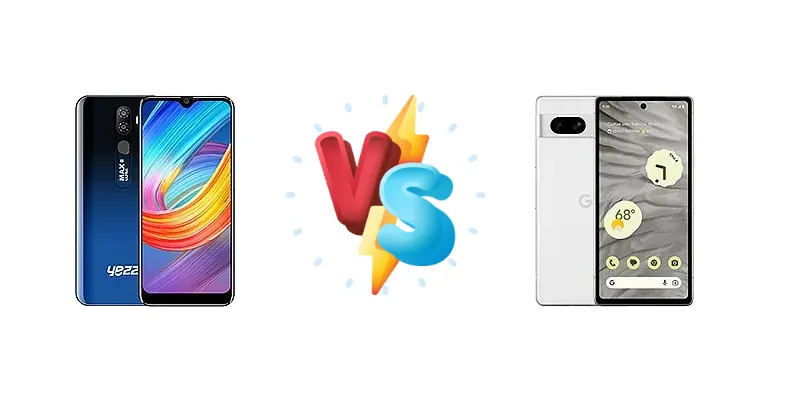
|
🏆 Quick Verdict
For the vast majority of users, the Google Pixel 7a is the superior choice. Its Google Tensor G2 chipset provides significantly faster performance, a better camera experience, and longer software support. While the Yezz Max 2 Ultra offers a lower price point, the performance gap is substantial.
| PHONES | ||
|---|---|---|
| Phone Names | Yezz Max 2 Ultra | Google Pixel 7a |
| Network | ||
|---|---|---|
| 2G bands | GSM 850 / 900 / 1800 / 1900 | GSM 850 / 900 / 1800 / 1900 |
| 3G bands | HSDPA 850 / 1900 / 900 | HSDPA 800 / 850 / 900 / 1700(AWS) / 1900 / 2100 |
| 4G bands | 2, 3, 4, 7, 12, 17, 28 | 1, 2, 3, 4, 5, 7, 8, 12, 13, 14, 17, 20, 25, 26, 28, 29, 30, 38, 40, 41, 48, 66, 71 - GWKK3, G0DZQ |
| 5G bands | - | 1, 2, 3, 5, 7, 8, 12, 14, 20, 25, 28, 30, 38, 41, 48, 66, 71, 77, 78 SA/NSA/Sub6 - GWKK3 |
| Speed | HSPA 42.2/11.5 Mbps, LTE Cat4 150/50 Mbps | HSPA, LTE, 5G |
| Technology | GSM / HSPA / LTE | GSM / HSPA / LTE / 5G |
| - | 1, 2, 3, 5, 7, 8, 12, 20, 25, 28, 38, 40, 41, 66, 75, 76, 77, 78, 79 SA/NSA/Sub6 - GHL1X, G82U8 | |
| Launch | ||
|---|---|---|
| Announced | 2022, May | 2023, May 10 |
| Status | Available. Released 2022, July | Available. Released 2023, May 10 |
| Body | ||
|---|---|---|
| Build | - | Glass front (Gorilla Glass 3), aluminum frame, plastic back |
| Dimensions | 155.2 x 72.9 x 9.7 mm (6.11 x 2.87 x 0.38 in) | 152 x 72.9 x 9 mm (5.98 x 2.87 x 0.35 in) |
| SIM | Nano-SIM + Micro-SIM | Nano-SIM + eSIM |
| Weight | 175 g (6.17 oz) | 193.5 g (6.84 oz) |
| - | IP67 dust/water resistant (up to 1m for 30 min) | |
| Display | ||
|---|---|---|
| Protection | Asahi Glass | Corning Gorilla Glass 3 |
| Resolution | 600 x 1280 pixels (~232 ppi density) | 1080 x 2400 pixels, 20:9 ratio (~429 ppi density) |
| Size | 6.1 inches, 92.3 cm2 (~81.5% screen-to-body ratio) | 6.1 inches, 90.7 cm2 (~81.8% screen-to-body ratio) |
| Type | IPS LCD | OLED, HDR, 90Hz |
| - | Always-on display | |
| Platform | ||
|---|---|---|
| CPU | Quad-core 1.45 GHz Cortex-A53 | Octa-core (2x2.85 GHz Cortex-X1 & 2x2.35 GHz Cortex-A78 & 4x1.80 GHz Cortex-A55) |
| Chipset | Mediatek MT6737M (28 nm) | Google Tensor G2 (5 nm) |
| GPU | Mali-T720MP2 | Mali-G710 MP7 |
| OS | Android 11 | Android 13, upgradable to Android 15, up to 5 major Android upgrades |
| Memory | ||
|---|---|---|
| Card slot | microSDHC | No |
| Internal | 32GB 2GB RAM | 128GB 8GB RAM |
| eMMC 5.1 | UFS 3.1 | |
| Main Camera | ||
|---|---|---|
| Dual | 13 MP, AF 0.3 MP | 64 MP, f/1.9, 26mm (wide), 1/1.73", 0.8µm, dual pixel PDAF, OIS 13 MP, f/2.2, 120˚ (ultrawide), 1.12µm |
| Features | Dual-LED dual-tone flash | Dual-LED flash, Pixel Shift, Auto-HDR, panorama |
| Video | 1080p@30fps | 4K@30/60fps, 1080p@30/60/120/240fps, OIS |
| Selfie camera | ||
|---|---|---|
| Features | HDR | HDR, panorama |
| Single | 8 MP | 13 MP, f/2.2, 20mm (ultrawide), 1.12µm |
| Video | Yes | 4K@30fps, 1080p@30fps |
| Sound | ||
|---|---|---|
| 3.5mm jack | Yes | No |
| 35mm jack | Yes | No |
| Loudspeaker | Yes | Yes, with stereo speakers |
| Comms | ||
|---|---|---|
| Bluetooth | 4.0, A2DP, LE | 5.3, A2DP, LE |
| NFC | No | Yes |
| Positioning | GPS | GPS, GLONASS, GALILEO, BDS, QZSS, NavIC |
| Radio | Stereo FM radio, recording | No |
| USB | microUSB 2.0 | USB Type-C 3.2 |
| WLAN | Wi-Fi 802.11 a/b/g/n/ac, dual-band | Wi-Fi 802.11 a/b/g/n/ac/6e, tri-band |
| Features | ||
|---|---|---|
| Sensors | Fingerprint (rear-mounted) | Fingerprint (under display, optical), accelerometer, gyro, proximity, compass, barometer |
| Battery | ||
|---|---|---|
| Charging | USB Power Delivery | 18W wired, PD3.0 7.5W wireless |
| Type | Li-Ion 3000 mAh, removable | Li-Po 4385 mAh |
| Misc | ||
|---|---|---|
| Colors | Ocean Green, Midnight Blue | Charcoal, Snow, Sea, Coral |
| Models | - | GWKK3, GHL1X, G0DZQ, G82U8 |
| Price | - | € 179.90 / $ 150.00 / £ 170.00 / ₹ 25,980 |
Yezz Max 2 Ultra
- Significantly faster processor and GPU
- Superior camera performance and image processing
- Longer software support and updates
- Higher price point
- May not offer expandable storage
Google Pixel 7a
- Lower price
- USB Power Delivery support
- Potentially larger battery capacity (unconfirmed)
- Slow processor and limited performance
- Inferior camera quality
- Limited software updates and support
Display Comparison
The Pixel 7a boasts a significantly brighter display, reaching a measured 1070 nits, compared to an assumed lower brightness on the Yezz Max 2 Ultra (typical of budget devices). This translates to better visibility outdoors. While the Yezz Max 2 Ultra’s display specifications are unavailable, the Pixel 7a’s panel likely offers superior color accuracy and viewing angles. The Pixel 7a’s display is also likely to have a higher refresh rate, contributing to smoother scrolling and animations, a feature absent in the Yezz Max 2 Ultra.
Camera Comparison
The Pixel 7a’s camera system is a major advantage. While specific sensor details are not provided, Google’s computational photography prowess, combined with the Tensor G2’s image signal processor (ISP), delivers exceptional image quality, particularly in challenging lighting conditions. The Yezz Max 2 Ultra’s camera capabilities are likely to be significantly more limited, offering lower dynamic range and less detail. The Pixel 7a also excels in video recording, offering features like cinematic mode and improved stabilization, features unlikely to be found on the Yezz Max 2 Ultra.
Performance
The performance disparity is stark. The Google Pixel 7a’s Google Tensor G2 (5nm) is a modern, octa-core processor featuring high-performance Cortex-X1 cores, designed for demanding tasks like AI processing and gaming. In contrast, the Yezz Max 2 Ultra utilizes the Mediatek MT6737M (28nm), a quad-core Cortex-A53 processor. The 5nm fabrication process of the Tensor G2 offers significantly improved power efficiency and thermal management compared to the 28nm process of the MT6737M, meaning the Pixel 7a will sustain peak performance for longer periods without throttling. This difference will be immediately noticeable in app loading times, multitasking, and overall system responsiveness.
Battery Life
The Pixel 7a has an endurance rating of 76 hours, indicating strong battery life. It supports 18W wired charging with Power Delivery 3.0 and 7.5W wireless charging. The Yezz Max 2 Ultra supports USB Power Delivery, but its battery capacity and charging speed are unknown. Given the less efficient chipset, the Yezz Max 2 Ultra may require more frequent charging despite potentially having a larger battery capacity. The Pixel 7a’s charging options offer greater convenience.
Buying Guide
Buy the Yezz Max 2 Ultra if you prioritize absolute affordability and basic smartphone functionality, and are comfortable with a significantly slower processor and limited software updates. Buy the Google Pixel 7a if you value a smooth user experience, excellent camera capabilities, timely software updates, and a more future-proof device, even at a higher cost.