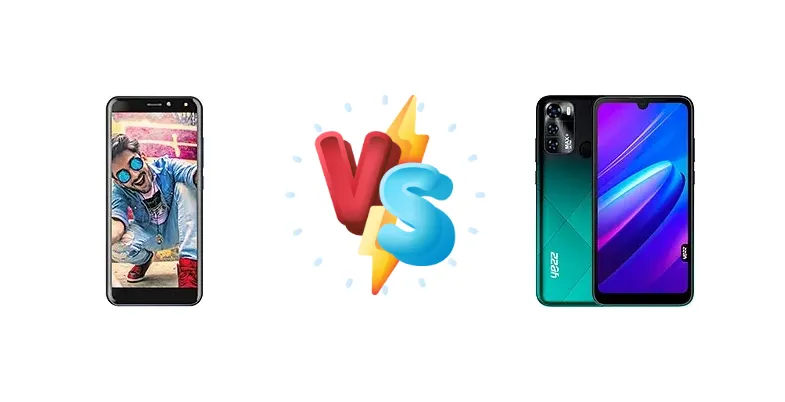
Yezz caters to the ultra-budget smartphone market, and the LIV1 and Max 3 Ultra represent two of their offerings. While both devices aim for affordability, they differ in their internal hardware. This comparison dissects the nuances between the Unisoc SC7731E-powered LIV1 and the SC9832E-equipped Max 3 Ultra, focusing on how these chipset choices translate to real-world user experience.
🏆 Quick Verdict
For the average user prioritizing slightly smoother performance and the convenience of 10W wired charging, the Yezz Max 3 Ultra is the better choice. Its marginally faster CPU and inclusion of charging support offer a more complete experience, despite both phones sharing a similar target market and manufacturing process.
| Network |
|---|
| 2G bands | GSM 850 / 900 / 1800 / 1900 | GSM 850 / 900 / 1800 / 1900 |
| 3G bands | HSDPA 850 / 900 / 1900 / 2100 | HSDPA 850 / 900 / 1900 / 2100 |
| 4G bands | - | 2, 3, 4, 7, 12, 17, 28 |
| Speed | HSPA 21.1/5.76 Mbps | HSPA, LTE |
| Technology | GSM / HSPA | GSM / HSPA / LTE |
| Launch |
|---|
| Announced | 2019, August. Released 2019, September | 2022, September |
| Status | Discontinued | Available. Released 2023, January |
| Body |
|---|
| Dimensions | 138.5 x 65.8 x 9.5 mm (5.45 x 2.59 x 0.37 in) | 159.7 x 77.3 x 9.9 mm (6.29 x 3.04 x 0.39 in) |
| SIM | Nano-SIM + Nano-SIM | Nano-SIM + Nano-SIM |
| Weight | 133.3 g (4.69 oz) | 182 g (6.42 oz) |
| Display |
|---|
| Protection | AGC glass | INX Glass |
| Resolution | 480 x 960 pixels, 18:9 ratio (~215 ppi density) | 720 x 1520 pixels, 19:9 ratio (~269 ppi density) |
| Size | 5.0 inches, 64.5 cm2 (~70.8% screen-to-body ratio) | 6.26 inches, 97.8 cm2 (~79.2% screen-to-body ratio) |
| Type | TFT LCD | IPS LCD |
| Platform |
|---|
| CPU | Quad-core 1.3 GHz Cortex-A7 | Quad-core 1.4 GHz |
| Chipset | Unisoc SC7731E (28 nm) | Unisoc SC9832E (28 nm) |
| GPU | Mali-T820 MP1 | Mali-T820 MP1 |
| OS | Android 9.1 Pie (Go edition) | Android 12 |
| Memory |
|---|
| Card slot | microSDXC (dedicated slot) | microSDXC |
| Internal | 16GB 1GB RAM | 32GB 2GB RAM |
| | - | eMMC 5.1 |
| Main Camera |
|---|
| Dual | - | 13 MP, AF
0.3 MP |
| Features | LED flash, panorama, HDR | Dual-LED flash |
| Single | 5 MP | - |
| Video | 1080p@30fps | 1080p@30fps |
| Selfie camera |
|---|
| Features | LED flash | - |
| Single | 2 MP | 8 MP |
| Video | 720p@30fps | Yes |
| Sound |
|---|
| 3.5mm jack | Yes | Yes |
| 35mm jack | Yes | Yes |
| Loudspeaker | Yes | Yes |
| Comms |
|---|
| Bluetooth | 4.0, A2DP, LE | 4.2, A2DP, LE |
| NFC | No | No |
| Positioning | GPS | GPS |
| Radio | Stereo FM radio | Stereo FM radio, recording |
| USB | microUSB 2.0 | USB Type-C 2.0 |
| WLAN | Wi-Fi 802.11 b/g/n | Wi-Fi 802.11 b/g/n |
| Features |
|---|
| Sensors | Accelerometer | Fingerprint (rear-mounted) |
| Battery |
|---|
| Charging | - | 10W wired |
| Stand-by | Up to 220 h | - |
| Talk time | Up to 7 h 30 min | - |
| Type | Li-Ion 2000 mAh, removable | Li-Ion 3700 mAh, removable |
| Misc |
|---|
| Colors | Black, Gun Metal, Blue, Red | Artic Blue, Aqua Green, Turquoise Green |
| Price | About 50 EUR | About 100 EUR |
Yezz LIV1
- Potentially lower price point.
- Functional for basic smartphone tasks.
- Simple and straightforward user experience.
- Slower processor compared to the Max 3 Ultra.
- No specified charging standard.
- Likely limited multitasking capabilities.
Yezz Max 3 Ultra
- Faster processor for smoother performance.
- 10W wired charging for convenience.
- Slightly improved multitasking capabilities.
- May be slightly more expensive than the LIV1.
- Still limited by the Unisoc SC9832E chipset.
- Camera performance likely similar to the LIV1.
Display Comparison
Unfortunately, detailed display specifications are unavailable. Given both phones target the budget segment, we can assume they utilize LCD panels with resolutions likely around 720p. Bezels are expected to be substantial on both devices. Color accuracy will likely be standard for this price point, prioritizing power efficiency over vibrant color reproduction. Without specific nit brightness data, it's difficult to assess outdoor visibility, but both will likely struggle in direct sunlight.
Camera Comparison
Camera details are sparse, but it’s safe to assume both phones feature basic camera setups. Given the target price point, image quality will be heavily reliant on software processing. The presence of a 2MP macro camera on either device is largely a marketing tactic, offering minimal practical benefit due to the low resolution and lack of optical image stabilization (OIS). Expect acceptable results in well-lit conditions, but significant noise and softness in low-light scenarios. The primary sensor resolution is unknown, but it's unlikely to be a significant differentiator.
Performance
The core difference lies in the chipsets. The Yezz Max 3 Ultra’s Unisoc SC9832E, with its quad-core CPU clocked at 1.4 GHz, represents a modest performance uplift over the LIV1’s Unisoc SC7731E (1.3 GHz). While both are based on the Cortex-A7 architecture and a 28nm process, the higher clock speed translates to faster app launch times and smoother multitasking. The SC9832E also benefits from potentially improved GPU performance, though neither chipset is geared towards demanding gaming. The LIV1 will likely exhibit more noticeable lag when switching between apps or loading heavier web pages. Both devices likely feature limited RAM, further impacting multitasking capabilities.
Battery Life
Battery capacity is not specified for either device. However, given their budget nature, we can anticipate capacities around 2000-3000 mAh. The Yezz Max 3 Ultra’s inclusion of 10W wired charging is a significant advantage. The LIV1 lacks any specified charging standard, implying a slower, potentially less efficient charging experience. While both phones will likely offer all-day battery life with moderate usage, the Max 3 Ultra’s charging capability provides more flexibility and convenience.
Buying Guide
Buy the Yezz LIV1 if you need a basic, functional smartphone for essential tasks like calls, texts, and light web browsing, and are comfortable with potentially slower app loading times and no official charging standard. Buy the Yezz Max 3 Ultra if you prefer a slightly more responsive experience, appreciate the convenience of 10W wired charging, and are willing to spend a small premium for these improvements.
Frequently Asked Questions
❓ Will the Yezz Max 3 Ultra handle popular social media apps like Facebook and Instagram without significant lag?
The Unisoc SC9832E in the Max 3 Ultra should be capable of running Facebook and Instagram, but expect some loading times and occasional stuttering, especially with multiple apps open. It's not designed for intensive multitasking, so closing unused apps is recommended.
❓ Is the lack of a specified charging standard on the Yezz LIV1 a major drawback?
Yes, the absence of a defined charging standard means you'll likely need to use the included charger, and charging speeds will be slower and potentially less efficient than the Yezz Max 3 Ultra's 10W charging. It also limits compatibility with readily available chargers.
❓ Can either of these phones play PUBG Mobile, and if so, at what settings?
While technically possible to launch PUBG Mobile on both devices, the experience will be far from ideal. Expect extremely low frame rates, even on the lowest settings, and significant lag. These phones are not designed for demanding games like PUBG.
❓ How much storage space is typically available on these devices after the operating system is installed?
Storage capacity is not specified, but budget smartphones often ship with 16GB or 32GB of internal storage. After accounting for the operating system and pre-installed apps, you can expect around 8-16GB of usable storage, necessitating a microSD card for additional space.