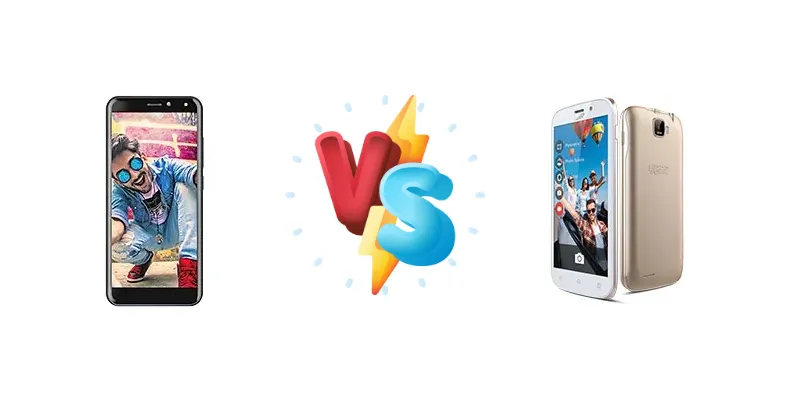
The Yezz LIV1 and Andy 5EI3 (2016) represent the ultra-budget end of the smartphone spectrum. Both devices target first-time smartphone buyers or those needing a secondary device for basic communication. This comparison dissects their core components to determine which offers the best value for essential smartphone functions.
🏆 Quick Verdict
For the average user prioritizing basic functionality, the Yezz LIV1 edges out the Andy 5EI3 (2016). While both utilize the same 28nm process and Cortex-A7 architecture, the Unisoc SC7731E chipset in the LIV1 offers slightly better potential for software optimization and future Android Go support, making it a marginally more future-proof choice.
| Network |
|---|
| 2G bands | GSM 850 / 900 / 1800 / 1900 | GSM 850 / 900 / 1800 / 1900 - SIM 1 & SIM 2 |
| 3G bands | HSDPA 850 / 900 / 1900 / 2100 | HSDPA 900 / 2100 - AM5E047 |
| Speed | HSPA 21.1/5.76 Mbps | HSPA 21.1/5.76 Mbps |
| Technology | GSM / HSPA | GSM / HSPA |
| Launch |
|---|
| Announced | 2019, August. Released 2019, September | 2016, June. Released 2016, August |
| Status | Discontinued | Discontinued |
| Body |
|---|
| Dimensions | 138.5 x 65.8 x 9.5 mm (5.45 x 2.59 x 0.37 in) | 145.5 x 74.8 x 8.9 mm (5.73 x 2.94 x 0.35 in) |
| SIM | Nano-SIM + Nano-SIM | Dual SIM (Mini-SIM/ Micro-SIM) |
| Weight | 133.3 g (4.69 oz) | 153 g (5.40 oz) |
| Display |
|---|
| Protection | AGC glass | - |
| Resolution | 480 x 960 pixels, 18:9 ratio (~215 ppi density) | 480 x 854 pixels, 16:9 ratio (~196 ppi density) |
| Size | 5.0 inches, 64.5 cm2 (~70.8% screen-to-body ratio) | 5.0 inches, 68.9 cm2 (~63.3% screen-to-body ratio) |
| Type | TFT LCD | TFT |
| Platform |
|---|
| CPU | Quad-core 1.3 GHz Cortex-A7 | Quad-core 1.3 GHz Cortex-A7 |
| Chipset | Unisoc SC7731E (28 nm) | Mediatek MT6580M (28 nm) |
| GPU | Mali-T820 MP1 | Mali-400MP2 |
| OS | Android 9.1 Pie (Go edition) | Android 6.0 (Marshmallow) |
| Memory |
|---|
| Card slot | microSDXC (dedicated slot) | microSDXC (dedicated slot) |
| Internal | 16GB 1GB RAM | 8GB 512MB RAM |
| Main Camera |
|---|
| Features | LED flash, panorama, HDR | LED flash, panorama |
| Single | 5 MP | 5 MP |
| Video | 1080p@30fps | 720p@30fps |
| Selfie camera |
|---|
| Features | LED flash | - |
| Single | 2 MP | 2 MP |
| Video | 720p@30fps | - |
| Sound |
|---|
| 3.5mm jack | Yes | Yes |
| 35mm jack | Yes | Yes |
| Loudspeaker | Yes | Yes |
| Comms |
|---|
| Bluetooth | 4.0, A2DP, LE | 4.0, LE |
| NFC | No | No |
| Positioning | GPS | GPS |
| Radio | Stereo FM radio | Stereo FM radio |
| USB | microUSB 2.0 | microUSB 2.0 |
| WLAN | Wi-Fi 802.11 b/g/n | Wi-Fi 802.11 a/b/g/n, Wi-Fi Direct |
| Features |
|---|
| Sensors | Accelerometer | Accelerometer |
| Battery |
|---|
| Stand-by | Up to 220 h | Up to 333 h (3G) |
| Talk time | Up to 7 h 30 min | Up to 8 h (3G) |
| Type | Li-Ion 2000 mAh, removable | Li-Ion 2000 mAh battery |
| Misc |
|---|
| Colors | Black, Gun Metal, Blue, Red | Black, Blue, Red, Gun Metal, White, Silver, Pink |
| Price | About 50 EUR | - |
Yezz LIV1
- Potential for better Android Go optimization with Unisoc chipset.
- Slightly more modern chipset architecture.
- Likely better software support long-term.
- Limited specifications available.
- Likely similar camera performance to the Andy 5EI3 (2016).
Yezz Andy 5EI3 (2016)
- May be available at a lower price point.
- Proven Mediatek chipset with established driver support.
- Simple and straightforward functionality.
- Limited software support and potential for updates.
- Older chipset architecture.
Display Comparison
Neither Yezz provides display specifications beyond size, making a direct comparison difficult. Given both phones target the budget segment, it's safe to assume both utilize TN or low-cost IPS panels with resolutions likely around 480x854. Color accuracy and viewing angles will likely be limited on both. The absence of any mention of protective glass suggests neither device prioritizes screen durability.
Camera Comparison
Camera details are sparse for both devices. It's highly probable both feature a basic 5MP rear camera and a 2MP front camera. Image quality will be heavily dependent on software processing and lighting conditions. The 2MP macro camera often found in this segment is unlikely to provide significant detail or usability. Expect limited dynamic range and noise reduction capabilities on both devices.
Performance
Both the Yezz LIV1 and Andy 5EI3 (2016) are powered by quad-core 1.3 GHz Cortex-A7 CPUs fabricated on a 28nm process. However, the chipset differs: the LIV1 uses a Unisoc SC7731E, while the Andy 5EI3 (2016) employs a Mediatek MT6580M. While the CPU clock speeds are identical, Unisoc has a history of optimizing for Android Go, suggesting the LIV1 might receive better software support and performance within the constraints of its hardware. The GPU performance will be similarly limited on both, suitable only for basic 2D games and video playback.
Battery Life
Battery capacity is not specified for either device. Given their budget nature, both likely house batteries in the 1500-2000 mAh range. Charging wattage is also unknown, but likely limited to 5W. Real-world battery life will depend heavily on usage patterns, but users should expect to charge these devices daily, even with minimal use. The 28nm process node, while older, isn't particularly power-hungry, but the limited battery capacity will be the primary constraint.
Buying Guide
Buy the Yezz LIV1 if you need a device primarily for calls, messaging, and light app usage, and value potential compatibility with newer Android Go releases. Buy the Yezz Andy 5EI3 (2016) if you can find it at a significantly lower price point and only require the most basic smartphone features, understanding its software support is likely limited.
Frequently Asked Questions
❓ Will the Yezz LIV1 receive Android updates?
Given its budget nature, major Android version updates are unlikely. However, the Unisoc SC7731E chipset has a history of being optimized for Android Go, meaning the LIV1 may receive security patches and benefit from the streamlined Android Go experience for longer than the Andy 5EI3 (2016).
❓ Is the Mediatek MT6580M chipset in the Andy 5EI3 (2016) sufficient for WhatsApp and Facebook?
Yes, the Mediatek MT6580M is capable of running basic applications like WhatsApp and Facebook. However, expect slow loading times and occasional lag, especially with multiple apps open. The limited RAM and processing power will be a bottleneck for multitasking.
❓ Can either of these phones play PUBG Mobile?
No. The GPUs in both the Unisoc SC7731E and Mediatek MT6580M are far too weak to run PUBG Mobile, even at the lowest settings. Attempting to do so will result in extremely poor performance and an unplayable experience.