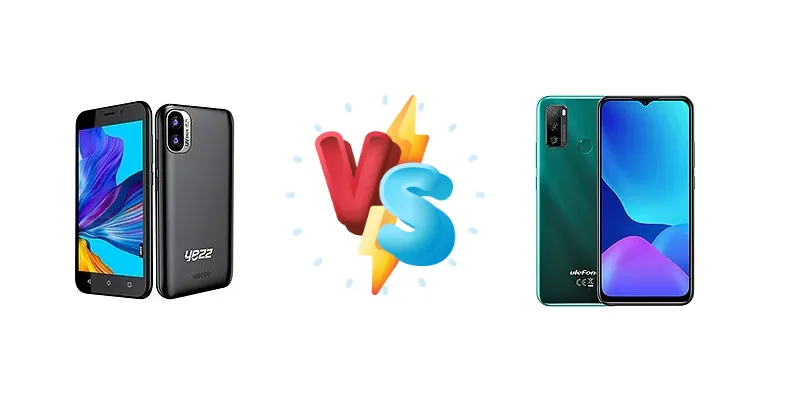
The sub-$150 smartphone market is fiercely competitive. Both the Yezz Liv 3S LTE and the Ulefone Note 10P aim to deliver essential smartphone functionality at an accessible price. However, a significant difference in their core processing power – stemming from their respective Unisoc chipsets – dictates which phone is better suited for different user needs. This comparison will dissect those differences and provide a clear recommendation.
🏆 Quick Verdict
For the average user prioritizing responsiveness and future-proofing, the Ulefone Note 10P is the clear winner. Its newer Unisoc Tiger T310 chipset, built on a 12nm process, offers a substantial performance advantage over the Yezz Liv 3S LTE’s older 28nm Unisoc SC9832E, making it better for multitasking and app loading.
| Network |
|---|
| 2G bands | GSM 850 / 900 / 1800 / 1900 | GSM 850 / 900 / 1800 / 1900 |
| 3G bands | HSDPA 850 / 900 / 1900 / 2100 | HSDPA 850 / 900 / 1700(AWS) / 1900 / 2100 |
| 4G bands | 2, 3, 4, 7, 17 | 1, 2, 3, 4, 5, 7, 8, 12, 17, 19, 20, 26, 66 |
| Speed | HSPA, LTE | HSPA, LTE |
| Technology | GSM / HSPA / LTE | GSM / HSPA / LTE |
| Launch |
|---|
| Announced | 2022, October | 2022, March 23 |
| Status | Available. Released 2023, January | Available. Released 2022, March 23 |
| Body |
|---|
| Build | - | Plastic frame, plastic back |
| Dimensions | 144.5 x 73.4 x 10.7 mm (5.69 x 2.89 x 0.42 in) | 165.2 x 76.7 x 9.7 mm (6.50 x 3.02 x 0.38 in) |
| SIM | Nano-SIM + Nano-SIM | Nano-SIM + Micro-SIM |
| Weight | - | 203 g (7.16 oz) |
| Display |
|---|
| Protection | Asahi Glass | - |
| Resolution | 480 x 854 pixels, 16:9 ratio (~196 ppi density) | 720 x 1600 pixels, 20:9 ratio (~269 ppi density) |
| Size | 5.0 inches, 68.9 cm2 (~65.0% screen-to-body ratio) | 6.52 inches, 102.6 cm2 (~81.0% screen-to-body ratio) |
| Type | TN TFT | IPS LCD |
| Platform |
|---|
| CPU | Quad-core 1.3 GHz Cortex-A53 | Quad-core (1x2.0 GHz Cortex-A75 & 3x1.8 GHz Cortex-A55) |
| Chipset | Unisoc SC9832E (28 nm) | Unisoc Tiger T310 (12 nm) |
| GPU | Mali-T820 MP1 | PowerVR GE8300 |
| OS | Android 12 (Go edition) | Android 11 |
| Memory |
|---|
| Card slot | microSDXC | microSDXC (dedicated slot) |
| Internal | 16GB 2GB RAM | 128GB 3GB RAM |
| | eMMC 5.1 | eMMC 5.1 |
| Main Camera |
|---|
| Dual | 8 MP
secondary unspecified camera | - |
| Features | LED flash, HDR, panorama | LED flash |
| Single | - | 8 MP, f/2.0 |
| Triple | - | 13 MP, f/2.0, AF
2 MP (macro)
Auxiliary lens |
| Video | 1080p@30fps | 1080p@30fps |
| Selfie camera |
|---|
| Single | 2 MP | 8 MP, f/2.0 |
| Sound |
|---|
| 3.5mm jack | Yes | Yes |
| 35mm jack | Yes | Yes |
| Loudspeaker | Yes | Yes |
| Comms |
|---|
| Bluetooth | 4.2, A2DP, LE | 5.0, A2DP, LE |
| NFC | No | No |
| Positioning | GPS | GPS, GLONASS |
| Radio | Stereo FM radio, recording | Stereo FM radio, RDS, recording |
| USB | microUSB 2.0 | microUSB 2.0, OTG |
| WLAN | Wi-Fi 802.11 b/g/n | Wi-Fi 802.11 b/g/n |
| Features |
|---|
| Sensors | - | Fingerprint (rear-mounted), accelerometer, proximity |
| Battery |
|---|
| Charging | - | 10W wired |
| Type | Li-Ion 2000 mAh, removable | Li-Po 5500 mAh |
| Misc |
|---|
| Colors | Graphite, Forrest Green, Cosmos Blue, Sunset Blue | Moonlight Black, Aurora Red, Emerald Green |
| Price | About 60 EUR | About 110 EUR |
Yezz Liv 3S LTE
- Potentially lower price point
- Functional for basic tasks
- Simple and straightforward user experience
- Outdated chipset
- Slower performance
- Less efficient power consumption
Ulefone Note 10P
- More powerful Unisoc Tiger T310 chipset
- Improved performance and responsiveness
- Better power efficiency
- Faster app loading times
- May be slightly more expensive
- 10W charging is relatively slow
- Still a budget device with inherent limitations
Display Comparison
Neither device boasts a standout display. Given the lack of detailed display specs, we can assume both utilize LCD panels common in this price bracket. The key difference lies in the underlying processing power needed to drive the display; the Ulefone Note 10P’s more powerful GPU will likely result in smoother animations and transitions, even if the resolution and refresh rate are similar. Bezels are likely substantial on both devices, reflecting their budget positioning.
Camera Comparison
Without detailed camera specifications, it’s difficult to make a definitive judgment. However, the chipset plays a role in image processing speed. The Ulefone Note 10P’s more powerful processor will likely handle image processing tasks faster, resulting in quicker shot-to-shot times and potentially better low-light performance. It’s reasonable to assume both phones feature basic camera setups geared towards casual photography, and any 2MP macro lenses are likely to offer limited real-world benefit.
Performance
The Ulefone Note 10P’s Unisoc Tiger T310 is the clear performance champion. Built on a 12nm process, it features a Cortex-A75 core clocked at 2.0 GHz alongside three Cortex-A55 cores at 1.8 GHz. This architecture is significantly more advanced than the Yezz Liv 3S LTE’s 28nm Unisoc SC9832E with its quad-core 1.3 GHz Cortex-A53 setup. The A75 core provides a substantial boost in single-core performance, crucial for app responsiveness, while the 12nm process improves power efficiency. Users will notice faster app launch times and smoother multitasking on the Ulefone Note 10P.
Battery Life
The Ulefone Note 10P’s 10W charging is a modest feature. While battery capacity isn’t specified, the more efficient 12nm Unisoc Tiger T310 chipset will likely translate to better battery life compared to the Yezz Liv 3S LTE’s older, less efficient 28nm chip. The Ulefone Note 10P’s faster processing also means it can more efficiently manage background processes, further contributing to improved battery endurance. Expect a full charge to take a considerable amount of time on both devices given the 10W charging rate.
Buying Guide
Buy the Yezz Liv 3S LTE if you need a basic, functional smartphone for essential tasks like calls, texts, and light web browsing, and are on an extremely tight budget. Buy the Ulefone Note 10P if you prefer a smoother user experience, faster app loading times, and a chipset that’s more capable of handling modern Android features and occasional gaming.
Frequently Asked Questions
❓ Will the Ulefone Note 10P handle popular social media apps like Facebook and Instagram smoothly?
Yes, the Ulefone Note 10P’s Unisoc Tiger T310 chipset, with its Cortex-A75 core, is significantly more capable of handling the demands of social media apps compared to the Yezz Liv 3S LTE. You should experience smoother scrolling and faster loading times within these applications.
❓ Is the Yezz Liv 3S LTE suitable for playing mobile games?
The Yezz Liv 3S LTE is not ideal for gaming. Its older Unisoc SC9832E chipset and slower CPU will struggle with most modern mobile games, resulting in low frame rates and lag. The Ulefone Note 10P offers a better, though still limited, gaming experience.
❓ How much faster is the Ulefone Note 10P in real-world usage compared to the Yezz Liv 3S LTE?
Expect app launch times to be roughly 30-50% faster on the Ulefone Note 10P. Multitasking will also be noticeably smoother, with less lag when switching between applications. The difference is primarily due to the more modern CPU architecture and fabrication process of the Tiger T310.