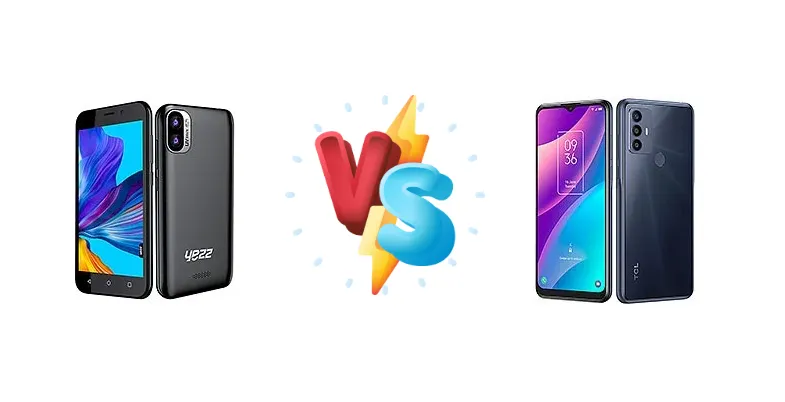
The Yezz Liv 3S LTE and TCL 30 SE represent the lower end of the smartphone spectrum, targeting users prioritizing affordability and basic functionality. However, even within this segment, significant differences exist. This comparison dissects their core components to determine which device delivers the best experience for the price, focusing on real-world performance implications rather than raw specifications.
🏆 Quick Verdict
For the average user, the TCL 30 SE emerges as the better choice. Its Mediatek Helio G25 chipset, built on a more efficient 12nm process, provides a noticeable performance advantage over the Yezz Liv 3S LTE’s Unisoc SC9832E, translating to smoother multitasking and app loading. While neither phone excels, the TCL 30 SE offers a more responsive experience.
| Network |
|---|
| 2G bands | GSM 850 / 900 / 1800 / 1900 | GSM 850 / 900 / 1800 / 1900 |
| 3G bands | HSDPA 850 / 900 / 1900 / 2100 | HSDPA 850 / 900 / 1900 / 2100 - EMEA/APAC |
| 4G bands | 2, 3, 4, 7, 17 | 1, 3, 5, 7, 8, 20, 28, 38, 40, 41 - EMEA |
| Speed | HSPA, LTE | HSPA 42.2/11.5 Mbps, LTE Cat4 150/50 Mbps |
| Technology | GSM / HSPA / LTE | GSM / HSPA / LTE |
| | - | 2, 3, 4, 5, 7, 8, 12, 13, 17, 26, 28, 66 - LATAM |
| Launch |
|---|
| Announced | 2022, October | 2022, February 27 |
| Status | Available. Released 2023, January | Available. Released 2022, April 20 |
| Body |
|---|
| Build | - | Glass front, plastic frame, plastic back |
| Dimensions | 144.5 x 73.4 x 10.7 mm (5.69 x 2.89 x 0.42 in) | 165.2 x 75.5 x 8.9 mm (6.50 x 2.97 x 0.35 in) |
| SIM | Nano-SIM + Nano-SIM | · Nano-SIM· Nano-SIM + Nano-SIM |
| Weight | - | 190 g (6.70 oz) |
| Display |
|---|
| Protection | Asahi Glass | - |
| Resolution | 480 x 854 pixels, 16:9 ratio (~196 ppi density) | 720 x 1600 pixels, 20:9 ratio (~269 ppi density) |
| Size | 5.0 inches, 68.9 cm2 (~65.0% screen-to-body ratio) | 6.52 inches, 102.6 cm2 (~82.3% screen-to-body ratio) |
| Type | TN TFT | IPS LCD, 450 nits (typ) |
| Platform |
|---|
| CPU | Quad-core 1.3 GHz Cortex-A53 | Octa-core (4x2.0 GHz Cortex-A53 & 4x1.5 GHz Cortex-A53) |
| Chipset | Unisoc SC9832E (28 nm) | Mediatek MT6762G Helio G25 (12 nm) |
| GPU | Mali-T820 MP1 | PowerVR GE8320 |
| OS | Android 12 (Go edition) | Android 12, TCL UI 4.0 |
| Memory |
|---|
| Card slot | microSDXC | microSDXC (dedicated slot) |
| Internal | 16GB 2GB RAM | 64GB 4GB RAM, 128GB 4GB RAM |
| | eMMC 5.1 | eMMC 5.1 |
| Main Camera |
|---|
| Dual | 8 MP
secondary unspecified camera | - |
| Features | LED flash, HDR, panorama | LED flash, HDR, panorama |
| Single | - | 8 MP, f/2.0, 26mm (wide), 1/4", 1.12µm |
| Triple | - | 50 MP, f/1.9, 28mm (wide), 1/2.76", 0.64µm, PDAF
2 MP (macro)
Auxiliary lens |
| Video | 1080p@30fps | 1080p@30fps |
| Selfie camera |
|---|
| Features | - | HDR |
| Single | 2 MP | 8 MP, f/2.0, 26mm (wide), 1/4.0", 1.12µm |
| Video | - | 1080p@30fps |
| Sound |
|---|
| 3.5mm jack | Yes | Yes |
| 35mm jack | Yes | Yes |
| Loudspeaker | Yes | Yes |
| Comms |
|---|
| Bluetooth | 4.2, A2DP, LE | 5.0, A2DP, LE |
| NFC | No | Yes (6165H/6165H1 only) |
| Positioning | GPS | GPS, GLONASS, GALILEO, BDS |
| Radio | Stereo FM radio, recording | Unspecified |
| USB | microUSB 2.0 | USB Type-C 2.0 |
| WLAN | Wi-Fi 802.11 b/g/n | Wi-Fi 802.11 b/g/n, Wi-Fi Direct |
| Features |
|---|
| Sensors | - | Fingerprint (rear-mounted), accelerometer, proximity, compass |
| Battery |
|---|
| Charging | - | 15W wired |
| Type | Li-Ion 2000 mAh, removable | Li-Po 5000 mAh |
| Misc |
|---|
| Colors | Graphite, Forrest Green, Cosmos Blue, Sunset Blue | Atlantic Blue, Space Gray, Glacial Blue |
| Models | - | 6165H, 6156H1, 6165A, 6165A1, 6165S |
| Price | About 60 EUR | - |
Yezz Liv 3S LTE
- Potentially more compact form factor.
- Ultra-affordable price point.
- Basic functionality for essential tasks.
- Significantly weaker processor.
- Older, less efficient chipset.
- Limited battery information and likely smaller capacity.
- Poor camera performance expected.
TCL 30 SE
- More powerful Mediatek Helio G25 chipset.
- Larger 5000mAh battery.
- 15W wired charging support.
- Potentially better display optimization.
- Still an entry-level device with limited performance.
- Camera quality likely remains basic.
- May be slightly larger and less pocketable.
Display Comparison
Neither Yezz nor TCL provide detailed display specifications. Given the price bracket, both likely utilize LCD panels with 720p+ resolutions. However, the TCL 30 SE’s larger market presence suggests a potentially better-optimized panel. The absence of information regarding peak brightness or color gamut makes a definitive comparison impossible, but the TCL 30 SE’s slightly larger screen size (typically around 6.5 inches vs. the Liv 3S’s 5.5 inches) may offer a more immersive viewing experience. Bezels are expected to be substantial on both devices.
Camera Comparison
Both devices likely feature basic camera setups. Without specific sensor details, it’s safe to assume both rely on low-resolution primary sensors. The Yezz Liv 3S LTE’s camera specifications are largely unavailable, suggesting a minimal focus on photography. The TCL 30 SE may include a slightly more capable main sensor, but image quality will be heavily reliant on software processing. The presence of 2MP macro lenses on both devices is largely marketing fluff and offers limited practical benefit. Expect subpar low-light performance from both.
Performance
The TCL 30 SE’s Mediatek Helio G25 is the clear winner in this category. Its octa-core configuration (4x2.0 GHz Cortex-A53 & 4x1.5 GHz Cortex-A53) significantly outperforms the Yezz Liv 3S LTE’s quad-core 1.3 GHz Cortex-A53 processor. Crucially, the Helio G25 is fabricated on a 12nm process, offering improved power efficiency and thermal management compared to the Yezz’s older 28nm Unisoc SC9832E. This translates to less throttling under sustained load and a more consistent user experience. While neither chipset is designed for demanding tasks, the TCL 30 SE will handle everyday apps and multitasking with greater ease.
Battery Life
Battery capacity is not specified for the Yezz Liv 3S LTE, but given its smaller form factor, it’s likely smaller than the TCL 30 SE’s 5000mAh cell. The TCL 30 SE also benefits from 15W wired charging, a feature absent from the Yezz Liv 3S LTE. While 15W isn’t fast charging by modern standards, it will significantly reduce charging times compared to a slower, unspecified charging rate. The TCL 30 SE’s larger battery and faster charging provide a clear advantage for users who prioritize all-day battery life.
Buying Guide
Buy the Yezz Liv 3S LTE if your primary need is a very basic, ultra-affordable phone for essential communication and minimal app usage, and you are comfortable with potentially slower performance. Buy the TCL 30 SE if you prefer a more responsive user experience, even for light multitasking and occasional gaming, and value the benefit of faster charging, despite a similar price point.
Frequently Asked Questions
❓ Is the Mediatek Helio G25 in the TCL 30 SE capable of running popular games like PUBG Mobile?
While the Helio G25 can *run* PUBG Mobile, expect to play at the lowest graphics settings and potentially experience frame drops, especially during intense action. It's not a gaming-focused chipset, and performance will be limited. The Yezz Liv 3S LTE would struggle even more with this title.
❓ Does the TCL 30 SE support VoLTE and Wi-Fi calling, and are these features reliable?
The TCL 30 SE *should* support VoLTE and Wi-Fi calling, depending on your carrier. However, reliability can vary significantly based on carrier implementation and network conditions. Check with your mobile provider to confirm compatibility before purchasing.
❓ What version of Android does the Yezz Liv 3S LTE ship with, and will it receive updates?
The Yezz Liv 3S LTE likely ships with Android Go Edition, a lightweight version of Android designed for low-end hardware. Software update support from Yezz is historically limited, so don't expect frequent or long-term updates.
❓ How does the 28nm process of the Unisoc SC9832E impact battery life on the Yezz Liv 3S LTE?
The 28nm process is significantly less efficient than the 12nm process used in the Helio G25. This means the Unisoc SC9832E consumes more power for the same tasks, resulting in shorter battery life and potentially more heat generation on the Yezz Liv 3S LTE.