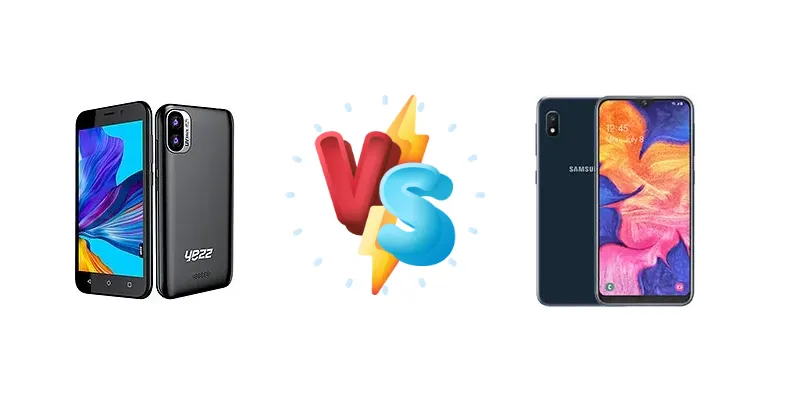
The Yezz Liv 3S LTE and Samsung Galaxy A10e represent the lower end of the smartphone market, targeting users prioritizing affordability. However, beneath the similar price points lie significant differences in processing power and overall user experience. This comparison dissects these differences to determine which device delivers the best value.
🏆 Quick Verdict
For the average user, the Samsung Galaxy A10e emerges as the better choice. Its Exynos 7884 chipset, featuring an octa-core configuration, provides a noticeable performance advantage over the Yezz Liv 3S LTE’s quad-core Unisoc SC9832E, translating to smoother multitasking and app loading, despite potentially slightly lower battery efficiency.
| Network |
|---|
| 2G bands | GSM 850 / 900 / 1800 / 1900 | GSM 850 / 900 / 1800 / 1900 |
| 3G bands | HSDPA 850 / 900 / 1900 / 2100 | HSDPA 850 / 1700(AWS) / 1900 / 2100 - AT&T |
| 4G bands | 2, 3, 4, 7, 17 | 2, 3, 4, 5, 7, 12, 14, 29, 30, 66 - AT&T |
| Speed | HSPA, LTE | HSPA 42.2/5.76 Mbps, LTE Cat4 150/50 Mbps |
| Technology | GSM / HSPA / LTE | GSM / CDMA / HSPA / LTE |
| | - | 1, 2, 3, 4, 5, 7, 8, 12, 13, 20, 25, 26, 28, 38, 39, 40, 41, 66, 71 - Metro PCS, T-Mobile |
| Launch |
|---|
| Announced | 2022, October | 2019, July. Released 2019, August |
| Status | Available. Released 2023, January | Discontinued |
| Body |
|---|
| Build | - | Glass front, plastic back, plastic frame |
| Dimensions | 144.5 x 73.4 x 10.7 mm (5.69 x 2.89 x 0.42 in) | 147.3 x 69.6 x 8.4 mm (5.80 x 2.74 x 0.33 in) |
| SIM | Nano-SIM + Nano-SIM | Nano-SIM |
| Weight | - | 141 g (4.97 oz) |
| Display |
|---|
| Protection | Asahi Glass | - |
| Resolution | 480 x 854 pixels, 16:9 ratio (~196 ppi density) | 720 x 1560 pixels, 19.5:9 ratio (~295 ppi density) |
| Size | 5.0 inches, 68.9 cm2 (~65.0% screen-to-body ratio) | 5.83 inches, 83.4 cm2 (~81.4% screen-to-body ratio) |
| Type | TN TFT | PLS LCD |
| Platform |
|---|
| CPU | Quad-core 1.3 GHz Cortex-A53 | Octa-core (2x1.6 GHz Cortex-A73 & 6x1.35 GHz Cortex-A53) |
| Chipset | Unisoc SC9832E (28 nm) | Exynos 7884 (14 nm) |
| GPU | Mali-T820 MP1 | Mali-G71 MP2 |
| OS | Android 12 (Go edition) | Android 9.0 (Pie), upgradable to Android 11, One UI 3.1 |
| Memory |
|---|
| Card slot | microSDXC | microSDXC (dedicated slot) |
| Internal | 16GB 2GB RAM | 32GB 2GB RAM, 32GB 3GB RAM |
| | eMMC 5.1 | eMMC 5.1 |
| Main Camera |
|---|
| Dual | 8 MP
secondary unspecified camera | - |
| Features | LED flash, HDR, panorama | LED flash, panorama, HDR |
| Single | - | 8 MP, f/1.9, AF
or
5 MP, AF |
| Video | 1080p@30fps | 1080p@30fps |
| Selfie camera |
|---|
| Single | 2 MP | 5 MP, f/2.0
or
2 MP |
| Sound |
|---|
| 3.5mm jack | Yes | Yes |
| 35mm jack | Yes | Yes |
| Loudspeaker | Yes | Yes |
| Comms |
|---|
| Bluetooth | 4.2, A2DP, LE | 5.0, A2DP, LE |
| NFC | No | No |
| Positioning | GPS | GPS, GLONASS, GALILEO |
| Radio | Stereo FM radio, recording | No |
| USB | microUSB 2.0 | USB Type-C 2.0 |
| WLAN | Wi-Fi 802.11 b/g/n | Wi-Fi 802.11 a/b/g/n/ac, dual-band, Wi-Fi Direct |
| Features |
|---|
| Sensors | - | Accelerometer, proximity |
| Battery |
|---|
| Type | Li-Ion 2000 mAh, removable | Li-Ion 3000 mAh, non-removable |
| Misc |
|---|
| Colors | Graphite, Forrest Green, Cosmos Blue, Sunset Blue | Black |
| Models | - | SM-A102U, SM-S102DL, SM-A102U1, SM-A102W, SM-A102N |
| Price | About 60 EUR | About 80 EUR |
| SAR | - | 0.47 W/kg (head) 0.54 W/kg (body) |
Yezz Liv 3S LTE
- Potentially longer battery life due to less powerful chipset
- Likely more affordable
- Functional for basic smartphone tasks
- Significantly slower performance
- Limited multitasking capabilities
- Lower quality camera
Samsung Galaxy A10e
- Faster and more responsive performance
- Better multitasking capabilities
- More versatile camera system
- Potentially shorter battery life
- May be slightly more expensive
- Basic display quality
Display Comparison
Neither device boasts a standout display. Both likely utilize LCD panels, common in this price bracket. The Yezz Liv 3S LTE’s display specifications are unavailable, but given its positioning, it’s likely a 720p panel. The Samsung Galaxy A10e features a 6.3-inch HD+ (720 x 1520) display. The A10e’s larger size offers more screen real estate, but the resolution is similar. Color accuracy and brightness are expected to be average on both, with neither offering features like HDR support or high refresh rates.
Camera Comparison
Camera performance on both devices is expected to be basic. The Yezz Liv 3S LTE’s camera specifications are unknown, but it likely features a single rear camera. The Samsung Galaxy A10e features a dual-camera setup: a 12MP main sensor with an f/1.8 aperture and a 5MP ultrawide lens. While the A10e’s ultrawide lens adds versatility, the primary sensor’s aperture is more important for low-light performance. Image processing will be limited on both, and the common 2MP macro lenses found on similar devices are largely ineffective. The A10e’s larger sensor and Samsung’s image processing algorithms will likely yield better results.
Performance
This is where the most significant difference lies. The Samsung Galaxy A10e’s Exynos 7884, built on a 14nm process, is a substantial upgrade over the Yezz Liv 3S LTE’s Unisoc SC9832E (28nm). The A10e’s octa-core CPU – comprised of two 1.6 GHz Cortex-A73 cores and six 1.35 GHz Cortex-A53 cores – provides a significant advantage in multi-threaded tasks and overall responsiveness. The Yezz Liv 3S LTE’s quad-core 1.3 GHz Cortex-A53 CPU will struggle with demanding applications and multitasking. The 14nm process of the Exynos also implies better power efficiency, though the A10e’s more powerful cores will likely offset some of this benefit. Users intending to play even casual games will find the A10e a far more enjoyable experience.
Battery Life
The Samsung Galaxy A10e packs a 3000 mAh battery, while the Yezz Liv 3S LTE’s battery capacity is unknown. However, the Unisoc SC9832E’s less demanding architecture *could* translate to longer battery life despite a potentially smaller capacity. The A10e supports 15W charging, while the Yezz Liv 3S LTE’s charging speed is unknown. The Exynos 7884’s higher power draw will likely result in faster battery depletion during intensive use, but the A10e’s faster charging could mitigate this.
Buying Guide
Buy the Yezz Liv 3S LTE if your primary need is a basic, functional smartphone for essential tasks like calls, texts, and light web browsing, and you prioritize potentially longer battery life due to the less powerful chipset. Buy the Samsung Galaxy A10e if you value a more responsive user experience, smoother multitasking, and the ability to handle moderately demanding apps, even if it means potentially shorter battery runtimes.
Frequently Asked Questions
❓ Does the Unisoc SC9832E chip struggle with popular apps like Facebook or WhatsApp?
Yes, the Unisoc SC9832E is a very basic chipset. While it can run apps like Facebook and WhatsApp, you may experience noticeable lag, slow loading times, and occasional crashes, especially when multitasking. The Samsung Galaxy A10e’s Exynos 7884 handles these apps with significantly more ease.
❓ Is the Samsung Galaxy A10e suitable for playing mobile games like PUBG Mobile or Call of Duty Mobile?
The Samsung Galaxy A10e can *run* PUBG Mobile and Call of Duty Mobile, but not at high settings. You’ll likely need to play at the lowest graphics settings and frame rates to achieve a playable experience. Expect occasional frame drops and stuttering. The Yezz Liv 3S LTE is unlikely to provide a satisfactory gaming experience with these titles.
❓ What kind of software updates can I expect on the Yezz Liv 3S LTE?
Yezz is not known for providing extensive software updates. It's likely the Liv 3S LTE will ship with an older version of Android and receive limited security patches, if any. The Samsung Galaxy A10e, while also aging, has a better track record for software support, though major Android version updates are unlikely.
❓ How does the 28nm process of the Unisoc chip affect battery life compared to the 14nm Exynos?
A smaller process node (like 14nm) generally means better power efficiency. The Unisoc SC9832E's 28nm process is less efficient, meaning it consumes more power for the same amount of processing. However, because the Unisoc chip is less powerful overall, it may still result in comparable or even slightly better battery life during light usage, as it's not drawing as much power under load.