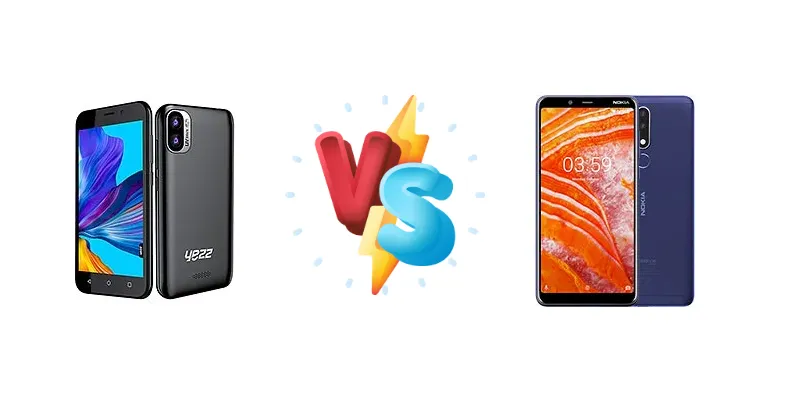
The Yezz Liv 3S LTE and Nokia 3.1 Plus represent two approaches to the ultra-budget smartphone market. The Yezz focuses on providing basic LTE connectivity at a low price point, while the Nokia 3.1 Plus aims for a more balanced experience with a more powerful chipset, albeit with regional variations. This comparison will dissect their key differences to determine which device offers the best value.
🏆 Quick Verdict
For the average user prioritizing responsiveness and future-proofing, the Nokia 3.1 Plus is the better choice. Its Mediatek Helio P22 (or Snapdragon 439 in the US) chipset delivers significantly improved performance over the Yezz Liv 3S LTE’s Unisoc SC9832E, making everyday tasks smoother and more enjoyable. However, the Yezz remains a viable option for those needing the absolute cheapest LTE experience.
| Network |
|---|
| 2G bands | GSM 850 / 900 / 1800 / 1900 | GSM 850 / 900 / 1800 / 1900 |
| 3G bands | HSDPA 850 / 900 / 1900 / 2100 | HSDPA 850 / 900 / 1900 / 2100 |
| 4G bands | 2, 3, 4, 7, 17 | 2, 4, 5, 12, 14, 29, 30 - USA |
| Speed | HSPA, LTE | HSPA 42.2/5.76 Mbps, LTE Cat4 150/50 Mbps |
| Technology | GSM / HSPA / LTE | GSM / HSPA / LTE |
| | - | HSDPA 850 / 1700(AWS) / 1900 - USA |
| Launch |
|---|
| Announced | 2022, October | 2018, October. Released 2018, October |
| Status | Available. Released 2023, January | Discontinued |
| Body |
|---|
| Build | - | Glass front, aluminum back, aluminum frame |
| Dimensions | 144.5 x 73.4 x 10.7 mm (5.69 x 2.89 x 0.42 in) | 156.9 x 76.4 x 8.2 mm (6.18 x 3.01 x 0.32 in) |
| SIM | Nano-SIM + Nano-SIM | Nano-SIM + Nano-SIM |
| Weight | - | 180 g (6.35 oz) |
| Display |
|---|
| Protection | Asahi Glass | - |
| Resolution | 480 x 854 pixels, 16:9 ratio (~196 ppi density) | 720 x 1440 pixels, 18:9 ratio (~268 ppi density) |
| Size | 5.0 inches, 68.9 cm2 (~65.0% screen-to-body ratio) | 6.0 inches, 92.9 cm2 (~77.5% screen-to-body ratio) |
| Type | TN TFT | IPS LCD |
| Platform |
|---|
| CPU | Quad-core 1.3 GHz Cortex-A53 | Octa-core 2.0 GHz Cortex-A53 - GlobalOcta-core (4x1.95 GHz Cortex-A53 & 4x1.45 GHz Cortex A53) - USA |
| Chipset | Unisoc SC9832E (28 nm) | Mediatek MT6762 Helio P22 (12 nm) - GlobalQualcomm SDM439 Snapdragon 439 (12 nm) - USA |
| GPU | Mali-T820 MP1 | PowerVR GE8320 - GlobalAdreno 505 - USA |
| OS | Android 12 (Go edition) | Android 8.1 (Oreo), upgradable to Android 10, Android One |
| Memory |
|---|
| Card slot | microSDXC | microSDXC (dedicated slot) |
| Internal | 16GB 2GB RAM | 16GB 2GB RAM, 32GB 2GB RAM, 32GB 3GB RAM |
| | eMMC 5.1 | eMMC 5.1 |
| Main Camera |
|---|
| Dual | 8 MP
secondary unspecified camera | 13 MP, f/2.0, AF
Auxiliary lens |
| Features | LED flash, HDR, panorama | LED flash, HDR, panorama |
| Video | 1080p@30fps | 1080p@30fps |
| Selfie camera |
|---|
| Features | - | LED flash, HDR |
| Single | 2 MP | 8 MP, f/2.2 |
| Video | - | 720p@30fps |
| Sound |
|---|
| 3.5mm jack | Yes | Yes |
| 35mm jack | Yes | Yes |
| Loudspeaker | Yes | Yes |
| Comms |
|---|
| Bluetooth | 4.2, A2DP, LE | 4.1, A2DP, LE |
| NFC | No | Yes (USA, APAC & EMEA) |
| Positioning | GPS | GPS, GLONASS, BDS, GALILEO |
| Radio | Stereo FM radio, recording | FM radio |
| USB | microUSB 2.0 | microUSB 2.0, OTG |
| WLAN | Wi-Fi 802.11 b/g/n | Wi-Fi 802.11 b/g/n, Wi-Fi Direct |
| Features |
|---|
| Sensors | - | Fingerprint (rear-mounted), accelerometer, gyro, proximity, compass |
| Battery |
|---|
| Charging | - | 10W wired |
| Type | Li-Ion 2000 mAh, removable | Li-Ion 3500 mAh, non-removable |
| Misc |
|---|
| Colors | Graphite, Forrest Green, Cosmos Blue, Sunset Blue | Blue, White, Gray |
| Models | - | TA-1118, TA-1125, TA-1113, TA-1117, TA-1124, TA-1125 |
| Price | About 60 EUR | About 120 EUR |
| SAR EU | - | 0.41 W/kg (head) 1.58 W/kg (body) |
Yezz Liv 3S LTE
- Extremely affordable price point
- LTE connectivity for basic communication
- Potentially smaller and lighter form factor (speculation)
- Significantly slower processor
- Limited multitasking capabilities
- Likely poor camera performance
- Older, less efficient chipset
Nokia 3.1 Plus
- Faster and more responsive processor
- Better multitasking performance
- More efficient chipset for longer battery life
- Potentially better camera quality
- 10W charging support
- Slightly higher price point
- 10W charging is relatively slow
- Still a budget device with limitations
Display Comparison
Neither device boasts a standout display. Both likely utilize IPS LCD panels, common in this price bracket. However, the lack of detailed display specifications for the Yezz Liv 3S LTE makes a direct comparison difficult. The Nokia 3.1 Plus, while not specifying peak brightness, benefits from a more modern chipset capable of driving a potentially higher quality panel. Bezels are expected to be substantial on both devices, reflecting their budget nature. Color accuracy is unlikely to be a priority on either.
Camera Comparison
Camera performance is likely to be similar in real-world usage, meaning limited. Both devices likely feature basic camera setups. The Yezz Liv 3S LTE’s camera specifications are unavailable, but it’s reasonable to assume a low-resolution main sensor. The Nokia 3.1 Plus typically features a 13MP main camera, which, while not exceptional, will likely outperform whatever the Yezz offers. The presence of a dedicated image signal processor (ISP) in the Helio P22/Snapdragon 439 will also contribute to better image processing. Avoid expecting high-quality photos from either device; they are adequate for casual snapshots.
Performance
The performance gap is the most significant differentiator. The Yezz Liv 3S LTE’s Unisoc SC9832E, built on a 28nm process, features a quad-core Cortex-A53 CPU clocked at 1.3 GHz. This is a relatively slow and inefficient chipset. In contrast, the Nokia 3.1 Plus utilizes either the Mediatek Helio P22 (12nm) globally or the Qualcomm Snapdragon 439 (12nm) in the US. Both are octa-core CPUs, with the Helio P22 clocked at 2.0 GHz and the Snapdragon 439 at a dual-cluster configuration (1.95 GHz & 1.45 GHz). The 12nm process node and higher clock speeds translate to a substantial performance advantage for the Nokia 3.1 Plus, particularly in multitasking and demanding applications. The Nokia’s chipset also benefits from a more capable GPU, improving graphics performance.
Battery Life
Battery capacity details for the Yezz Liv 3S LTE are missing. The Nokia 3.1 Plus features a 3000mAh battery and supports 10W wired charging. While 10W charging is slow by modern standards, it’s typical for this price range. The more efficient chipset in the Nokia 3.1 Plus will likely result in longer battery life despite potentially having a similar capacity to the Yezz. The Unisoc SC9832E’s older 28nm process is inherently less power-efficient.
Buying Guide
Buy the Yezz Liv 3S LTE if you need a functional, incredibly affordable LTE-enabled smartphone for basic communication and are willing to compromise on performance. It’s ideal for users on a very strict budget or as a temporary device. Buy the Nokia 3.1 Plus if you prefer a more responsive user experience, better multitasking capabilities, and a chipset that will handle app updates and future Android versions with greater ease. It’s suited for users who want a phone that will last longer and offer a more fluid experience.
Frequently Asked Questions
❓ Is the Mediatek Helio P22 in the Nokia 3.1 Plus prone to overheating during extended use?
The Mediatek Helio P22 is a relatively efficient chipset and is unlikely to overheat significantly during typical usage. While it can get warm during prolonged gaming or video recording, it’s not known for thermal throttling issues in this class of device. The 12nm process node contributes to better thermal management compared to the Yezz's 28nm chip.
❓ How does the Unisoc SC9832E in the Yezz Liv 3S LTE handle common apps like WhatsApp and Facebook?
The Unisoc SC9832E can run apps like WhatsApp and Facebook, but expect noticeable lag and slower loading times. Multitasking between these apps and others will be sluggish. It's sufficient for very basic use, but not ideal for a smooth experience.
❓ Does the Nokia 3.1 Plus support software updates beyond Android 9 Pie (its original OS)?
The Nokia 3.1 Plus was part of the Android One program, guaranteeing at least one major Android version update and regular security patches. It has received updates to Android 10 and 11, offering improved security and features compared to the Yezz Liv 3S LTE, which likely remains on an older Android version.