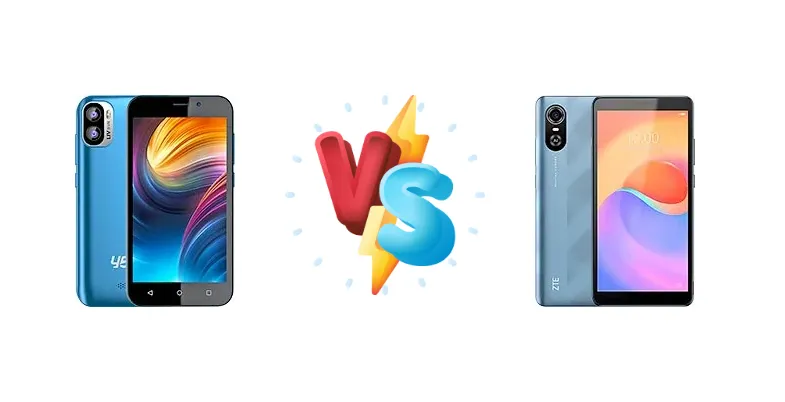
The Yezz Liv 3 LTE and ZTE Blade A31 Plus represent the lower end of the smartphone market, targeting users prioritizing affordability and basic functionality. Both devices utilize Unisoc chipsets, but differ significantly in core count and architecture. This comparison dissects these differences to determine which phone offers the best experience for the price.
🏆 Quick Verdict
For the average user seeking a functional, affordable LTE smartphone, the ZTE Blade A31 Plus emerges as the better choice. Its octa-core processor, utilizing Cortex-A55 cores, provides a noticeable performance advantage over the Yezz Liv 3 LTE’s quad-core Cortex-A53, translating to smoother multitasking and app loading.
| Network |
|---|
| 2G bands | GSM 850 / 900 / 1800 / 1900 | GSM 850 / 900 / 1800 / 1900 |
| 3G bands | HSDPA 850 / 900 / 1900 / 2100 | HSDPA 850 / 900 / 2100 |
| 4G bands | 2, 3, 4, 7, 17 | 1, 2, 3, 5, 7, 8, 20, 28, 38, 40, 41 |
| Speed | HSPA 21.1/5.76 Mbps, LTE Cat4 150/50 Mbps | HSPA, LTE |
| Technology | GSM / HSPA / LTE | GSM / HSPA / LTE |
| Launch |
|---|
| Announced | 2021, August. Released 2021, December | 2021, October 31 |
| Status | Discontinued | Available. Released 2021, October 31 |
| Body |
|---|
| Dimensions | 144.6 x 73.4 x 10.7 mm (5.69 x 2.89 x 0.42 in) | 159.2 x 77.5 x 9.6 mm (6.27 x 3.05 x 0.38 in) |
| SIM | Nano-SIM + Nano-SIM | Nano-SIM + Nano-SIM |
| Weight | - | - |
| Display |
|---|
| Protection | Asahi Glass | - |
| Resolution | 480 x 854 pixels, 16:9 ratio (~196 ppi density) | 480 x 960 pixels, 18:9 ratio (~179 ppi density) |
| Size | 5.0 inches, 68.9 cm2 (~64.9% screen-to-body ratio) | 6.0 inches, 92.9 cm2 (~75.3% screen-to-body ratio) |
| Type | TFT LCD | IPS LCD |
| Platform |
|---|
| CPU | Quad-core 1.3 GHz Cortex-A53 | Octa-core (4x1.6 GHz Cortex-A55 & 4x1.2 GHz Cortex-A55) |
| Chipset | Unisoc SC9832E (28 nm) | Unisoc SC9863A (28 nm) |
| GPU | Mali-T820 MP1 | IMG8322 |
| OS | Android 11 (Go edition) | Android 11 (Go edition) |
| Memory |
|---|
| Card slot | microSDXC (dedicated slot) | microSDXC |
| Internal | 16GB 1GB RAM | 32GB 1GB RAM |
| | eMMC 5.1 | eMMC 5.1 |
| Main Camera |
|---|
| Dual | 5 MP
VGA | - |
| Features | LED flash, HDR, panorama | LED flash, HDR |
| Single | - | 5 MP (up-scaled to 8 MP) |
| Video | 1080p@30fps | 720p@30fps |
| Selfie camera |
|---|
| Single | 2 MP | 2 MP (up-scaled to 5 MP) |
| Sound |
|---|
| 3.5mm jack | Yes | Yes |
| 35mm jack | Yes | Yes |
| Loudspeaker | Yes | Yes |
| Comms |
|---|
| Bluetooth | 4.2, A2DP, LE | 4.2, A2DP, LE |
| NFC | No | Yes |
| Positioning | GPS | GPS, GLONASS |
| Radio | Stereo FM radio | FM radio |
| USB | microUSB 2.0 | microUSB 2.0 |
| WLAN | Wi-Fi 802.11 b/g/n | Wi-Fi 802.11 b/g/n |
| Features |
|---|
| Sensors | Accelerometer | Accelerometer |
| Battery |
|---|
| Type | Li-Ion 2000 mAh, removable | Li-Ion 3000 mAh |
| Misc |
|---|
| Colors | Smoke Black, Glacier Blue, Forest Green | Blue, Gray |
Yezz Liv 3 LTE
- Potentially lower price point
- Simpler user experience for basic tasks
- May offer slightly longer battery life (speculative)
- Significantly slower performance
- Outdated processor architecture
- Less responsive user interface
ZTE Blade A31 Plus
- Faster and more responsive performance
- More efficient processor architecture
- Better multitasking capabilities
- Potentially higher price
- May have slightly shorter battery life (speculative)
- More demanding on battery resources
Display Comparison
Neither device boasts a standout display. Given the context data lacks display specifics, we can assume both utilize LCD panels common in this price bracket. The focus here isn't on visual fidelity, but rather basic usability. Bezels are likely substantial on both, and color accuracy will be standard for budget phones. The absence of information regarding refresh rates suggests both operate at the standard 60Hz.
Camera Comparison
Without detailed camera specifications, it's safe to assume both devices feature basic camera setups geared towards casual photography. The market segment suggests primary sensors will be in the 8-13MP range. Any additional sensors (likely a depth or macro lens) will be of low resolution and limited utility. Image processing will be basic, prioritizing speed over quality. The ZTE Blade A31 Plus *may* have a slight edge due to the more powerful ISP within the SC9863A chipset, potentially allowing for faster image processing and slightly better low-light performance, but this is speculative.
Performance
The core difference lies in the chipsets. The ZTE Blade A31 Plus’s Unisoc SC9863A, with its octa-core configuration (4x1.6 GHz Cortex-A55 & 4x1.2 GHz Cortex-A55), represents a significant architectural leap over the Yezz Liv 3 LTE’s Unisoc SC9832E and its quad-core 1.3 GHz Cortex-A53. The Cortex-A55 cores are more efficient and offer improved instruction throughput compared to the older A53 architecture. This translates to faster app launches, smoother scrolling, and a more responsive overall experience on the ZTE. While both are 28nm, the increased core count and newer architecture of the SC9863A provide a clear advantage.
Battery Life
Battery capacity is not specified for either device. However, given the lower processing demands of the Yezz Liv 3 LTE, it *could* potentially achieve slightly longer battery life on a single charge, assuming similar battery capacities. The ZTE Blade A31 Plus, with its more powerful processor, will likely consume more power, but the improved performance may offset this in real-world usage. Charging wattage is also unknown, suggesting both will likely utilize standard 5W or 10W charging, resulting in relatively slow charge times.
Buying Guide
Buy the Yezz Liv 3 LTE if you absolutely need the lowest possible price point and are primarily focused on basic communication tasks like calls and messaging. Buy the ZTE Blade A31 Plus if you value a more responsive user experience, even for light multitasking, and anticipate using more than just essential apps. The A31 Plus offers a better balance of performance and features for everyday use.
Frequently Asked Questions
❓ Will the ZTE Blade A31 Plus handle basic social media apps like Facebook and WhatsApp smoothly?
Yes, the octa-core processor and Cortex-A55 architecture of the ZTE Blade A31 Plus are well-suited for running basic social media applications like Facebook and WhatsApp without significant lag. The increased processing power compared to the Yezz Liv 3 LTE will provide a noticeably smoother experience.
❓ Is the Yezz Liv 3 LTE a good choice for someone who primarily uses their phone for calls and texts?
The Yezz Liv 3 LTE is a viable option for users who primarily need a phone for calls and texts. Its simpler processor and potentially lower price point make it suitable for basic communication tasks. However, be aware that performance will be limited if you attempt to run more demanding applications.
❓ Can either of these phones run popular mobile games like PUBG Mobile or Call of Duty Mobile?
While technically possible, neither phone is ideal for gaming. The Unisoc chipsets lack the graphical power to deliver a smooth gaming experience in demanding titles like PUBG Mobile or Call of Duty Mobile. You'll likely need to play at the lowest settings with significant frame rate drops.
❓ What kind of storage options are typically available on these devices?
Based on the market segment, both devices likely offer 16GB or 32GB of internal storage, expandable via microSD card. However, this is not confirmed by the provided specifications. It's crucial to check the specific model's storage capacity before purchasing.