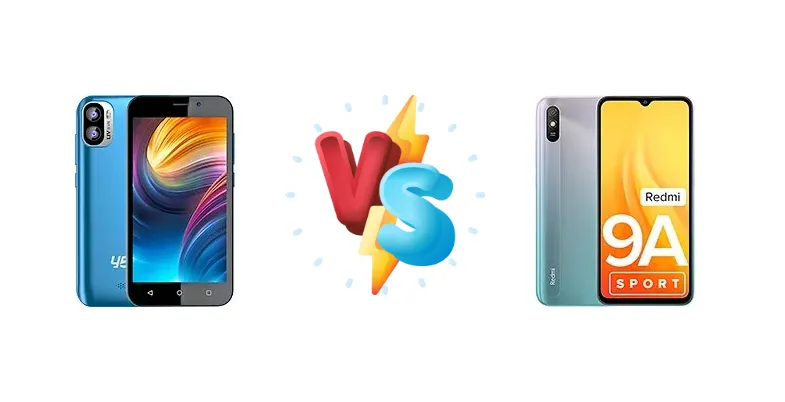
The sub-$150 smartphone market is fiercely competitive. Both the Yezz Liv 3 LTE and the Xiaomi Redmi 9A Sport aim to deliver essential smartphone functionality at an accessible price. However, significant differences in their underlying hardware dictate vastly different user experiences, making a direct comparison crucial for informed buyers.
🏆 Quick Verdict
For the average user, the Xiaomi Redmi 9A Sport is the superior choice. Its Mediatek Helio G25 chipset, built on a more efficient 12nm process, provides a noticeable performance advantage over the Yezz Liv 3 LTE’s older Unisoc SC9832E. While both phones target the budget segment, the Redmi 9A Sport offers a smoother, more responsive experience.
| Network |
|---|
| 2G bands | GSM 850 / 900 / 1800 / 1900 | GSM 850 / 900 / 1800 / 1900 |
| 3G bands | HSDPA 850 / 900 / 1900 / 2100 | HSDPA 850 / 900 / 2100 |
| 4G bands | 2, 3, 4, 7, 17 | 1, 3, 5, 8, 40, 41 |
| Speed | HSPA 21.1/5.76 Mbps, LTE Cat4 150/50 Mbps | HSPA, LTE |
| Technology | GSM / HSPA / LTE | GSM / HSPA / LTE |
| Launch |
|---|
| Announced | 2021, August. Released 2021, December | 2021, September 28 |
| Status | Discontinued | Available. Released 2021, September 28 |
| Body |
|---|
| Dimensions | 144.6 x 73.4 x 10.7 mm (5.69 x 2.89 x 0.42 in) | 164.9 x 77.1 x 9 mm (6.49 x 3.04 x 0.35 in) |
| SIM | Nano-SIM + Nano-SIM | Nano-SIM + Nano-SIM |
| Weight | - | 194 g (6.84 oz) |
| | - | Water-repellent coating |
| Display |
|---|
| Protection | Asahi Glass | - |
| Resolution | 480 x 854 pixels, 16:9 ratio (~196 ppi density) | 720 x 1600 pixels, 20:9 ratio (~269 ppi density) |
| Size | 5.0 inches, 68.9 cm2 (~64.9% screen-to-body ratio) | 6.53 inches, 102.9 cm2 (~81.0% screen-to-body ratio) |
| Type | TFT LCD | IPS LCD, 400 nits (typ) |
| Platform |
|---|
| CPU | Quad-core 1.3 GHz Cortex-A53 | Octa-core (4x2.0 GHz Cortex-A53 & 4x1.5 GHz Cortex-A53) |
| Chipset | Unisoc SC9832E (28 nm) | Mediatek MT6762G Helio G25 (12 nm) |
| GPU | Mali-T820 MP1 | PowerVR GE8320 |
| OS | Android 11 (Go edition) | Android 10, MIUI 12 |
| Memory |
|---|
| Card slot | microSDXC (dedicated slot) | microSDXC (dedicated slot) |
| Internal | 16GB 1GB RAM | 32GB 2GB RAM, 32GB 3GB RAM |
| | eMMC 5.1 | eMMC 5.1 |
| Main Camera |
|---|
| Dual | 5 MP
VGA | - |
| Features | LED flash, HDR, panorama | LED flash, HDR |
| Single | - | 13 MP, f/2.2, 28mm (wide), 1.0µm, PDAF |
| Video | 1080p@30fps | 1080p@30/60fps |
| Selfie camera |
|---|
| Features | - | HDR |
| Single | 2 MP | 5 MP, f/2.2, (wide), 1.12µm |
| Video | - | 1080p@30fps |
| Sound |
|---|
| 3.5mm jack | Yes | Yes |
| 35mm jack | Yes | Yes |
| Loudspeaker | Yes | Yes |
| Comms |
|---|
| Bluetooth | 4.2, A2DP, LE | 5.0, A2DP, LE |
| NFC | No | No |
| Positioning | GPS | GPS, GLONASS, BDS |
| Radio | Stereo FM radio | FM radio |
| USB | microUSB 2.0 | microUSB 2.0, OTG |
| WLAN | Wi-Fi 802.11 b/g/n | Wi-Fi 802.11 a/b/g/n, Wi-Fi Direct |
| Features |
|---|
| Sensors | Accelerometer | Accelerometer, proximity |
| Battery |
|---|
| Charging | - | 10W wired |
| Type | Li-Ion 2000 mAh, removable | Li-Po 5000 mAh |
| Misc |
|---|
| Colors | Smoke Black, Glacier Blue, Forest Green | Carbon Black, Coral Green, Metallic Blue |
| Price | - | About 100 EUR |
Yezz Liv 3 LTE
- Potentially lower price point
- Functional for basic communication
- LTE connectivity
- Outdated and less powerful processor
- Larger, less efficient 28nm manufacturing process
- Likely inferior camera performance
Xiaomi Redmi 9A Sport
- More powerful and efficient Helio G25 chipset
- Larger 5000mAh battery
- Better multi-tasking capabilities
- Slow 10W charging
- Basic camera system
- Still a budget-focused device with limitations
Display Comparison
Neither device is expected to boast a high-end display. Given the price point, both likely utilize LCD panels. However, details on resolution, brightness, and color accuracy are missing for the Yezz Liv 3 LTE. The Redmi 9A Sport, while also basic, benefits from a larger screen size, potentially offering a more immersive viewing experience. The absence of any mention of features like high refresh rates or Gorilla Glass on either device confirms their budget positioning.
Camera Comparison
Camera performance is likely to be similar – basic. Both devices are expected to feature modest camera setups. Without specific sensor details for the Yezz Liv 3 LTE, it’s safe to assume it won’t compete with even mid-range smartphone cameras. The Redmi 9A Sport’s camera specifications are also limited, but the Helio G25’s ISP (Image Signal Processor) offers some advantages in image processing. Users should expect acceptable results in good lighting conditions, but both phones will struggle in low-light scenarios. The inclusion of a 2MP macro camera on the Redmi 9A Sport is largely a marketing gimmick and offers limited practical benefit.
Performance
The performance gap is the most significant differentiator. The Xiaomi Redmi 9A Sport’s Mediatek Helio G25, an octa-core processor fabricated on a 12nm process, demonstrably outperforms the Yezz Liv 3 LTE’s Unisoc SC9832E. The Unisoc chip, built on a larger 28nm node, is a quad-core design clocked at 1.3GHz. The Helio G25’s combination of four 2.0 GHz Cortex-A53 cores and four 1.5 GHz Cortex-A53 cores provides a substantial boost in multi-tasking and application responsiveness. This translates to smoother app launches, less lag during scrolling, and a more enjoyable overall user experience. The Redmi 9A Sport is better suited for light gaming, while the Yezz Liv 3 LTE will struggle with anything beyond basic tasks.
Battery Life
Battery capacity details are missing for the Yezz Liv 3 LTE. The Redmi 9A Sport features a 5000mAh battery and supports 10W wired charging. While 10W charging is slow by modern standards, the large battery capacity should provide all-day battery life for moderate users. The more efficient 12nm Helio G25 chipset in the Redmi 9A Sport will also contribute to better battery endurance compared to the 28nm Unisoc chip in the Yezz Liv 3 LTE, assuming similar battery capacities.
Buying Guide
Buy the Yezz Liv 3 LTE if your primary need is a basic, functional phone for essential communication and you prioritize minimal cost above all else. Buy the Xiaomi Redmi 9A Sport if you value a more responsive user experience, occasional gaming, and a slightly more modern chipset architecture, even if it means spending a bit more.
Frequently Asked Questions
❓ Will the Redmi 9A Sport struggle with popular apps like Facebook and WhatsApp?
No, the Redmi 9A Sport’s Helio G25 chipset is capable of running apps like Facebook and WhatsApp smoothly. While it won’t offer a flagship-level experience, it provides a responsive and usable experience for everyday social media and messaging.
❓ Is the Unisoc SC9832E in the Yezz Liv 3 LTE sufficient for basic web browsing?
Yes, the Unisoc SC9832E can handle basic web browsing, but expect slower page loading times and potential lag when dealing with complex websites. It’s adequate for simple tasks, but not ideal for a seamless browsing experience.
❓ Can the Redmi 9A Sport handle any mobile games?
The Redmi 9A Sport can handle light mobile games like Candy Crush or Subway Surfers. However, demanding titles like PUBG Mobile will require significantly reduced graphics settings and may still experience frame rate drops. It's not a gaming phone, but offers some limited gaming capability.
❓ What type of charging port does the Redmi 9A Sport use?
The Xiaomi Redmi 9A Sport uses a Micro-USB port for charging and data transfer. This is an older standard, and charging speeds are limited to 10W.