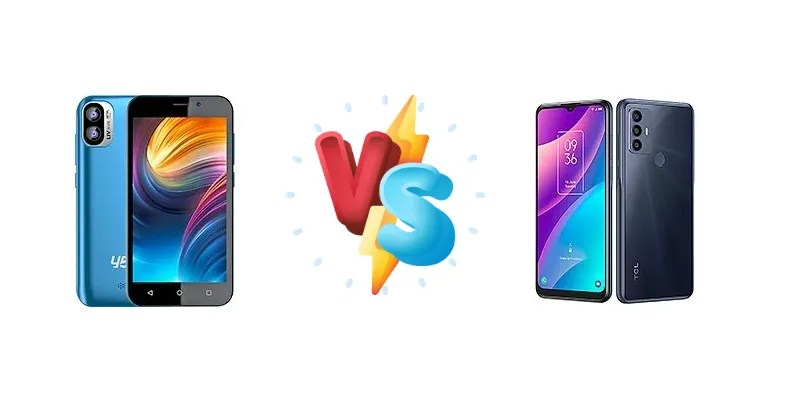
The Yezz Liv 3 LTE and TCL 30 SE represent the lower end of the smartphone market, targeting users prioritizing affordability. However, significant differences in their core hardware – specifically the chipset – suggest varying performance capabilities. This comparison dives deep into the specs to determine which device delivers the best experience for the price.
🏆 Quick Verdict
For the average user, the TCL 30 SE emerges as the better choice. Its Mediatek Helio G25 chipset, featuring an octa-core CPU built on a more efficient 12nm process, provides a noticeable performance uplift over the Yezz Liv 3 LTE’s quad-core Unisoc SC9832E. While both phones are entry-level, the TCL offers a smoother experience for everyday tasks and light gaming.
| Network |
|---|
| 2G bands | GSM 850 / 900 / 1800 / 1900 | GSM 850 / 900 / 1800 / 1900 |
| 3G bands | HSDPA 850 / 900 / 1900 / 2100 | HSDPA 850 / 900 / 1900 / 2100 - EMEA/APAC |
| 4G bands | 2, 3, 4, 7, 17 | 1, 3, 5, 7, 8, 20, 28, 38, 40, 41 - EMEA |
| Speed | HSPA 21.1/5.76 Mbps, LTE Cat4 150/50 Mbps | HSPA 42.2/11.5 Mbps, LTE Cat4 150/50 Mbps |
| Technology | GSM / HSPA / LTE | GSM / HSPA / LTE |
| | - | 2, 3, 4, 5, 7, 8, 12, 13, 17, 26, 28, 66 - LATAM |
| Launch |
|---|
| Announced | 2021, August. Released 2021, December | 2022, February 27 |
| Status | Discontinued | Available. Released 2022, April 20 |
| Body |
|---|
| Build | - | Glass front, plastic frame, plastic back |
| Dimensions | 144.6 x 73.4 x 10.7 mm (5.69 x 2.89 x 0.42 in) | 165.2 x 75.5 x 8.9 mm (6.50 x 2.97 x 0.35 in) |
| SIM | Nano-SIM + Nano-SIM | · Nano-SIM· Nano-SIM + Nano-SIM |
| Weight | - | 190 g (6.70 oz) |
| Display |
|---|
| Protection | Asahi Glass | - |
| Resolution | 480 x 854 pixels, 16:9 ratio (~196 ppi density) | 720 x 1600 pixels, 20:9 ratio (~269 ppi density) |
| Size | 5.0 inches, 68.9 cm2 (~64.9% screen-to-body ratio) | 6.52 inches, 102.6 cm2 (~82.3% screen-to-body ratio) |
| Type | TFT LCD | IPS LCD, 450 nits (typ) |
| Platform |
|---|
| CPU | Quad-core 1.3 GHz Cortex-A53 | Octa-core (4x2.0 GHz Cortex-A53 & 4x1.5 GHz Cortex-A53) |
| Chipset | Unisoc SC9832E (28 nm) | Mediatek MT6762G Helio G25 (12 nm) |
| GPU | Mali-T820 MP1 | PowerVR GE8320 |
| OS | Android 11 (Go edition) | Android 12, TCL UI 4.0 |
| Memory |
|---|
| Card slot | microSDXC (dedicated slot) | microSDXC (dedicated slot) |
| Internal | 16GB 1GB RAM | 64GB 4GB RAM, 128GB 4GB RAM |
| | eMMC 5.1 | eMMC 5.1 |
| Main Camera |
|---|
| Dual | 5 MP
VGA | - |
| Features | LED flash, HDR, panorama | LED flash, HDR, panorama |
| Single | - | 8 MP, f/2.0, 26mm (wide), 1/4", 1.12µm |
| Triple | - | 50 MP, f/1.9, 28mm (wide), 1/2.76", 0.64µm, PDAF
2 MP (macro)
Auxiliary lens |
| Video | 1080p@30fps | 1080p@30fps |
| Selfie camera |
|---|
| Features | - | HDR |
| Single | 2 MP | 8 MP, f/2.0, 26mm (wide), 1/4.0", 1.12µm |
| Video | - | 1080p@30fps |
| Sound |
|---|
| 3.5mm jack | Yes | Yes |
| 35mm jack | Yes | Yes |
| Loudspeaker | Yes | Yes |
| Comms |
|---|
| Bluetooth | 4.2, A2DP, LE | 5.0, A2DP, LE |
| NFC | No | Yes (6165H/6165H1 only) |
| Positioning | GPS | GPS, GLONASS, GALILEO, BDS |
| Radio | Stereo FM radio | Unspecified |
| USB | microUSB 2.0 | USB Type-C 2.0 |
| WLAN | Wi-Fi 802.11 b/g/n | Wi-Fi 802.11 b/g/n, Wi-Fi Direct |
| Features |
|---|
| Sensors | Accelerometer | Fingerprint (rear-mounted), accelerometer, proximity, compass |
| Battery |
|---|
| Charging | - | 15W wired |
| Type | Li-Ion 2000 mAh, removable | Li-Po 5000 mAh |
| Misc |
|---|
| Colors | Smoke Black, Glacier Blue, Forest Green | Atlantic Blue, Space Gray, Glacial Blue |
| Models | - | 6165H, 6156H1, 6165A, 6165A1, 6165S |
Yezz Liv 3 LTE
- Potentially lower price point
- Functional for basic tasks
- LTE connectivity
- Outdated 28nm chipset
- Quad-core CPU limits performance
- Likely slower charging
TCL 30 SE
- Octa-core Helio G25 CPU
- More efficient 12nm process
- 15W fast charging
- May be slightly more expensive
- Still an entry-level device
- Camera quality likely limited
Display Comparison
Neither device boasts a standout display. Given the context data, we can assume both likely utilize LCD panels, common in this price bracket. The TCL 30 SE’s advantage isn’t in panel technology, but potentially in its software optimization for color accuracy. The Yezz Liv 3 LTE’s display specs are unknown, but given its positioning, it’s unlikely to surpass the TCL in brightness or viewing angles. Bezels are expected to be substantial on both.
Camera Comparison
Without detailed camera specs, a direct comparison is difficult. However, it’s safe to assume both phones feature basic camera setups geared towards casual photography. The TCL 30 SE likely benefits from Mediatek’s image signal processor (ISP), potentially offering slightly better image processing and noise reduction. The presence of a 2MP macro camera on either device is largely a marketing gimmick and shouldn’t be a deciding factor. Sensor size and aperture are key, but unknown for both.
Performance
The TCL 30 SE’s Mediatek Helio G25 is the clear winner here. Its octa-core configuration (4x2.0 GHz Cortex-A53 & 4x1.5 GHz Cortex-A53) significantly outperforms the Yezz Liv 3 LTE’s quad-core 1.3 GHz Cortex-A53. Crucially, the Helio G25 is fabricated on a 12nm process, offering improved power efficiency and thermal management compared to the Yezz’s older 28nm Unisoc SC9832E. This translates to less throttling under sustained load and a more consistent user experience. The TCL will handle multitasking and app switching with greater ease.
Battery Life
Battery life will depend heavily on usage patterns. While the mAh capacity isn’t specified for either device, the TCL 30 SE’s 15W wired charging is a notable advantage. The Yezz Liv 3 LTE likely charges at a slower rate, extending the time to reach a full charge. The more efficient Helio G25 chipset in the TCL 30 SE may also contribute to slightly better battery endurance during typical use.
Buying Guide
Buy the Yezz Liv 3 LTE if your primary need is a basic, functional phone for essential communication and you are on an extremely tight budget. It will handle calls, texts, and light app usage. Buy the TCL 30 SE if you prioritize a more responsive user experience, occasional gaming, and a slightly more modern chipset architecture, even if it means spending a bit more.
Frequently Asked Questions
❓ Will the TCL 30 SE be able to run popular social media apps like TikTok and Instagram smoothly?
Yes, the TCL 30 SE’s Helio G25 chipset and octa-core CPU are sufficient to run most popular social media apps without significant lag. While it won’t offer a flagship-level experience, it should provide a usable and enjoyable experience for casual social media browsing.
❓ Is the Unisoc SC9832E in the Yezz Liv 3 LTE known to have overheating issues?
The Unisoc SC9832E is an older chipset and, due to its 28nm manufacturing process, is more prone to generating heat under sustained load. While it’s unlikely to cause catastrophic overheating, users may experience performance throttling during extended gaming sessions or demanding tasks.
❓ Can the TCL 30 SE handle basic mobile games like Candy Crush or Subway Surfers?
Absolutely. The Helio G25 is capable of handling less demanding mobile games like Candy Crush and Subway Surfers without issue. While it won’t run graphically intensive titles at high settings, it provides a playable experience for casual gaming.