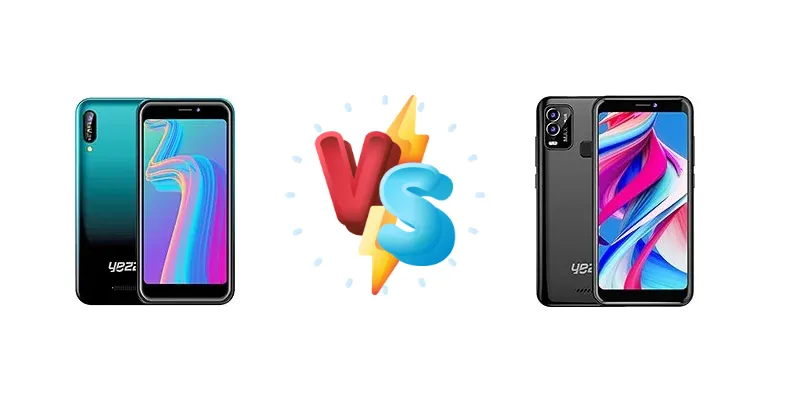
Yezz targets the ultra-budget smartphone market, and the Liv 1s and Max 2 Plus represent their attempts to deliver functionality at the lowest possible price point. While both devices share a similar price bracket and core specifications like a quad-core processor, key differences in chipset and features like USB Power Delivery on the Max 2 Plus warrant a closer look to determine which offers the best value.
🏆 Quick Verdict
For the average user prioritizing future-proofing and faster charging, the Yezz Max 2 Plus is the better choice. Its inclusion of USB Power Delivery, despite both phones using the same 28nm process, suggests a more modern design and potentially broader compatibility with charging accessories. However, the Liv 1s remains a viable option for those on the absolute tightest budget.
| Network |
|---|
| 2G bands | GSM 850 / 900 / 1800 / 1900 | GSM 850 / 900 / 1800 / 1900 |
| 3G bands | HSDPA 850 / 900 / 1900 / 2100 | HSDPA 850 / 900 / 1900 / 2100 |
| 4G bands | - | 2, 3, 4, 7, 12, 17, 28 |
| Speed | HSPA 21.1/5.76 Mbps | HSPA 21.1/5.76 Mbps, LTE Cat4 150/50 Mbps |
| Technology | GSM / HSPA | GSM / HSPA / LTE |
| Launch |
|---|
| Announced | 2020, November. Released 2021, February | 2021, April. Released 2021, July |
| Status | Discontinued | Discontinued |
| Body |
|---|
| Dimensions | 141.2 x 66.7 x 10 mm (5.56 x 2.63 x 0.39 in) | 149.7 x 72.2 x 9.7 mm (5.89 x 2.84 x 0.38 in) |
| SIM | Nano-SIM + Nano-SIM | Nano-SIM + Nano-SIM |
| Weight | 137 g (4.83 oz) | 150 g (5.29 oz) |
| Display |
|---|
| Protection | Asahi Glass | Asahi Glass |
| Resolution | 480 x 960 pixels, 18:9 ratio (~217 ppi density) | 720 x 1440 pixels, 18:9 ratio (~293 ppi density) |
| Size | 4.95 inches, 63.2 cm2 (~67.1% screen-to-body ratio) | 5.5 inches, 78.1 cm2 (~72.2% screen-to-body ratio) |
| Type | IPS LCD | IPS LCD |
| Platform |
|---|
| CPU | Quad-core 1.3 GHz | Quad-core 1.3 GHz |
| Chipset | Spreadtrum SC7731E (28 nm) | Unisoc SC9832E (28 nm) |
| GPU | Mali-T820 | Mali-T820 MP1 |
| OS | Android 10 (Go edition) | Android 11 |
| Memory |
|---|
| Card slot | microSDXC (dedicated slot) | microSDXC |
| Internal | 16GB 1GB RAM | 32GB 2GB RAM |
| | eMMC 5.1 | eMMC 5.1 |
| Main Camera |
|---|
| Dual | - | 13 MP, AF
0.3 MP |
| Features | LED flash, HDR, panorama | LED flash, HDR, panorama |
| Single | 5 MP, f/2.2, AF | - |
| Video | 1080p@30fps | 1080p@30fps |
| Selfie camera |
|---|
| Features | LED flash | - |
| Single | 2 MP, f/2.8 | 8 MP |
| Sound |
|---|
| 3.5mm jack | Yes | Yes |
| 35mm jack | Yes | Yes |
| Loudspeaker | Yes | Yes |
| Comms |
|---|
| Bluetooth | 4.2, A2DP, LE | 4.0, A2DP, LE |
| NFC | No | No |
| Positioning | GPS, GLONASS | GPS |
| Radio | FM radio, recording | Stereo FM radio, recording |
| USB | microUSB 2.0 | microUSB 2.0 |
| WLAN | Wi-Fi 802.11 b/g/n | Wi-Fi 802.11 b/g/n |
| Features |
|---|
| Sensors | Accelerometer | Fingerprint (rear-mounted), accelerometer |
| Battery |
|---|
| Charging | - | USB Power Delivery |
| Type | Li-Ion 2000 mAh, removable | Li-Ion 2600 mAh, removable |
| Misc |
|---|
| Colors | Storm Black, Steel Grey, Tropical Green, Caribbean Blue | Black Panther, Pacific Blue |
| Price | About 50 EUR | About 70 EUR |
| SAR | - | 0.77 W/kg (head) 0.59 W/kg (body) |
Yezz Liv 1s
- Potentially lower price point
- Functional for basic smartphone tasks
- Simple and straightforward user experience
- Older chipset (Spreadtrum SC7731E)
- Lacks USB Power Delivery for faster charging
- Likely limited software updates
Yezz Max 2 Plus
- More modern chipset (Unisoc SC9832E)
- USB Power Delivery for faster and versatile charging
- Potentially better performance in light tasks
- May be slightly more expensive
- Still utilizes a 28nm process, prone to throttling
- Camera quality likely remains basic
Display Comparison
Both the Yezz Liv 1s and Max 2 Plus likely feature LCD panels, typical for this price segment. Without specific resolution or brightness data, it's safe to assume both offer a basic viewing experience. The absence of any mention of features like high refresh rates or Gorilla Glass suggests neither prioritizes display quality or durability. Bezels are likely substantial on both devices, maximizing screen real estate within a compact form factor.
Camera Comparison
Camera details are sparse, but it's reasonable to assume both phones feature basic camera setups. Without sensor size or aperture information, it's difficult to make a definitive judgment. The inclusion of a 2MP macro camera on either device is largely a marketing gimmick, offering limited practical benefit due to the small sensor size and lack of optical image stabilization. Image processing will likely be basic on both, relying heavily on software algorithms to enhance photos.
Performance
Both devices are powered by quad-core 1.3 GHz processors fabricated on a 28nm process. However, the chipset differs: the Liv 1s uses the Spreadtrum SC7731E, while the Max 2 Plus utilizes the Unisoc SC9832E. While clock speeds are identical, Unisoc generally offers slightly improved CPU and GPU performance within the same process node. This means the Max 2 Plus will likely handle multitasking and light gaming marginally better. The 28nm fabrication process on both chips means thermal throttling could be a concern during sustained workloads, but the Max 2 Plus's USB Power Delivery suggests a more modern power management system that *might* mitigate this slightly.
Battery Life
Battery capacity is not specified for either device. However, the Yezz Max 2 Plus's inclusion of USB Power Delivery is a significant advantage. This allows for faster charging speeds with compatible chargers and power banks, and broader compatibility with modern charging standards. The Liv 1s, lacking USB Power Delivery, will be limited to slower charging speeds via micro-USB, potentially taking several hours to fully charge.
Buying Guide
Buy the Yezz Liv 1s if you need a functional smartphone for basic tasks like calls, texts, and light social media, and are unwilling to spend even a little extra. Buy the Yezz Max 2 Plus if you prefer the convenience of USB Power Delivery for faster and more versatile charging, and anticipate needing to use a wider range of chargers or power banks with your device.
Frequently Asked Questions
❓ Will the Yezz Max 2 Plus charge faster with any USB-C charger, or does it require a specific Power Delivery charger?
The Yezz Max 2 Plus supports USB Power Delivery, meaning it will charge faster with any charger that adheres to the USB PD standard. However, the charging speed will depend on the wattage supported by both the charger and the phone. A higher wattage charger will generally result in faster charging times, up to the phone's maximum supported input.
❓ Is the Unisoc SC9832E in the Yezz Max 2 Plus capable of running popular games like PUBG Mobile?
While the Unisoc SC9832E can *run* PUBG Mobile, expect to play at the lowest graphics settings and potentially experience frame rate drops, especially during intense action. The chipset's limited processing power and the 28nm fabrication process will likely result in thermal throttling, further impacting performance. It's suitable for casual gaming, but not for demanding titles.
❓ Does the Yezz Liv 1s support over-the-air (OTA) software updates?
Given Yezz's position in the ultra-budget market, OTA updates are unlikely to be frequent or extensive on the Liv 1s. While the phone may receive occasional security patches, major Android version updates are improbable. Users should not expect the same level of software support as with more established brands.