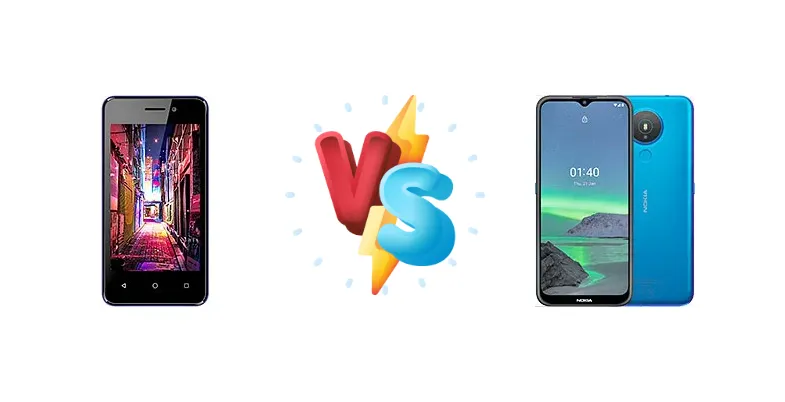
The Yezz GO 1 and Nokia 1.4 represent the extreme lower end of the smartphone market, targeting users prioritizing affordability above all else. Both devices run Android Go edition, optimized for low RAM and storage. However, beneath the surface, a key difference lies in their chipsets: Mediatek’s MT6580 in the Yezz GO 1 versus Qualcomm’s Snapdragon 215 in the Nokia 1.4. This comparison will dissect these differences to determine which phone delivers the best experience for the price.
🏆 Quick Verdict
For the average user seeking a basic smartphone for calls, messaging, and light app usage, the Nokia 1.4 edges out the Yezz GO 1. The Snapdragon 215, utilizing Cortex-A53 cores, offers a more modern architecture and slightly improved performance, translating to a smoother, more responsive user experience despite both phones sharing a 1.3GHz clock speed.
| Network |
|---|
| 2G bands | GSM 850 / 900 / 1800 / 1900 | GSM 850 / 900 / 1800 / 1900 |
| 3G bands | HSDPA 850 / 900 / 1900 / 2100 | HSDPA 850 / 900 / 2100 - International |
| 4G bands | - | 1, 3, 5, 7, 8, 20, 28, 38, 40, 41 - International |
| Speed | HSPA 21.1/5.76 Mbps | HSPA 42.2/5.76 Mbps, LTE Cat4 150/50 Mbps |
| Technology | GSM / HSPA | GSM / HSPA / LTE |
| | - | 1, 2, 3, 4, 5, 7, 12, 17, 28, 66 - LATAM, USA |
| Launch |
|---|
| Announced | 2020, February. Released 2020, July 28 | 2021, February 03 |
| Status | Discontinued | Available. Released 2021, February 03 |
| Body |
|---|
| Build | - | Glass front, plastic back, plastic frame |
| Dimensions | 128.5 x 65.2 x 11 mm (5.06 x 2.57 x 0.43 in) | 166.4 x 76.7 x 8.7 mm (6.55 x 3.02 x 0.34 in) |
| SIM | Nano-SIM + Nano-SIM | · Nano-SIM· Nano-SIM + Nano-SIM |
| Weight | 123 g (4.34 oz) | 178 g (6.28 oz) |
| Display |
|---|
| Resolution | 480 x 800 pixels, 5:3 ratio (~233 ppi density) | 720 x 1600 pixels, 20:9 ratio (~269 ppi density) |
| Size | 4.0 inches, 45.5 cm2 (~54.4% screen-to-body ratio) | 6.52 inches, 102.6 cm2 (~80.4% screen-to-body ratio) |
| Type | TFT LCD | IPS LCD |
| Platform |
|---|
| CPU | Quad-core 1.3 GHz | Quad-core 1.3 GHz Cortex-A53 |
| Chipset | Mediatek MT6580 (28 nm) | Qualcomm QM215 Snapdragon 215 (28 nm) |
| GPU | Mali-400 | Adreno 308 |
| OS | Android 10 (Go edition) | Android 10 (Go edition), planned upgrade to Android 11 (Go edition) |
| Memory |
|---|
| Card slot | microSDXC (dedicated slot) | microSDXC |
| Internal | 8GB 1GB RAM | 16GB 1GB RAM, 32GB 2GB RAM, 64GB 3GB RAM |
| | - | eMMC 5.1 |
| Main Camera |
|---|
| Dual | - | 8 MP, (wide), AF
2 MP (macro) |
| Features | LED flash, Panorama, HDR | LED flash, HDR |
| Single | 5 MP | - |
| Video | 720p | 720p@30fps |
| Selfie camera |
|---|
| Single | 2 MP | 5 MP |
| Video | - | 720p@30fps |
| Sound |
|---|
| 3.5mm jack | Yes | Yes |
| 35mm jack | Yes | Yes |
| Loudspeaker | Yes | Yes |
| Comms |
|---|
| Bluetooth | 4.0, A2DP, LE | 4.2, A2DP, LE |
| NFC | No | No |
| Positioning | GPS | GPS |
| Radio | FM radio | FM radio |
| USB | microUSB 2.0 | microUSB 2.0 |
| WLAN | Wi-Fi 802.11 a/b/g/n | Wi-Fi 802.11 b/g/n |
| Features |
|---|
| Sensors | Accelerometer | Fingerprint (rear-mounted), accelerometer, proximity |
| Battery |
|---|
| Type | Li-Ion 1400 mAh, removable | Li-Po 4000 mAh |
| Misc |
|---|
| Colors | Black | Fjord, Charcoal, Dusk |
| Models | - | TA-1322 |
| Price | - | About 90 EUR |
Yezz GO 1
- Potentially lower price point
- Functional for basic tasks
- Android Go edition optimized for low resources
- Older CPU architecture (Cortex-A7)
- Less efficient chipset
- Potentially limited software support
Nokia 1.4
- More modern CPU architecture (Cortex-A53)
- Better chipset efficiency
- Reputable brand with potential for better software support
- Slightly higher price
- Still limited performance overall
- Basic camera capabilities
Display Comparison
Neither device boasts a standout display. Both are likely to feature basic LCD panels with resolutions around 480x854, typical for this price point. Without specific brightness or color gamut data, it’s safe to assume both offer adequate, but not impressive, viewing experiences. The focus here isn’t on media consumption, but basic usability. Bezels are likely to be substantial on both devices, maximizing screen real estate within a compact form factor.
Camera Comparison
Camera performance on both devices will be limited. Expect basic 5MP or 8MP main sensors, likely paired with a low-resolution secondary camera for depth sensing. Image quality will be acceptable in good lighting conditions, but struggle in low light. Without specific aperture or sensor size data, it’s difficult to definitively say which performs better, but Qualcomm’s image signal processor (ISP) in the Snapdragon 215 generally offers better noise reduction and dynamic range. The inclusion of a 2MP macro camera on either device is largely a marketing gimmick and won’t significantly improve image quality.
Performance
The core difference lies in the chipsets. The Yezz GO 1’s Mediatek MT6580 utilizes older Cortex-A7 cores, while the Nokia 1.4’s Snapdragon 215 employs Cortex-A53 cores. While both are quad-core and clocked at 1.3 GHz, the A53 architecture is significantly more efficient and offers better instructions per clock (IPC). This translates to snappier app launches and smoother multitasking on the Nokia 1.4. Both chipsets are built on a 28nm process, meaning thermal management isn’t a major concern, but the Snapdragon 215 will likely exhibit less throttling under sustained load. The GPU in the Snapdragon 215 (Adreno A304) is also a step up from the MT6580’s Mali-400 MP2, offering slightly better graphics performance.
Battery Life
Battery life will depend heavily on usage patterns. Both devices likely house batteries in the 2000-3000 mAh range. The more efficient Snapdragon 215 in the Nokia 1.4 may provide slightly longer battery life under similar usage. Charging speeds are likely to be slow on both, utilizing Micro-USB, and a full charge will likely take several hours. The focus here isn’t on fast charging, but on providing all-day battery life for basic tasks.
Buying Guide
Buy the Yezz GO 1 if you absolutely need the lowest possible price and are willing to accept compromises in performance and potentially software updates. It’s a functional device for essential tasks. Buy the Nokia 1.4 if you prioritize a slightly more refined user experience, a more reputable brand with a better track record for software support, and a chipset with a more modern CPU architecture, even if the performance gains are modest.
Frequently Asked Questions
❓ Will the Snapdragon 215 in the Nokia 1.4 handle popular social media apps like Facebook and WhatsApp smoothly?
Yes, the Snapdragon 215, with its Cortex-A53 cores, is capable of running social media apps like Facebook and WhatsApp without significant lag. While it won't offer a high-end experience, it will provide a usable and responsive experience for these common tasks.
❓ Is the Yezz GO 1 a good choice for someone who primarily needs a phone for making calls and sending texts?
Absolutely. The Yezz GO 1 is perfectly adequate for basic communication tasks like making calls and sending texts. Its lower price point makes it a viable option for users with minimal smartphone needs.
❓ Can either of these phones play modern mobile games like PUBG Mobile or Call of Duty Mobile?
While technically possible, playing demanding games like PUBG Mobile or Call of Duty Mobile on either the Yezz GO 1 or Nokia 1.4 will result in a very poor experience. Frame rates will be low, and the games may be unplayable even on the lowest settings. These phones are not designed for gaming.
❓ How often can I expect software updates on the Nokia 1.4 compared to the Yezz GO 1?
Nokia generally provides more consistent software updates, including security patches, than Yezz. While both run Android Go edition, Nokia's commitment to software support is significantly stronger, meaning the Nokia 1.4 is likely to receive updates for a longer period.